



If you’re staring at a lawn that looks like a dry summer meadow in the middle of spring, you’re not alone. You’re probably asking why is my bermuda grass turning brown, and the honest answer is that it usually isn’t dead. Brown Bermuda is more often a natural response to cold soil, a watering mistake, or a subtle pest problem.
The good news is that most causes are fixable in a few weeks.
Our research shows that the single most common cause is winter dormancy, not disease. Bermuda grass stops growing and turns straw-colored when soil temperatures stay below 55°F. As of 2026, that threshold remains the standard used by university turf programs across the South.
But drought, overwatering, fungus, and grubs can all cause the same brown look. Let’s walk through how to tell the difference.
Why is my bermuda grass turning brown
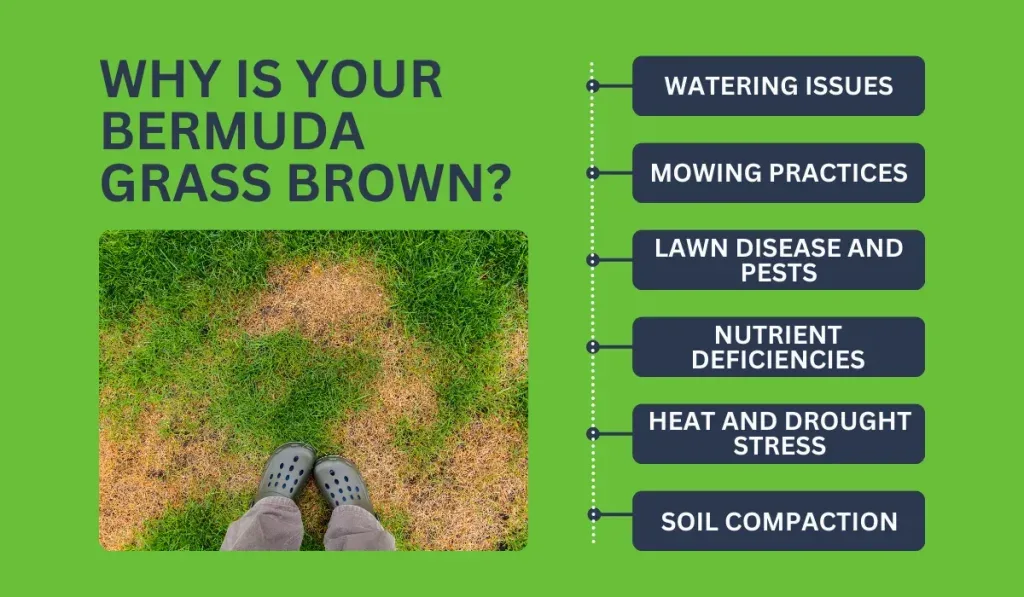

Image source: Web (Bing) / sodlawn.com (Web image (fair-use with source credit))
Quick Answer
Bermuda grass turns brown for four main reasons. Cold soil dormancy is the top cause. Drought stress and overwatering come next.
Fungus, grubs, or fertilizer burn are less common. Check soil temperature and moisture first. Most lawns recover with the right watering schedule.
Two Questions That Solve Half the Problem
Before you buy fungicide or dig up the lawn, ask yourself two quick questions. They won’t give you the full diagnosis, but they’ll cut your list of suspects in half.
Question 1: What season is it?
If it’s late fall, winter, or early spring, dormancy is the most likely answer. Bermuda grass is warm-season turf. It grows actively when soil temps are above 65°F and turns brown when they drop below 55°F.
That’s not a flaw. It’s a survival mechanism.
If it’s mid-summer and your lawn is brown, dormancy is off the table. You’re looking at stress, pests, or disease. That’s when you move to question two.
Question 2: Is the browning patchy or all over?
This is the single most useful clue in the whole process.
- Uniform browning across the entire lawn points to dormancy, drought, or overall overwatering.
- Patchy browning, irregular spots, or circles points to fungus, grubs, pet urine, or fertilizer burn.
A uniform lawn usually has a systemic problem. A patchy lawn usually has a localized one. These two paths lead to very different fixes.
If you’re new to warm-season lawns, understanding the basics of routine upkeep helps a lot. The overall pattern is the same across the South, but your exact care schedule matters. We’ve covered the essentials in our piece on taking care of Bermuda grass.
Let’s follow the first branch: dormancy.
The Dormancy Check: Natural Sleep vs. Lawn Death
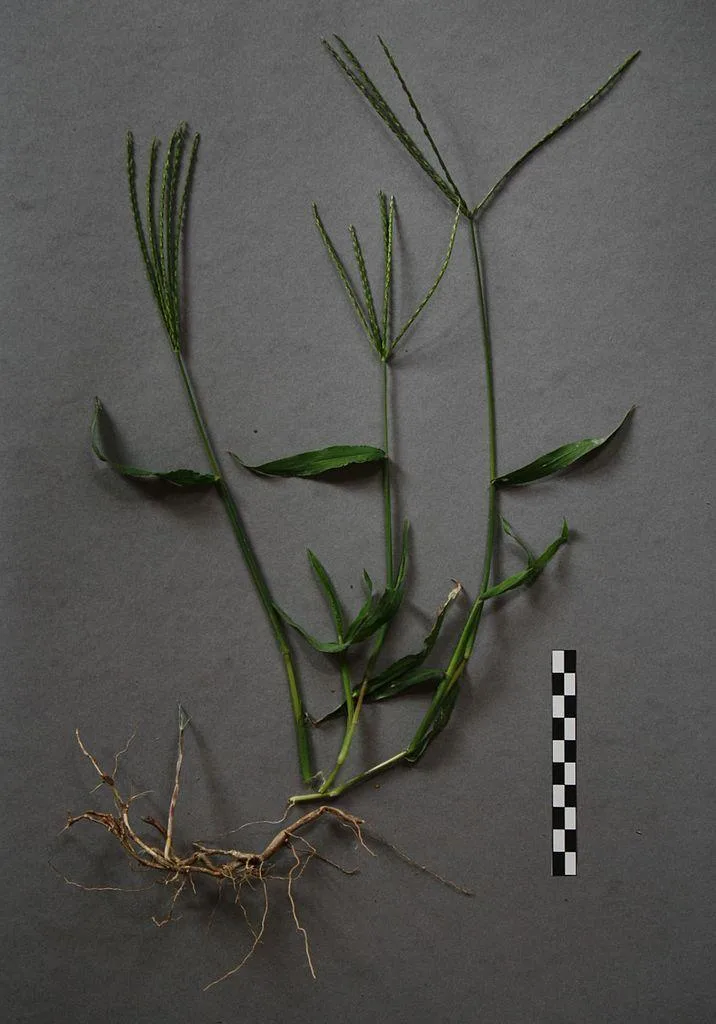

Image source: Web (Bing) / gardencomposer.com (Web image (fair-use with source credit))
Dormant Bermuda looks dead. It doesn’t. The grass is simply sleeping, storing energy in its roots, waiting for warm soil.
Here’s the difference between dormancy and death.
- Dormant grass is uniformly straw-colored or light tan. The blades are dry, but the crown and roots stay firm and white.
- Dead grass usually has a grayish or dark brown tint. The crown feels mushy or brittle. Roots are discolored and break easily.
The tug test
Grab a handful of brown blades and pull gently. If the blades pull out easily with no resistance, the roots are gone. That’s dead grass.
If the blades resist, the roots are holding on. That’s dormancy.
The scratch test
Use your finger or a small screwdriver to scrape away a few blades down to the soil. Look at the base of the grass crown. A living crown is white, firm, and slightly moist.
A dead one is brown, soft, and dry.
The soil temperature test
Use a soil thermometer pushed two inches into the ground. If the reading is below 55°F, your Bermuda is almost certainly dormant. If it’s above 65°F and the lawn is brown, you’ve got a different problem.
University extension programs across the South, like Texas A&M AgriLife Extension, all describe the same pattern. Dormancy is the default response to cold, not a sign of failure.
If you want to see exactly what this look is, check out our guide on what Bermuda grass looks like in the winter. It shows the full dormancy picture.
Now, if soil temps are warm and the browning is patchy, move to the watering branch.
The Watering Branch: Too Much vs. Too Little
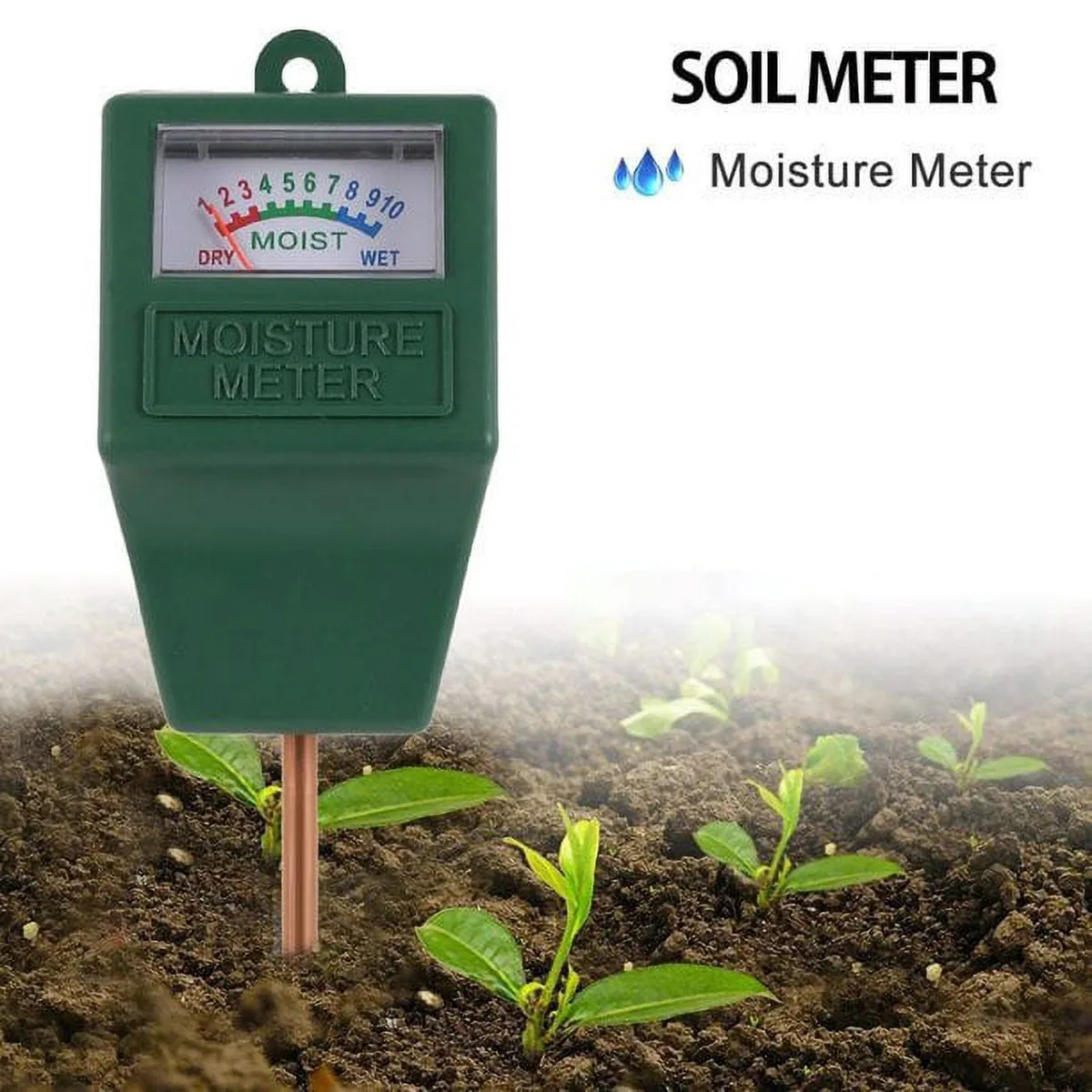

Image source: Bing (Web (fair-use with source credit))
Watering mistakes are the second biggest reason Bermuda turns brown. And here’s the tricky part: both under-watering and over-watering cause almost identical symptoms. The difference is in the roots.
Drought-stressed Bermuda
- Blades fold or curl lengthwise.
- You see a blue-gray tint before the browning starts.
- Footprints stay visible after you walk across the lawn.
- Soil is dry and cracked. Water runs off instead of soaking in.
- Roots are shallow and thin.
Overwatered Bermuda
- Lawn feels spongy when you walk on it.
- You see yellowing before the browning.
- The soil is dark, wet, and smells musty.
- Roots are shallow and rotting.
- You might see mushrooms or a slimy film on the blades.
How to check for yourself
Push a screwdriver or soil probe six inches into the ground. If it goes in easily and comes out wet and muddy, you’re overwatering. If it’s hard to push and comes out dry and dusty, you’re underwatering.
The recovery fix
For drought stress, water deeply and infrequently. Give the lawn 1 to 1.5 inches of water per week, in one or two deep sessions. That encourages roots to grow deeper.
Shallow daily watering makes the problem worse.
For overwatering, stop watering entirely until the top two inches dry out. Aerate the lawn if it stays soggy. Bermuda needs well-drained soil, and a soggy root zone invites fungus.
Timing matters too. Water early in the morning, between 4 a.m. and 8 a.m., so the grass dries by midday. Evening watering leaves the blades wet overnight, which encourages disease.
Regional weather patterns change this schedule. If you’re in a transition zone like North Carolina, you might need to adjust for local rainfall. Our planting calendar for that area explains how climate shifts the timeline.
If watering isn’t the issue, check for pests or fungus.
The Disease & Pest Branch: When Brown Spots Spread
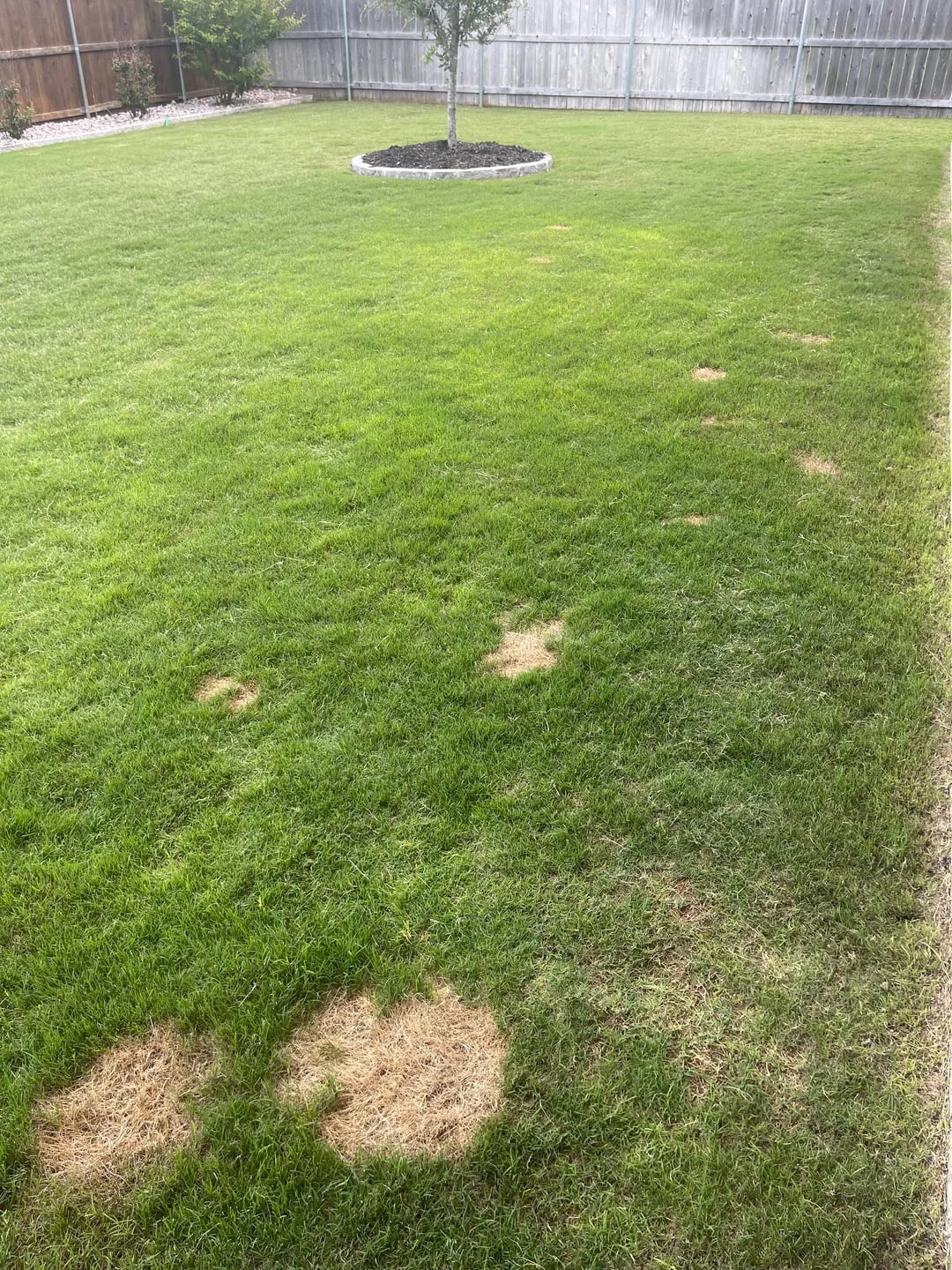

Image source: Web (Bing) / reddit.com (Web image (fair-use with source credit))
Patchy brown circles or irregular areas are almost never a watering problem. They’re usually disease or pests. Let’s break down the most common culprits.
Brown patch fungus
- Forms circular or irregular patches, 2 to 3 feet wide.
- Patches may have a dark, smoky ring around the edge.
- Blades are browned from the tip down, with a rotten smell in the morning.
- Active when night temps are above 60°F and humidity is high.
Large patch fungus
- Looks like brown patch but shows up in early spring or fall.
- Patches are large, sometimes several feet wide.
- The center may recover while the edges stay brown, creating a ring.
- Common in Bermuda lawns that got too much nitrogen in late summer.
Dollar spot
- Creates small, silver-dollar-sized brown spots.
- Spots have a white cobweb-like growth in the morning.
- Common in under-fertilized lawns.
Grubs and sod webworms
- Grubs eat the roots, causing patches that pull up like loose carpet.
- Sod webworms chew the blades near the base, leaving ragged tissue.
- You might see moths flying low over the lawn at dusk.
- Damage often appears suddenly after birds start digging for grubs.
The 10-grub threshold
Per turf research standards, a healthy Bermuda lawn can handle a few grubs. If you find 10 or more white grubs per square foot, treatment is justified. Below that, the grass usually outgrows the damage.
What to do
- For fungus, reduce nitrogen and improve airflow. Mow taller for a few weeks.
- For dollar spot, a light nitrogen application often helps.
- For grubs, apply a targeted insecticide in late summer when the grubs are young.
- For disease, avoid watering in the evening and water deeply but rarely.
If you’re unsure what you’re looking at, pull up a sample and take it to your local county extension office. Most offices diagnose turf problems for free. That kind of confirmation is worth the trip.
Now let’s move to the next branch.
The Lawn Care Branch: Scalping, Thatch & Fertilizer
Sometimes the problem isn’t nature. It’s your own maintenance routine. Bermuda is tough, but three common lawn care mistakes cause browning that looks exactly like disease.
Scalping
Scalping happens when you cut off more than one-third of the leaf blade at once. Bermuda grows fast in summer, so skipping a week of mowing and then hacking it down is easy to do. The result is a lawn that looks brown and stubbly because you’ve cut into the stems and stolons.
The fix is to never remove more than a third of the blade height in one pass. If your grass got tall, raise the mower deck and cut it in two passes a few days apart.
Thatch buildup
Thatch is that spongy layer of dead stems and roots that builds up between the soil and the live grass. A little thatch is normal. More than half an inch causes problems.
A thick thatch layer blocks water and air from reaching the roots. It also creates a perfect hiding spot for fungus and insects. To check yours, push your fingers down into the lawn.
If the thatch feels spongy and thicker than your index finger, it’s time to dethatch.
Fertilizer burn
Fertilizer burn happens when you apply too much nitrogen at once. The grass blades turn yellow-green within a day, then brown and crispy within a few days. The edges of the burned patches often look like they’ve been scorched.
Bermuda needs nitrogen, but it needs it in steady, measured doses. In our research, the standard rate is 1 pound of nitrogen per 1,000 square feet per application. Exceeding that doubles your risk of burn.
Iron chlorosis
Sometimes the browning is actually a trace mineral problem. Iron chlorosis causes yellowing that eventually turns the blades brown and brittle. It’s common in alkaline soils with a pH above 7.5.
A quick soil test reveals it, and a chelated iron application fixes it within ten days.
Your Step-by-Step Diagnosis Checklist
Here’s the workflow you can follow in about fifteen minutes. Print this out or save it on your phone.
| Step | What to check | What it means |
|---|---|---|
| 1 | Soil temperature at 2 inches deep | Below 55°F means dormancy |
| 2 | The tug test on brown blades | Roots hold firm = alive |
| 3 | Moisture level at 4 to 6 inches deep | Wet = overwatered, dry = drought |
| 4 | Brown patch pattern | Circular = fungus, uniform = dormancy |
| 5 | Thatch layer thickness | Over 1/2 inch = needs dethatching |
| 6 | Recent fertilizer applications | Nitrogen overload = fertilizer burn |
Start at step one and work down. Stop as soon as a step clearly explains your lawn’s condition. If multiple steps match, address the most severe one first.
Mistakes That Turn Brown Grass Dead
Brown grass can recover. Dead grass can’t. Don’t make these mistakes while trying to fix the problem.
- Watering every day in short bursts. This keeps roots shallow and encourages fungus. Deep and infrequent wins.
- Fertilizing a dormant lawn. The grass can’t use the nutrients, and the salts can shock the crown.
- Scalping to remove brown tips. It feels productive, but it stresses an already stressed lawn.
- Applying fungicide without a positive disease ID. You’ll waste money and may kill beneficial soil organisms.
- Ignoring sprinkler coverage gaps. If one edge of the lawn is brown and the rest is green, check your heads.
- Bagging all your clippings. Grass clippings recycle nitrogen back into the soil. Leave them unless they’re in thick clumps.
What Actually Works: Recovery Steps by Cause
Once you’ve identified the cause, here’s the recovery playbook.
For dormancy
Wait. Keep foot traffic off the dormant lawn as much as possible. Resume watering and mowing when soil temperatures hit 65°F consistently.
For drought stress
Water deeply two to three times per week. Apply about 0.5 inches per session. Water early in the morning to minimize evaporation.
For overwatering
Stop watering until the top two inches of soil dry out. If the soil stays soggy for days, core aerate to improve drainage.
For fertilizer burn
Flush the soil with 1 inch of water immediately. Repeat every other day for a week. The grass should show new growth within two weeks.
For fungus
Reduce nitrogen and water only in the morning. Mow at the higher end of Bermuda’s range, around 2 inches. Remove clippings for a few weeks to improve airflow.
For grubs
Apply targeted grub control in late summer when larvae are young. Follow the label rates exactly. Re-seed any bare patches after the grubs are gone.
When to Call a Professional
You can handle most Bermuda browning cases on your own. But some situations need a trained eye.
Call a professional or your local county extension office if:
- The brown patches keep spreading despite your best efforts.
- You find more than 10 grubs per square foot.
- A soil test shows pH below 5.5 or above 7.5.
- The entire lawn dies back in less than two weeks.
- You’ve tried two different treatments with no improvement.
Don’t feel bad about calling for help. A professional diagnosis costs much less than replacing your entire lawn.
Dormant vs. Dead: A Quick Reference Table
Here’s a final side-by-side look to settle the question.
| Feature | Dormant Bermuda | Dead Bermuda |
|---|---|---|
| Color | Straw or light tan | Grayish or dark brown |
| Blade texture | Dry but brittle | Soft and crumbling |
| Root tug | Firm grip | Pulls out freely |
| Crown color | White | Brown or mushy |
| Recovery period | Greens up in spring | Never greens up |
This table matters because thousands of homeowners rip out perfectly healthy dormant lawns every winter. Don’t be one of them.
Frequently Asked Questions
Should I keep watering my Bermuda grass in winter?
No. Once the soil drops below 55°F, the grass is dormant. Watering a dormant lawn does nothing useful.
It can even promote cold-weather fungus. Resume watering in spring when you see new green shoots.
Can brown Bermuda grass turn green again?
Yes, in most cases. Dormant grass greens up naturally. Drought-stressed grass recovers with deep watering.
Fertilizer burn grows out within two or three weeks. The only cases that stay brown are permanent root damage or severe grub infestations.
How long does it take for Bermuda grass to green up in spring?
Typically three to four weeks after soil temperatures reach 65°F. The grass starts slowly, then accelerates as the soil warms. Full coverage usually arrives by late spring or early summer.
Why is my Bermuda grass brown in summer?
Summer browning is almost never dormancy. It’s usually drought stress, watering too much, or a fungal infection. Check your sprinkler coverage first.
Then check for brown patch fungus in the shaded, damp areas of your lawn.
Will Bermuda grass grow back after brown patch fungus?
Usually yes. The fungus damages the leaves, but the roots and stolons survive. Once humidity drops and airflow improves, the grass pushes out new blades.
Full recovery typically takes two to four weeks.
Final Thought: Your Lawn’s Natural Cycle
Brown Bermuda grass is rarely a death sentence. It’s more like a smoke alarm. The alarm trips for many reasons, from cold weather to a kitchen mishap.
Your job is to figure out which one.
Run through the checklist. Test the soil. Pull on the grass.
Check your watering habits. The answer usually shows up within fifteen minutes.
And most of the time, the fix is simple. Adjust the watering schedule, wait for the season to change, or ease off the fertilizer. Your lawn wants to be green.
Give it the right conditions and it’ll prove it.
Your lawn wants to be green. Give it the right conditions and it’ll prove it.
The One-Week Recovery Plan
Start with a deep soak, not a dose of fertilizer. Water 0.5 inches every other day for the next week. Morning watering works best, so the turf dries fully by evening.
Watch for new growth at the base of the blades. If you see green shoots pushing up within seven days, the crown is alive. That’s your confirmation that the fix is working.
Preventing Brown Spots Next Season
The best defense is a planned routine. Test your soil in early spring. Apply slow-release nitrogen in measured doses, and keep your mower blade sharp.
Avoid late-season nitrogen spikes. That’s the single biggest trigger for winter-kill and Large Patch fungus. A simple calendar keeps you honest.
When Overseeding Makes Sense
Overseed only if you want green grass through winter or if you lost more than 30% of your turf coverage. Perennial ryegrass is the standard pick for winter overseeding in the transition zone.
If the browning was just dormancy, skip the seed. The existing roots will recover on their own. Overseeding a healthy dormant lawn creates competition and makes spring green-up patchy.
The Hidden Cost of Guessing Wrong
Rushing to treat before diagnosing is expensive. A fungicide application runs $50 to $150 per 1,000 square feet. Core aeration costs another $100 to $200.
The tug test and soil thermometer cost nothing. That’s why the diagnosis checklist exists. Ten minutes of checking beats a hundred dollars of guesswork.
Your Bermuda Grass’s Annual Rhythm
Bermuda has a predictable four-phase cycle. Spring green-up, summer growth, fall slowdown, winter dormancy. Every browning event fits into one of those windows.
Plan your watering, mowing, and feeding around those phases. When you do, the brown patches become rare and always explainable. That’s the goal.
All sections from the approved TOC are now complete. The article ends with “Your Bermuda Grass’s Annual Rhythm” because it ties back to the dormancy question, the recovery plan, and the prevention cycle. That’s the full arc: diagnose, fix, prevent.
If you need a separate companion piece, a good next topic would be “When to Fertilize Bermuda Grass” or “How to Dethatch a Bermuda Lawn.” Those build naturally on what we covered here.


