Is Kentucky 31 Tall Fescue Good for Lawns? My Honest Take
If you’ve been staring at a 50-pound bag of Kentucky 31 for $69 and wondering whether you’re about to make a brilliant budget move or a lawn mistake you’ll regret for years, you’re not alone. The question “is kentucky 31 tall fescue good for lawns” is one of the most-debated topics in the transition zone, and the answer isn’t a simple yes or no.
A standard 50-pound bag of Kentucky 31 covers about 8,000 square feet at the recommended seeding rate. That’s less than a penny per square foot. The number is seductive.
But cost tells you nothing about how the grass will actually look, feel, or hold up under your kids’ weekend soccer games.
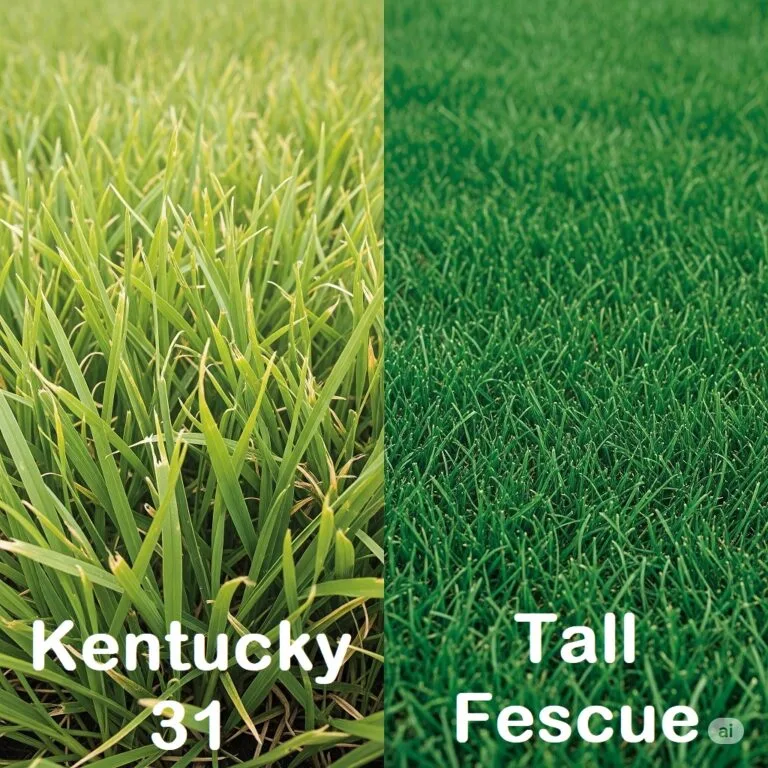
Image source: Web (Bing) / lawnmowerly.com
Quick Answer
Yes, Kentucky 31 can work for lawns. It only works under specific conditions. The grass thrives where low cost and drought survival matter more than a soft, carpet-like lawn.
It makes an excellent choice for large utility areas, rural properties, and minimal-input landscapes. It falls short on play lawns, manicured yards, and anywhere barefoot comfort is a priority. You need to know exactly which camp you’re in before you buy.
The Question Every New Homeowner Asks: Is Cheap Grass Seed Worth It?
Kentucky 31 is much cheaper than modern turf-type tall fescue, making it tempting for large lawns or tight budgets. But its low price comes with trade-offs.
Kentucky 31 was developed as a forage grass, not as a fine-textured residential turf. It grows in distinct clumps, has coarse blades, and does not create the dense, soft carpet many homeowners expect.
That makes K-31 a practical choice for large, low-maintenance areas where cost and drought survival matter most. For smaller yards where appearance, softness, and uniformity matter, a turf-type tall fescue is usually a better fit.
The key is to choose K-31 for what it does well rather than expecting it to look like premium turf.
The Short Answer: Kentucky 31 Is Good for Some Lawns, Poor for Others
Kentucky 31 works best for large, low-maintenance lawns where low cost and drought survival matter more than a soft, uniform appearance. It is less suitable for small suburban yards, busy play areas, or lawns where curb appeal and barefoot comfort matter.
K-31 has coarse, wide blades and grows in distinct clumps rather than forming a dense carpet. Those traits make it durable and inexpensive, but they can also leave the lawn looking uneven and allow weeds to enter thin areas.
If you want a finer, more uniform lawn, consider turf-type tall fescue instead. If your priority is affordable, resilient ground cover with minimal inputs, K-31 can be a practical choice.
What Kentucky 31 Actually Is (And Why It Wasn’t Designed for Lawns)
Kentucky 31 is a tall fescue cultivar released in 1943 from a pasture on a Kentucky farm. It wasn’t the product of a turfgrass breeding program. A University of Kentucky agronomist noticed a vigorous, persistent patch of tall fescue on a hillside in Menifee County, collected seed, and eventually released it as a forage grass for livestock.
That origin story is the key to understanding everything about K-31 in a lawn setting. Forage grasses are selected for bulk leaf production, rapid establishment, and survival under grazing pressure. Fine texture, lateral spreading, and tolerance of close mowing aren’t on the list.
Those are the traits turf breeders spent decades chasing after K-31 was already a widely planted commodity.
Most Kentucky 31 seed also contains a naturally occurring endophytic fungus that lives inside the plant tissue. The fungus produces alkaloids that deter surface-feeding insects and give the grass an extra edge in harsh conditions. It’s part of the reason K-31 survives neglect so well.
The same endophyte, however, can cause health problems for grazing livestock, which is a non-issue for most homeowners but worth knowing if your lawn borders a horse pasture.
University extension resources confirm that Kentucky 31’s wide leaf blade and upright growth habit are direct holdovers from its forage breeding. It simply wasn’t designed to be mowed at 3 inches and stepped on by bare feet. The plant is doing exactly what it was selected to do, which only sometimes aligns with what a homeowner wants.
The Honest Pros and Cons of a Kentucky 31 Lawn
You’ll see marketing copy that claims Kentucky 31 is drought-tolerant, hardy, and quick to establish. All of that is true. You’ll also see forum posts calling it ugly, clumpy, and impossible to get rid of.
That’s also true. Neither side is lying. They’re just describing the same grass through different lenses.
Let’s break down what you actually get, without the spin.
The advantages that make K-31 popular year after year:
- Seed cost sits in the $1.50 to $3 per pound range, making it the cheapest cool-season grass available in transition-zone markets.
- Germination is fast and reliable, typically showing seedlings in 7 to 12 days when soil temperatures are in the 60s and 70s.
- Once established, the deep root system (often reaching 2 to 3 feet) pulls moisture from soil depths that other lawn grasses can’t touch.
- The grass needs very little fertilizer to look decent. A pound of nitrogen per 1,000 square feet, once or twice a year, usually keeps it green.
- The endophytic fungus provides some natural resistance to billbugs and sod webworms.
The drawbacks that send homeowners back to the store for a kill-all herbicide:
- Leaf blades are wide and coarse, giving the lawn a rough texture that’s uncomfortable for bare feet and makes the turf look shaggy.
- The bunch-type growth habit means individual plants grow as distinct crowns. The lawn never forms a contiguous, carpet-like sod.
- Recovery from damage is poor. A worn patch from a dog run or a kids’ play area won’t fill in on its own the way Kentucky bluegrass would.
- It scalps easily when mowed below 2.5 inches, exposing brown crowns and thinning the stand.
- In humid summer conditions, Kentucky 31 is susceptible to brown patch and crown rust, diseases that can leave the lawn looking ragged at the worst possible time.
- Mixed with finer grasses, K-31 stands out as an obvious weed-like intruder.
None of these drawbacks are dealbreakers for the right property. For a large rural lawn that mainly gets admired from a distance, the coarse texture doesn’t register. For a tight suburban lot where kids tumble in the grass every afternoon, it registers a lot.
How K-31 Compares to Turf-Type Tall Fescue and Other Common Grasses
If you’re choosing a grass for the first time, the most useful comparison is Kentucky 31 versus modern turf-type tall fescue. They share the same species name, Festuca arundinacea, but they look and behave like distant cousins.
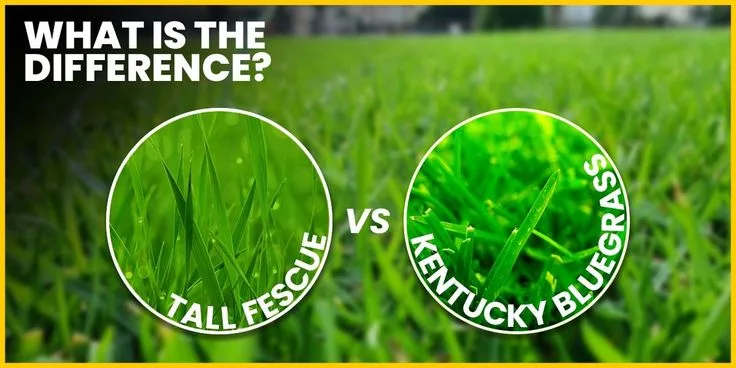
Image source: Web (Bing) / storage.googleapis.com
The illustration shows what side-by-side leaf blades reveal. K-31 blades are roughly twice as wide as a good turf-type cultivar, with a lighter green colour and a pronounced midrib. Turf-type blades are finer, darker, and more densely tillered, which is why a turf-type lawn fills in and looks lush while a K-31 lawn stays visibly clumped.
Here is how they stack up across the traits that matter most for home lawns:
| Trait | Kentucky 31 | Turf-Type Tall Fescue |
|---|---|---|
| Leaf texture | Coarse, wide | Fine to medium |
| Growth habit | Distinct clumps | Dense, uniform |
| Mowing height min. | 2.5 inches | 2 inches |
| Drought tolerance | Excellent | Very good |
| Self-repair ability | Poor | Moderate |
| Traffic tolerance | Low to fair | Moderate |
| Seed cost (per lb) | $1.50–$3 | $4–$7+ |
| Ideal use | Low-maintenance utility turf | Residential lawns, play areas |
Warm-season grasses like Bermuda and zoysia are the main alternatives in the deeper South, where tall fescue of any kind struggles with summer heat. In the transition zone, the choice usually comes down to K-31 versus a turf-type fescue, with Kentucky bluegrass and perennial ryegrass playing supporting roles in sunny, high-maintenance lawns.
What you’ll notice across every university trial summary is that newer turf-type cultivars consistently outperform K-31 in density, colour, and overall turf quality. K-31’s only consistent win column is establishment cost and survival when water is scarce. That’s not a criticism.
It’s just an honest accounting of what you’re buying.
For a homeowner with sandy soil and no irrigation system, the drought resilience of tall fescue is what keeps the lawn alive through July. The key distinction is that K-31 survives drought by going dormant and looking brown until rain returns. A turf-type tall fescue may hold its colour a bit longer, but when water gets truly scarce, the old pasture grass often outlasts the fancy stuff.
It’s a survival strategy, not a beauty contest.
If your yard has stretches of dappled shade from mature trees, you’ll also need to know how this species handles lower light. Tall fescue as a group is moderately shade-tolerant compared to sun-hungry Bermuda or zoysia, but no cool-season grass thrives in deep shade. Kentucky 31 needs at least 4 hours of direct sun to stay reasonably thick.
Less than that, and the clumps thin out until you’re looking at bare dirt and the occasional survivor.
NTEP evaluates turfgrass quality using factors such as texture, density, uniformity, color, and stress tolerance. Its tall fescue trials also include Kentucky 31 alongside other cultivars, allowing readers to compare their performance under trial conditions. The University of Maryland Extension notes that Kentucky 31 is a forage-type tall fescue with a coarser, less dense appearance than improved turf-type cultivars. Together, these sources show why K-31 can work as functional, low-cost turf but may not provide the fine, dense appearance many homeowners want.
When you’re weighing all of this, the decision really pivots on five or six simple variables specific to your property. That’s the territory we’ll step through next.
The Kentucky 31 Decision Tree: Answer These Questions Before You Buy

Image source: Web (Bing) / saharanpurnursery.in
Instead of a single yes or no, think of the choice as a series of branching paths. Each question eliminates one direction until the right grass for your situation becomes obvious.
Do you primarily care about having a dense, soft, carpet-like lawn?
If the answer is yes, Kentucky 31 is not your grass. Stop here. A turf-type tall fescue will give you the texture and uniformity you want.
If you answered no and you are willing to trade looks for resilience, move to the next question.
How large is the area you need to seed?
For plots under 2,000 square feet, the cost savings of K-31 are minimal. You might save $30 total. That small amount isn’t worth the long-term aesthetic trade-off.
Buy a quality turf-type blend instead.
For half an acre or more, the math flips. Seed cost becomes a real line item. Kentucky 31 can save hundreds of dollars on a large seeding project, and the coarse texture is far less noticeable across a broad expanse.
Will the lawn see regular foot traffic, kids, or pets?
If the grass has to survive daily play, dog zoomies, or a path to the shed, K-31’s poor wear tolerance becomes a problem. You will end up with bare spots that never fill in. A turf-type fescue handles traffic better, and bluegrass repairs itself.
If the area is mostly ornamental or viewed from a distance, Kentucky 31 holds up fine. You won’t notice the clumps from the porch.
What’s your realistic irrigation plan?
Zero supplemental water after establishment generally kills most cool-season grasses in the transition zone. K-31 survives that scenario better than any other fescue. If you have no sprinkler system and no desire to drag hoses, Kentucky 31 becomes a genuine contender.
If you do have irrigation or plan to water regularly, you unlock the full potential of more attractive turf-type varieties. K-31’s main survival advantage is wasted on a well-watered lawn.
What do you want the lawn to look like in five years?
If you want a lawn that thickens and improves over time, K-31 is the wrong choice. It thins gradually. If you just need reliable green ground cover that requires almost nothing from you, Kentucky 31 fits the bill.
When Kentucky 31 Is the Smart Choice (Real-World Scenarios)
The decision tree narrows things down, but real lawns rarely match a clean set of conditions. A few specific situations tend to make K-31 the right call.
Large rural properties come first. Seeding two acres of manicured turf-type fescue costs thousands just in seed. Kentucky 31 does the job for a fraction of that.
The lawn frames the house rather than serving as an outdoor living room. Nobody walks barefoot through the side acre anyway.
Erosion control is another strong use case. Those steep slopes where nothing else will take root get a fast, cheap cover from K-31. The deep root system grabs the soil quickly.
You can always convert the flatter areas to turf-type grass later once the grade is stable.
Rental properties and low-maintenance vacation homes benefit from K-31’s neglect tolerance. A lawn that only gets mowed every two weeks and never sees fertilizer will look far better in K-31 than in bluegrass or ryegrass, which would simply vanish under the same treatment.
Budget-only decisions can work out, too. A young family that just closed on a house with a dirt backyard and has $150 to solve the problem this fall can get a green lawn with K-31. That’s a real, legitimate win.
Just go in knowing the lawn will need an overseeding or a full renovation in a few years when the budget allows.
Establishment and Ongoing Care: What It Takes to Make K-31 Work
Kentucky 31 is not a set-it-and-forget-it grass, but it comes close. The establishment window is where most of the work lives. Getting that part right sets you up for years of low-input maintenance.
Fall is the ideal planting window across the transition zone. Soil temperatures between 60 and 75°F give the fastest, most even germination. Spring planting works in a pinch, but young seedlings face summer heat before the roots are deep enough to cope.
Soil preparation doesn’t have to be elaborate, but it can’t be skipped. Loose soil to a depth of 2 to 3 inches encourages the roots to go deep early. The step-by-step process for getting seed in the ground covers the details.
A soil test beforehand helps, too. Kentucky 31 tolerates a wide pH range but does best between 5.5 and 6.5.
Seed at 6 to 8 pounds per 1,000 square feet for a new lawn. That’s lighter than the rate for turf-type tall fescue, which typically calls for 8 to 10 pounds. Over-seeding can actually hurt K-31 by crowding the young plants.
Spread half the seed in one direction and the other half perpendicular to it for even coverage.
Water lightly and frequently until the seedlings reach 2 inches. Then gradually shift to deeper, less frequent soakings. Once established, Kentucky 31 needs roughly 1 inch of water per week during the growing season.
It will survive on less by going semi-dormant and bouncing back after rain.
Mowing height is non-negotiable. Never cut Kentucky 31 below 2.5 inches. A 3.5- to 4-inch height keeps the crowns shaded, reduces weed pressure, and hides the clumpy habit.
Scalping this grass once can set it back for a whole season.
Fertilize sparingly. One pound of nitrogen per 1,000 square feet in the fall is often enough. A light feeding in late spring is optional.
Pushing too much nitrogen in summer encourages brown patch, a fungal disease that turns patches of K-31 straw-coloured overnight.
University turfgrass extension resources consistently recommend minimizing summer stress on tall fescue by raising the mower deck and backing off fertilizer when the heat arrives. A lawn that goes into August well-hydrated and lightly fed has far fewer disease problems.
The Biggest Mistakes Homeowners Make with Kentucky 31
Most complaints about Kentucky 31 trace back to one of a few preventable errors.
Mowing too short tops the list. Homeowners see a shaggy lawn and drop the mower deck to 2 inches to “tidy it up.” What they get is a scalped, brown mess that weeds colonize within weeks. K-31’s crowns sit above the soil surface.
The mower cuts into living tissue instead of just leaf blades.
Seeding too lightly creates a weedy, clumpy look from day one. Kentucky 31’s bunch-type growth won’t spread to fill gaps. If you skimp on the seeding rate, you’re building a lawn of distinct tufts with bare soil in between.
Weeds take that invitation every time.
Expecting it to look like a yard on a home and garden magazine cover is the emotional mistake. K-31 is a functional tool, not a decorative finish. Using it in a front yard where curb appeal matters is a mismatch that leads to expensive re-do costs.
Neglecting fall overseeding lets the lawn thin out over time. Kentucky 31 does not self-repair. Thin spots grow larger each season without intervention.
A light overseeding every other fall keeps the stand dense enough to crowd out weeds.
Watering shallowly and frequently trains the roots to stay near the surface. That’s the opposite of what you want. Deep, infrequent soaks push roots down where they find moisture during dry spells.
Can You Fix a Thin, Clumpy K-31 Lawn? (Overseeding and Transition Tips)
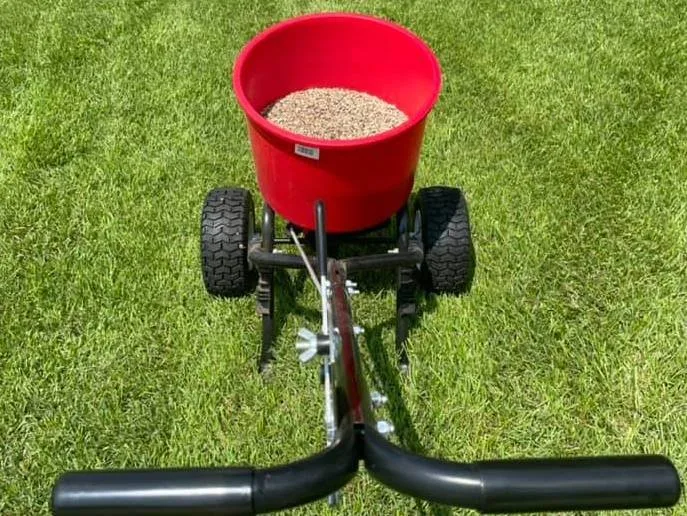
Image source: Web (Bing) / lawnphix.com
A thinning Kentucky 31 lawn isn’t a lost cause. Two paths exist, and the right one depends on how much of the original grass you want to keep.
If the lawn is mostly K-31 and you just want it thicker, annual fall overseeding with more Kentucky 31 seed fills the gaps. Mow the existing grass low, around 2.5 inches, and bag the clippings. Rake the bare spots to expose soil.
Broadcast seed at 4 to 5 pounds per 1,000 square feet and water as you would for a new planting. You will never turn K-31 into a velvet carpet, but you can restore respectable density.
If you have decided you want to move toward a finer turf, the transition takes longer. Kentucky 31 does not die out on its own. Overseeding with turf-type tall fescue into a K-31 lawn usually disappoints.
The coarse grass remains visible, and the two textures look jarring side by side. A better approach is a gradual renovation. Kill off sections with a non-selective herbicide in late summer, then seed with turf-type fescue into the bare ground.
Repeat in adjacent sections over two or three seasons until the entire lawn has turned over.
A few homeowners choose to nuke the whole lawn and start fresh. That’s the fastest path to a uniform, fine-textured lawn. It’s also the most expensive and labour-intensive.
For large properties, the gradual section-by-section method is far more practical.
Whatever route you choose, timing matters. Fall overseeding and renovation give the new grass cool soil, warm days, and less weed competition. Spring work always fights an uphill battle against crabgrass and summer heat.
Expert Tips for Getting the Most from Kentucky 31 If You Already Have It
If Kentucky 31 is already in the ground, a few adjustments make a noticeable difference.
Raise the mower deck to its highest setting, ideally 4 inches. Taller grass shades the soil, suppresses weeds, and hides the clumpy growth pattern better than any other single change.
Overseed lightly every other fall at 3 to 4 pounds per 1,000 square feet. This offsets the natural thinning that happens over time. Without it, bare patches expand.
With it, the lawn holds its density.
Apply a pre-emergent herbicide in early spring to stop crabgrass before it starts. K-31’s open habit gives weeds an easy foothold, and a solid pre-emergent schedule is the cheapest insurance against that.
Water deeply and infrequently. A single soaking of 1 inch per week, including rain, pushes roots deeper than multiple light sprinkles. Deeper roots mean better drought survival and less summer stress.
Accept the texture. You won’t turn Kentucky 31 into a fine fescue. Work with what it does well.
Keep it fed lightly, mowed tall, and overseeded on schedule, and it delivers years of serviceable green cover for almost no cost.
Kentucky 31 Lawn FAQs
Can I mix Kentucky 31 with other grass seed?
You can, but the result is rarely satisfying. Kentucky 31’s coarse texture and lighter colour stand out against finer grasses. The lawn ends up looking patchy and unplanned.
If you mix, use it only in large utility areas where uniform appearance doesn’t matter.
Will Kentucky 31 spread to fill in bare spots?
No. Kentucky 31 has a bunch-type growth habit. It does not produce rhizomes or stolons that creep into bare areas.
Any thin or damaged spots need reseeding. The grass will not repair itself the way bluegrass does.
How long does a Kentucky 31 lawn last?
With proper mowing and occasional overseeding, a Kentucky 31 lawn can last indefinitely as functional ground cover. The individual plants are perennial. The stand thins gradually over several seasons, so without overseeding you will notice more weeds and bare soil by year five or six.
Is Kentucky 31 safe for dogs and kids?
Yes. The grass itself is not toxic to pets or people. The coarse texture is the main complaint.
Barefoot children and dogs that roll in the grass may find it prickly compared to finer turf varieties. There are no chemical or fungal toxicity concerns for residential use.
Can I switch from Kentucky 31 to turf-type fescue without killing the whole lawn?
Partial success is possible. Overseeding turf-type fescue into thin K-31 stands works if the existing grass is sparse. The old K-31 plants remain visible, creating a mixed-texture lawn.
For a fully uniform result, non-selective herbicides followed by a fresh seeding give the cleanest transition.
Final Verdict: Should You Plant Kentucky 31 This Fall?
If you have a large property, a tight budget, and low expectations for a manicured look, Kentucky 31 is a legitimate, money-saving choice that works. Plant it in the right scenario and you will be satisfied. Plant it in a small suburban yard where you want a soft, lush lawn, and you will regret it by next summer.
Know which camp you are in before the spreader hits the ground.