What Does Perennial Ryegrass Look Like? 5 Signs to Know
If you’ve ever searched “what does perennial ryegrass look like” and ended up squinting at a dozen photos that all seem to show a different plant, you’re not alone. Most online images show unmowed forage types in full seed head. Your mowed lawn looks nothing like that.
Perennial ryegrass (Lolium perenne) is a cool-season bunchgrass widely planted across northern lawns, sports fields, and pastures. As of 2026, turf-type varieties bred for finer leaves and denser growth dominate the residential market, according to the USDA Plants Database. The key to identifying it is not one single feature.
It is a combination of field marks that add up to a confident ID. Let’s walk through them, step by step.
Quick Answer
Perennial ryegrass has a medium-to-dark green colour with a glossy, shiny underside on each leaf blade. The leaves emerge folded in the bud, not rolled. Small claw-like auricles clasp the stem at the collar.
A short membranous ligule sits just above them. The lower sheaths often show a reddish-purple tint. The plant grows in dense, upright bunches.
It has no spreading runners or rhizomes. The seed head is a flat spike with spikelets alternating along the stem.
Why You Can’t Rely on a Single Photo to ID Perennial Ryegrass
A photograph of perennial ryegrass taken in a pasture tells a very different story than one snapped on a golf fairway. Mowing height alone changes the entire visual. At 2 inches, you’ll never see a seed head.
At 4 inches unmowed, the spike inflorescence dominates the frame.
Season and nutrition shift the colour dramatically. Well-fed, irrigated turf in October glows a rich emerald green. That same stand in late July, heat-stressed and low on nitrogen, turns pale and yellowish.
The glossy underside that makes identification so reliable can fade when the plant is drought-stressed.
Forage-type perennial ryegrass has wider, coarser leaves than the fine-bladed turf types bred for home lawns. A photo of a forage variety will mislead you if you’re trying to match it to your residential turf. Seedling stage is another trap.
Very young plants, before the second or third leaf emerges, look nearly identical to several other cool-season grasses. The folks at NC State TurfFiles have documented just how many misidentifications happen at the seedling stage.
The safest approach is to ignore any single photo. Instead, learn a short sequence of field marks. You want features that stay consistent regardless of mowing, weather, or growth stage.
That sequence starts with what you can see from standing height.
The 5 Quick Field Marks That Work From Standing Height

You don’t need to crawl around on your hands and knees to get a solid initial read on perennial ryegrass. Five visual cues give you a strong provisional ID before you ever pull a single leaf. Run through these in order.
1. The glossy leaf underside. Bend down and tilt a blade so the light catches the back of the leaf. If it reflects a noticeable shine, almost like a very thin coat of clear varnish, you’re already leaning toward perennial ryegrass.
Most other common lawn grasses have dull or matte undersides.
2. The bunched growth pattern. Look at the lawn’s edge where it meets a sidewalk or garden bed. Perennial ryegrass forms tight, distinct clumps.
You won’t see runners creeping across the soil surface. If the grass sends out above-ground stolons or underground rhizomes into bare patches, it’s not perennial ryegrass. Kentucky bluegrass fills in bare spots on its own with rhizomes.
3. The reddish-purple base. Part the canopy with your fingers and look at the very bottom of the plant. A distinct pinkish-red to purple tint on the lower sheaths and crown is a hallmark of perennial ryegrass.
This colour is most vivid in spring and autumn.
4. The folded emergence. Find a young, unopened leaf blade poking up from the centre of a tiller. The new leaf comes out folded flat, like a book closed at the spine.
It does not emerge rolled up like a tiny scroll. This is the vernation test and it’s one of the most reliable separators from tall fescue, which handles dry spells differently.
5. The spike-type seed head. If the grass is unmowed and allowed to go to seed, the flower head is a single, slender spike. Spikelets attach directly to the main stem.
You won’t see any branching. This is a dead giveaway when it’s present.
These five marks give you about an 80% confidence level. For the final 20%, you need to get your hands on a single plant and check the details up close.
Getting Hands-On: Leaf and Blade Details
For a closer look, check a single perennial ryegrass plant from the edge of a clump. Focus on the youngest leaf and the mature blades.
The youngest leaf emerges folded, not rolled. This is one of the most reliable ways to distinguish perennial ryegrass from similar cool-season grasses.
The underside of a mature leaf feels smooth and glossy, while the upper surface has fine parallel ridges. The blade tapers to a sharp point, unlike the boat-shaped tip of Kentucky bluegrass.
Turf-type perennial ryegrass usually has narrow blades about 2 to 3 millimetres wide. The blades stand upright and stiff, and the plants grow in distinct bunches rather than spreading across the soil.
You can also check the sheath: it is split rather than fused, with overlapping edges. These features, combined with the glossy underside, folded leaf, and bunching habit, make identification much easier.
The Collar Region: Auricles, Ligule, and the Reddish-Purple Sheath

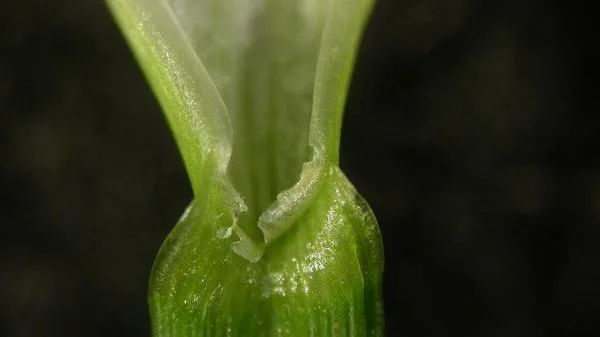
The collar is where the leaf blade meets the leaf sheath. It’s the single most information-dense square centimetre on the entire grass plant. If you’re going to buy a hand lens for turf ID, this is the spot you’ll point it at.
Perennial ryegrass has two small, claw-like appendages at the collar called auricles. They’re tiny, usually less than a millimetre long, and they wrap slightly around the stem. They look like little arms trying to give the stem a hug.
Not all grasses have auricles. Kentucky bluegrass has none. That absence alone can settle an ID in seconds.
The ligule sits at the top of the sheath, between the auricles. In perennial ryegrass, it’s short, about 1 to 2 millimetres tall, and membranous. It looks translucent and feels like thin plastic if you touch it with a fingernail.
The top edge may be very finely toothed, though you’ll need a hand lens to see that clearly. Annual ryegrass has a ligule that looks similar, but its auricles are noticeably longer and more clasping. That’s a key difference when you’re dealing with a poa annua invasion or a ryegrass mix-up.
The reddish-purple colour at the base of the plant is most intense right around the collar region and the lower portion of the sheath. The colour comes from anthocyanin pigments that the plant produces in response to cool temperatures and bright sunlight. It’s especially vivid in spring and autumn.
During hot, humid spells, the colour may fade almost entirely. Don’t rely on it alone in midsummer.
The sheath itself is split. The two edges overlap but they don’t fuse into a tube. You can separate them with a gentle pull.
Grasses like quackgrass and some brome species have sheaths that are fused into a complete tube for much of their length. This is a useful cross-check when you’re working through a turfgrass identification key.
The Seed Head: A Spike That Makes Everything Obvious

When perennial ryegrass is allowed to grow tall and produce a seed head, the identification becomes almost trivial. The inflorescence is a true spike, not a branched panicle. The central stem, called the rachis, stands upright.
Individual spikelets attach directly to it, edge-wise, alternating from side to side.
Each spikelet is flattened and contains several to many florets, typically 8 to 12 millimetres long. They press against the rachis rather than sticking out on little stalks. Run your finger up the seed head.
It feels like a zipper with the teeth facing edge-on. Orchardgrass, by contrast, has a branched panicle that looks completely different. The straw-brown dormant look of bermuda in winter is also nothing like the erect spike of perennial ryegrass in seed.
The seed head emerges in late spring to early summer, typically May through June in most northern regions. A mowed lawn won’t show seed heads unless you let a patch grow out for a few weeks. If you’re unsure about an unmowed area, this is the feature to wait for.
It removes all doubt.
The spike itself ranges from 4 to 12 inches tall. The size depends on the variety, fertility, and moisture. Diploid turf types tend to produce shorter, finer spikes.
Tetraploid forage types make bigger, coarser ones. Either way, the structure is the same: a single, unbranched stem with spikelets lined up like soldiers on alternating sides.
Once you’ve seen a perennial ryegrass seed head in person, you’ll never mistake it for a panicle-type grass again. It’s the visual clincher. But you don’t need to wait for seed heads to get a confident ID.
The combination of glossy underside, folded vernation, claw-like auricles, and reddish-purple base works in any season, mowed or not.
“Is It Perennial Ryegrass or Just a Lookalike?” — The 4 Most Common Mix-Ups
Four grasses get mistaken for perennial ryegrass more than any others. The confusion almost always comes down to skipping the vernation test or ignoring the auricles. Take thirty seconds with a single tiller and you’ll sort it out.
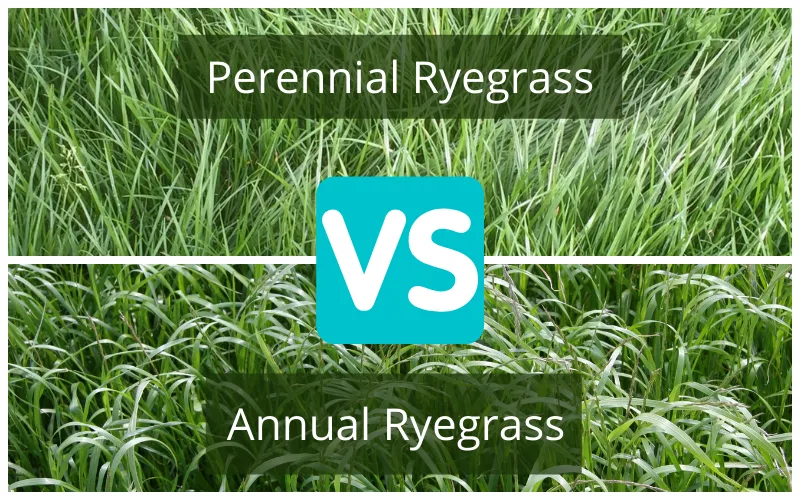
Annual ryegrass is the closest lookalike. The surest separator is vernation. Annual ryegrass leaves emerge rolled, not folded.
The auricles are also longer and more clasping, often wrapping noticeably around the stem. Perennial ryegrass auricles are short and stubby by comparison. If the plant dies completely after a hot summer, that’s another clue.
Perennial ryegrass survives year after year. Annual ryegrass is a one-and-done plant.
Tall fescue has rolled vernation too. But the real giveaway is the leaf underside. Tall fescue feels rough when you run your finger backward along it.
Perennial ryegrass is smooth. Tall fescue also has wider blades, typically 5 to 8 millimetres, and no reddish-purple base. A lawn with tall fescue can handle drought better too, but that’s a performance clue, not a visual one.
Kentucky bluegrass lacks auricles entirely. It also spreads by underground rhizomes. If you find a grass that’s creeping into bare spots and filling them, it’s not perennial ryegrass.
The classic bluegrass leaf tip is boat-shaped, not pointed. That single feature is enough to separate the two every time. Bluegrass has a softer, more velvety look overall.
If you’re wondering about its appearance in detail, there’s a dedicated guide on what Kentucky bluegrass looks like.
Quackgrass is the sneaky one. It has auricles that clasp the stem, much like perennial ryegrass. But quackgrass has aggressive, long white rhizomes.
Dig up a clump. If you see underground stems running horizontally, you’re dealing with quackgrass. Perennial ryegrass has none.
The auricles on quackgrass are also thin and tend to wrap further around the stem than the stubby claws on ryegrass.
What It Looks Like in a Real Lawn, Not a Botany Textbook
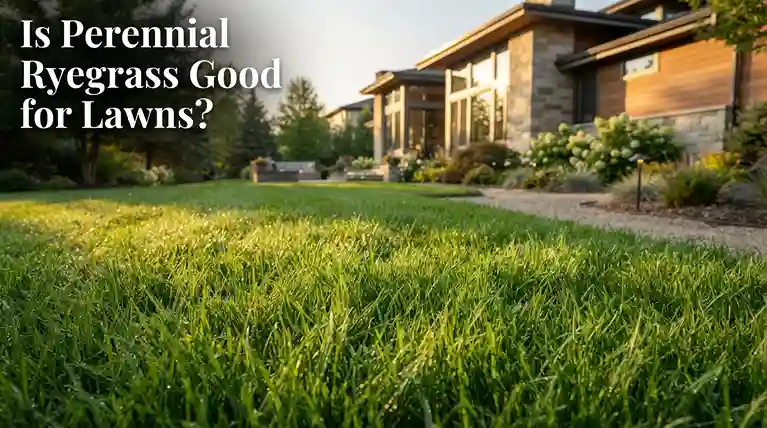
Textbook descriptions and close-up photos of individual leaves are useful. But they don’t match what you actually see standing in your driveway looking at the lawn. Here’s what perennial ryegrass looks like in a real mowed setting.
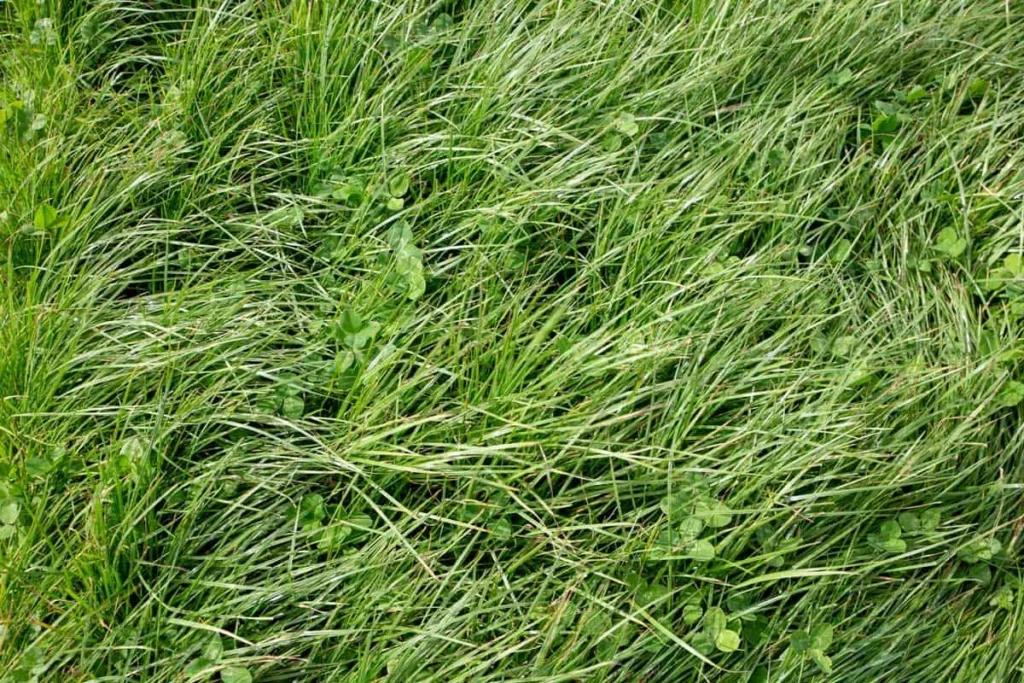
From a distance of about ten feet, a pure perennial ryegrass lawn has a distinct medium-dark green colour with a slight blue-grey undertone in certain light. It’s not as deep emerald as bluegrass. It’s not as lime-bright as tall fescue.
The surface texture looks finer and more uniform than a mixed fescue lawn, but not as velvet-smooth as a bluegrass monoculture.
Up close, you’ll notice the individual plants form distinct tufts. The edges of the lawn, where the turf meets the pavement, reveal the bunch-type habit clearly. Small gaps between clumps are normal.
The lawn won’t knit together into a solid mat the way a rhizomatous bluegrass lawn does. That’s why overseeding is a routine part of keeping it thick.
The mowed leaf tips often show a slight shredding or white bruising if the blades are dull. Perennial ryegrass has tough fibres that don’t cut as cleanly as bluegrass. If you see a whitish, frayed edge on freshly cut blades, that’s a hint.
Not diagnostic, but suggestive.
After a rain or heavy dew, the glossy leaf undersides catch the light in a way that makes the whole lawn shimmer slightly. It’s a subtle effect. You’ll notice it in early morning or late afternoon when the sun is low.
The reddish-purple colour at the base is still visible if you part the grass with your shoe. Even mowed at 2 inches, a hint of pink at the soil line says perennial ryegrass.
In winter, the lawn stays greener longer than warm-season grasses like bermuda, which turns brown when temperatures drop. By mid-December in a cool climate, your ryegrass lawn might be the only green thing on the block. By August in a heat wave, it might look pale and tired unless it gets regular water.
That seasonal swing is normal.
FAQs
How can I tell perennial ryegrass from Kentucky bluegrass by look alone?
Check the leaf tip first. Bluegrass has a boat-shaped tip. Ryegrass comes to a sharp point.
Look for auricles. Perennial ryegrass has small claw-like ones. Bluegrass has none.
Watch for rhizomes. Bluegrass sends out underground runners that fill bare spots. Ryegrass does not spread.
It stays in clumps. The overall colour of bluegrass is a deeper, richer green with a softer, velvet-like feel. Those four checks settle it every time.
What does perennial ryegrass look like when it first comes up?
Seedlings emerge fast, usually within 5 to 10 days. The first leaf is narrow and bright green with a slight sheen. The second leaf comes out folded and begins to show the hint of gloss on the underside.
At this stage it’s easily confused with annual ryegrass and tall fescue seedlings. Wait for the third or fourth leaf before attempting a certain ID. By then the auricles and reddish base start to develop enough to be useful.
Does perennial ryegrass look different in shade?
Yes. In heavy shade the leaves grow longer and thinner. The glossy underside is still present but the colour shifts to a lighter, more washed-out green.
The bunches become thinner and more sparse. You’ll see more bare soil between plants. Perennial ryegrass is not a shade-tolerant grass.
If the area gets less than about four hours of direct sun, the stand will thin noticeably over time and the visual differences from a sun-grown lawn become obvious.
What does perennial ryegrass look like in the summer?
During peak summer heat, especially without irrigation, the colour fades from dark green to a pale green or yellowish-brown. The glossy leaf shine may disappear as the plant conserves water. Growth slows dramatically.
The lawn can look thin and tired. This is normal summer dormancy for a cool-season grass. Once cooler weather and autumn rains return, the colour and density bounce back.
If you’re tackling fungus issues that crop up in stressed lawns, there’s advice on how to treat fungal problems that can apply here.
Can I identify perennial ryegrass by the seed head?
Yes, absolutely. The seed head is a single, unbranched spike with spikelets alternating edgewise along the main stem. It’s one of the most reliable identification features.
The only catch is you need an unmowed plant allowed to grow for several weeks in late spring. If you can’t wait, use the vegetative features. But if a seed head is present, it eliminates all doubt.
How is the glossy underside different from a wet leaf?
A wet leaf will shine on both surfaces from surface moisture. The perennial ryegrass gloss is an inherent property of the leaf underside itself, visible even when the leaf is completely dry. It looks more like a clear lacquer finish than a film of water.
Once you’ve compared the upper and lower surfaces on a dry leaf, the difference becomes unmistakable. It’s one of the quickest field marks to learn, and if you’re planning any lawn renovation, timing the reseeding right helps your new ryegrass establish before the heat sets in.