How Much Tall Fescue Grass Seed Per Square Foot? My Key Tips
You’ve probably searched “how much tall fescue grass seed per square foot” expecting a clean, single number. Something like 0.002 pounds. And technically, that number exists.
But if you take it and run, you’re going to end up with a patchy, thin lawn or a tangled mess of seedlings fighting each other to the death. The real answer depends on what you’re actually doing out there.
The standard recommendation for a new tall fescue lawn sits at 8 to 10 pounds per 1,000 square feet. That breaks down to roughly 0.18 to 0.23 pounds per 100 square feet. But that’s just the starting point.
Overseeding an existing lawn drops the rate dramatically. Seed quality, soil condition, and even the time of year all pull that number up or down. Here’s how to land on the right rate for your specific situation.
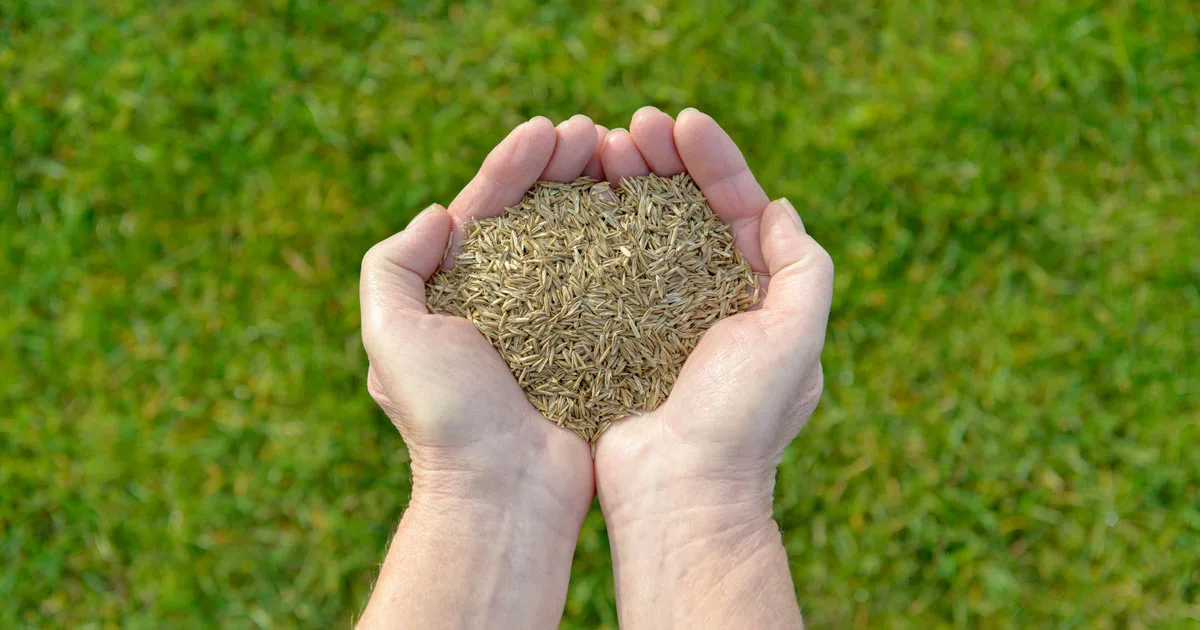
Quick Answer
For a new tall fescue lawn, use 8 to 10 pounds of seed per 1,000 square feet. That’s about 0.18 to 0.23 pounds per 100 square feet. For overseeding an existing lawn, drop to 3 to 5 pounds per 1,000 square feet.
Bare spots need roughly 1 to 2 pounds per 1,000 square feet of patch area. Always check your seed label’s germination and purity percentages before calculating.
Why “One Number” Doesn’t Work for Tall Fescue Seeding Rates
Here’s the thing about tall fescue. It’s a bunch-type grass. It doesn’t spread through rhizomes or stolons like Kentucky bluegrass or bermudagrass.
Each seed produces exactly one plant. That plant will thicken up over time through tillering, but it won’t send out runners to fill bare gaps next door.
This is why your seeding rate matters so much. Too little seed, and you’ll stare at bare dirt between clumps for months. Too much seed, and the seedlings compete for water, light, and nutrients.
The weaker ones die off anyway. You’ve just wasted half a bag.
The rate also shifts depending on what you’re trying to accomplish. Are you starting from bare dirt? That’s one number.
Are you thickening up a lawn that’s already 70% there? That’s a completely different number. Patching a few dead spots from the dog?
Different again.
Then there are the environmental factors. A lawn in full sun with good irrigation can handle the lower end of the range. A shady lawn under a maple tree needs a higher rate because some seedlings simply won’t make it.
If your soil is compacted or sandy, tall fescue’s natural resilience helps, but you’ll still want to bump the rate slightly to compensate for lower survival.
Timing changes things too. Fall seeding gives you the best establishment window. Cooler soil, warm days, and less weed pressure mean more of your seeds survive.
Spring seeding is riskier. Crabgrass is waking up at the same time, and summer heat can fry young roots before they dig deep. If you’re seeding in spring, many pros add 10 to 15 percent more seed to the rate.
The takeaway? The number on the back of the bag is a guideline. Not a commandment.
Think of it as the center point of a range you’ll adjust based on your specific conditions.
The Quick-Reference Numbers (Before We Get Into the Details)
Let’s get the baseline numbers on the table first. These are the rates recommended by university extension programs and the National Turfgrass Evaluation Program for turf-type tall fescue. Use them as your starting point.
| Scenario | Rate per 1,000 sq ft | Rate per 100 sq ft |
|---|---|---|
| New lawn from bare soil | 8 to 10 lbs | 0.18 to 0.23 lbs |
| Overseeding an existing lawn | 3 to 5 lbs | 0.07 to 0.12 lbs |
| Light maintenance overseeding | 1 to 2 lbs | 0.02 to 0.05 lbs |
| Bare spot repair | 1 to 2 lbs | 0.02 to 0.05 lbs |
If you’re using Kentucky 31, the older pasture-type tall fescue with larger seeds, drop the new-lawn rate to 5 to 6 pounds per 1,000 square feet. K31 has fewer seeds per pound than modern turf-type varieties, so a pound covers more ground.
New Lawn vs. Overseeding vs. Bare Spots: The Three Scenarios
A new lawn from bare soil needs the heaviest rate. You’re building a stand from scratch. Every square foot needs 20 to 25 healthy seedlings to form a dense, weed-resistant turf.
Given that only 50 to 70 percent of viable seeds typically survive to maturity, you need to put down more than you’ll keep.
Overseeding is different. You’re not starting from zero. You’re filling gaps in an existing lawn.
Drop too much seed, and the new seedlings will smother the old grass. A 3 to 5 pound rate per 1,000 square feet gives you enough new plants to fill thin areas without overcrowding.
Bare spots are the smallest scale. Maybe the dog left a burn mark. Maybe the snowplow scraped up a strip near the driveway.
You’re seeding a few square feet at a time. The rate per square foot stays the same as the new-lawn rate. You’re just buying less seed.
Pounds Per 1,000 Sq Ft vs. Per Square Foot: Making Sense of the Units
Nobody measures seed in fractions of a pound per square foot. It’s just not practical. A single square foot of new lawn needs about 0.008 to 0.01 pounds of seed.
That’s roughly an eighth of an ounce. Try weighing that on a kitchen scale.
This is why the entire turf industry talks in pounds per 1,000 square feet. It’s a scale that makes sense for a typical suburban lawn. Most front yards are between 1,000 and 3,000 square feet.
Most seed bags come in 5, 10, 25, and 50-pound sizes. The math is straightforward.
To convert, just remember that 1,000 square feet is your reference unit. A 100-square-foot patch needs one-tenth of the 1,000-square-foot rate. A 500-square-foot area needs half.
If you want per-square-foot numbers for a tiny patch, divide the 1,000-square-foot rate by 1,000. A new lawn at 8 pounds per 1,000 square feet works out to 0.008 pounds per square foot.
How to Measure Your Lawn Area Accurately (So the Math Actually Works)
None of these rates matter if you don’t know how big your lawn actually is. Guessing almost always goes wrong. Most people overestimate small lawns and underestimate large ones.
Here’s the simplest method that works.
Grab a long tape measure. A 100-foot reel tape is ideal. Walk the length and width of your lawn in feet.
Multiply them. That’s your square footage. If your lawn is a rectangle, you’re done in 60 seconds.
For an L-shaped lawn, split it into two rectangles. Measure each one separately. Add them together.
Same approach for a T-shape, an H-shape, or any other letter of the alphabet.
Got a curved bed or a winding driveway cutting through? Don’t try to measure the curves. Break the lawn into smaller rectangles and triangles that approximate the shape.
A triangle’s area is half the base times the height. Add up all the pieces. You’ll get within 5 percent of the true area, which is plenty accurate for seeding.
Odd-Shaped Lawns, Beds, and Driveways That Throw Off Your Calculation
The biggest measuring mistake is subtracting too much or too little. A 2,000-square-foot rectangle with a 200-square-foot flower bed isn’t a 1,800-square-foot lawn. You’ve got to subtract the bed area accurately.
Measure the bed separately and subtract it from the total.
Another common error: forgetting the side yard. That narrow strip between the house and the fence might only be 6 feet wide, but if it runs 40 feet long, that’s another 240 square feet. Miss it, and you’ll run out of seed halfway through the job.
If you want a quick sanity check, use Google Earth or a satellite view of your property. Most mapping tools have a measuring feature. Trace your lawn outline and it’ll give you a rough square footage.
It’s not as accurate as a tape measure, but it’ll catch major errors.
Once you have your square footage, write it down. Divide by 1,000. That’s your multiplier.
A 2,500-square-foot lawn at 8 pounds per 1,000 square feet needs 2.5 × 8, which is 20 pounds of seed. The full seeding guide walks through the entire process from soil prep to first mow.
The Seed Label Matters More Than the Bag Front
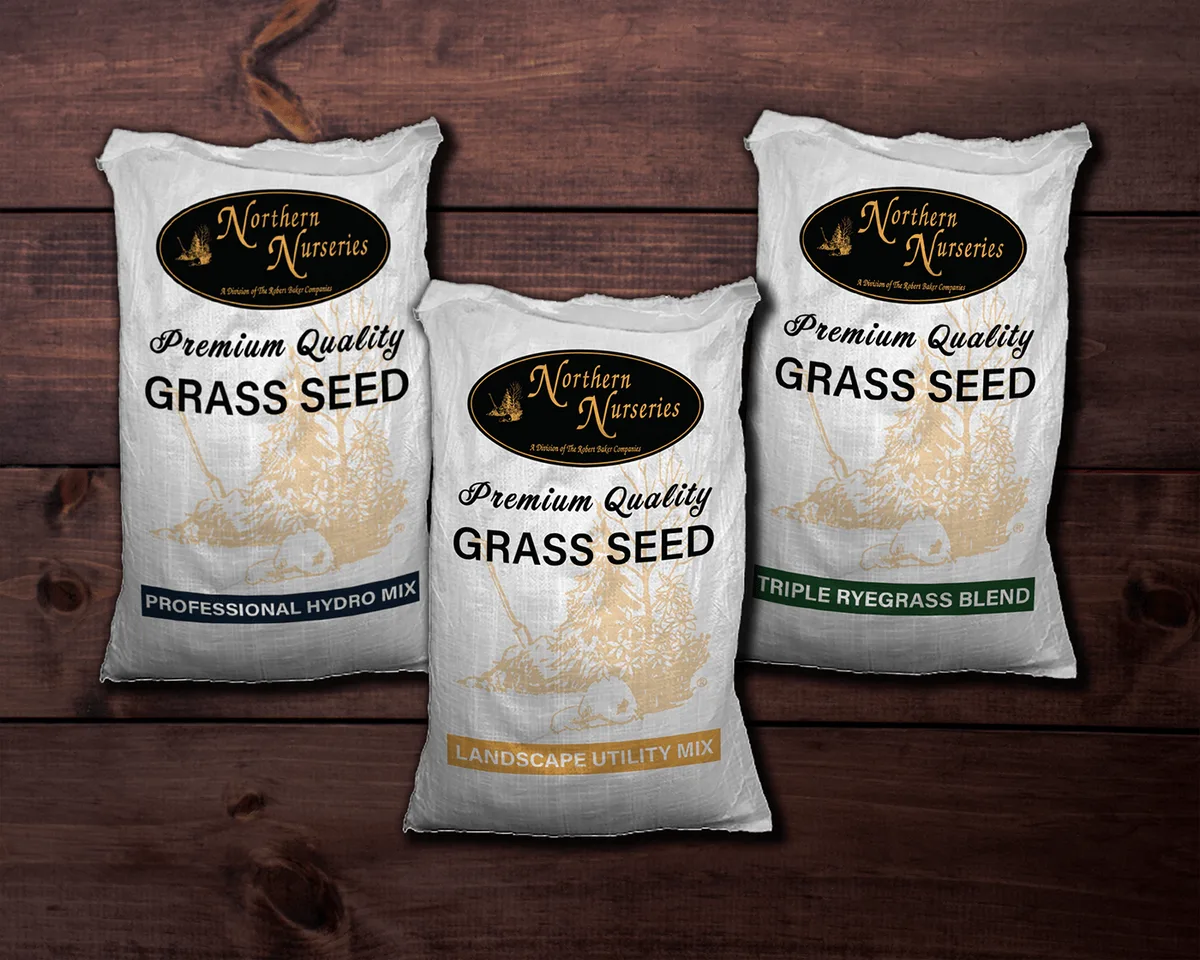
The front of the bag shows you a lush green lawn. The back of the bag tells you what you’re actually buying. Federal and state seed laws require every bag sold to carry a label with specific numbers.
Learning to read them takes about two minutes. It’ll save you from under-seeding by 30 percent or more.
Look for four numbers on the label: purity, germination, weed seed, and crop seed. Purity tells you what percentage of the bag is actually tall fescue seed. The rest is inert matter, chaff, or other crop seeds.
A bag with 98 percent purity means 2 percent of the weight is stuff that won’t grow into grass.
Germination rate tells you what percentage of that pure seed will sprout under ideal lab conditions. As of 2026, most quality turf-type tall fescue seed carries a germination rate of 85 to 95 percent. If your bag shows 80 percent, that’s on the low end.
You’ll need more seed to compensate.
Germination Rate, Purity, and Why Pure Live Seed Changes Everything
Pure live seed, or PLS, is the number that actually matters. It’s the percentage of the bag’s total weight that will turn into living grass plants. The formula is simple.
Multiply purity by germination. A bag with 98 percent purity and 90 percent germination gives you 0.98 × 0.90, which is 0.882, or 88.2 percent PLS. That means only 88.2 percent of the bag’s weight is viable seed.
The other 11.8 percent is inert material and dead seed.
Now adjust your seeding rate. If the recommended rate is 8 pounds per 1,000 square feet, and your PLS is 88.2 percent, divide 8 by 0.882. You get 9.07 pounds.
You need roughly 9 pounds per 1,000 square feet instead of 8. Ignore this math, and you’ll under-seed by more than 10 percent.
University extension programs, including Penn State’s turfgrass research, recommend always calculating PLS before buying seed. It’s the only way to compare bags fairly. A cheaper bag with lower germination might actually cost more per viable seed.
Coated Seed: When Half the Bag Isn’t Actually Seed
Some seed bags come with a coating. The coating is usually a polymer or clay-based material that holds moisture around the seed and sometimes includes a starter fertilizer or fungicide. It’s not a bad thing.
Coated seed can improve germination in dry conditions. But it does change the math.
A coated seed bag might be 50 percent coating by weight. If the label says “50% coating” or “50% inert matter,” then a 10-pound bag only contains 5 pounds of actual seed. The standard seeding rate assumes uncoated seed.
If you’re using coated seed, you need to double the weight you put down.
Check the label. If the coating percentage isn’t listed, weigh out a small sample and soak it in water. The coating will dissolve, and you can see what’s left.
Or just buy uncoated seed if you want to keep the math simple. Once you’ve sorted out the rate, the full seeding walkthrough covers everything from soil prep to watering.
Decision Branch: New Lawn From Bare Soil
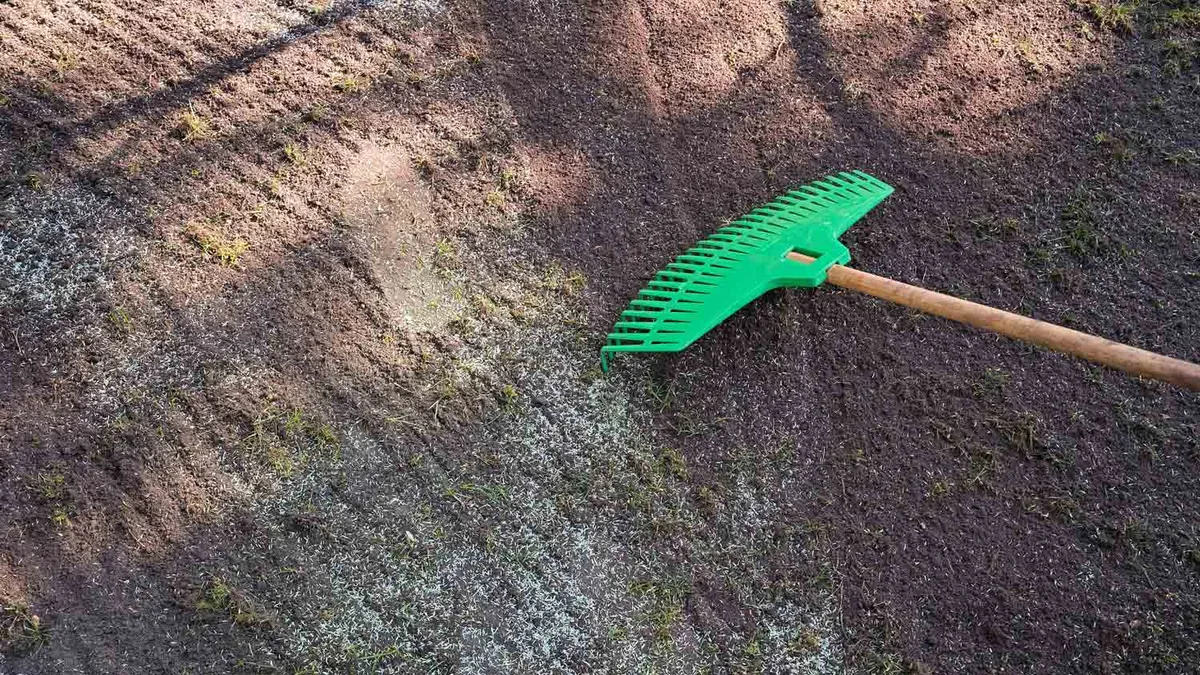
Starting from bare dirt is the most straightforward scenario. You’ve got a clean slate. It’s also the scenario where the seeding rate matters most.
Get it wrong, and you’ll be looking at a weedy, patchy mess for the next two years.
The standard recommendation is 8 to 10 pounds of turf-type tall fescue per 1,000 square feet. That’s your target. If your soil is in good shape, you’ve added compost, and you’re seeding in early fall, stick to the lower end of that range.
You don’t need to overdo it.
The Standard Rate and When to Adjust Up or Down
Stay at 8 pounds per 1,000 square feet if you’ve prepared the soil properly. That means tilling or raking to a depth of 4 to 6 inches, incorporating organic matter, and leveling the surface. Good seed-to-soil contact gives you higher germination rates.
Higher germination means you need less seed.
Bump up to 10 pounds per 1,000 square feet if any of these apply. Your soil is compacted clay. You’re seeding on a slope where erosion is a concern.
You’re seeding in spring instead of fall. Or you’re working with a seed lot that has a germination rate below 85 percent.
For shady areas under trees, tall fescue handles shade better than most warm-season grasses, but it still struggles in deep shade. Add an extra pound per 1,000 square feet to compensate for lower survival rates. Some of those seedlings won’t get enough light to make it.
If you’re in a dry climate or your irrigation is spotty, tall fescue’s deep root system gives it an edge. But even drought-tolerant varieties need consistent moisture during germination. If you can’t water frequently, go with the higher rate.
More seeds mean more chances that some will germinate after a rain event.
Seed Density Math: How Many Seedlings Per Square Foot You’re Actually Chasing
The goal for a new tall fescue lawn is 20 to 25 established seedlings per square foot. Turf-type tall fescue has about 225,000 to 250,000 seeds per pound. At 8 pounds per 1,000 square feet, you’re putting down roughly 1,800 to 2,000 seeds per square foot.
That sounds like a lot. It’s supposed to be. Only a fraction survive.
Seed washout, birds, inconsistent moisture, and natural mortality claim 50 to 70 percent of what you put down. If you start with 1,800 seeds per square foot and 60 percent die off, you’re left with 720 seedlings. That’s way more than the 20 to 25 you need.
The excess is intentional. Seedlings compete. The strongest ones survive.
The density self-thins over the first year as the plants mature and tiller. What you end up with is a dense, even stand of healthy plants that fill every square inch.
This is also why you shouldn’t panic and toss down extra seed “just in case.” Over-seeding a new lawn pushes the competition too hard. Seedlings stretch for light, develop weak crowns, and become susceptible to damping-off disease. More is not always better.
Twenty-five strong plants per square foot beat 50 weak ones every time.
Decision Branch: Overseeding an Existing Tall Fescue Lawn
Overseeding is where most people get the rate wrong. They treat it like a mini new-lawn seeding and dump way too much seed. The existing grass is still there.
It’s already occupying space, casting shade, and competing for moisture. You’re not building a lawn from scratch. You’re filling the gaps.
The standard overseeding rate for tall fescue is 3 to 5 pounds per 1,000 square feet. If your lawn is just a little thin, stay at 3 pounds. If you’ve got noticeable bare patches or the lawn has been declining for a few years, go with 5 pounds.
Slit seeding changes the math slightly. A slit seeder cuts grooves into the soil and drops seed directly into them. Germination rates are higher because the seed gets perfect soil contact.
If you’re slit seeding, you can drop to 2 to 3 pounds per 1,000 square feet. The machine does the precision work for you.
Maintenance Overseeding vs. Renovation Overseeding
Maintenance overseeding is light. You do it every year or two to keep the lawn thick before it thins out. Use 1 to 2 pounds per 1,000 square feet.
That’s enough to introduce fresh plants without crowding the existing turf. Think of it as a tune-up, not a rebuild.
Renovation overseeding is heavier. The lawn has real problems. Maybe 30 to 40 percent of the turf is gone.
Maybe you’re trying to transition from a mix with fine fescue to a pure tall fescue stand. Use the full 4 to 5 pounds per 1,000 square feet. Core aerate first.
The holes give seed a protected spot to germinate without washing away.
Why Thick Lawns Need Less Seed, Not More
It sounds backwards. A thick lawn seems like it would smother new seedlings. And it does.
That’s exactly why you use less seed. The existing grass canopy blocks light. Only the strongest seedlings push through.
If you dump 8 pounds per 1,000 on an overseed job, half those seeds germinate and then stall out in the shade. They die. You’ve wasted seed.
The existing plants also occupy root space underground. There’s only so much room in the soil profile. Young seedlings can’t compete with a mature tall fescue root system that runs 2 to 3 feet deep.
You’re aiming for a few new plants per square foot. Not a full stand. That’s why 3 to 5 pounds works.
Decision Branch: Repairing Bare Patches and Problem Spots
Bare patches are their own micro-project. You don’t need to calculate for the whole lawn. Just measure the patch area.
A 5-foot by 4-foot spot is 20 square feet. At the new-lawn rate of 8 pounds per 1,000 square feet, you need about 0.16 pounds for that patch. That’s roughly 2.5 ounces.
Weigh it on a kitchen scale if you want precision. Or eyeball it. You want roughly 35 to 40 seeds per square inch of bare soil.
That’s a light, even dusting. Not a pile. Rake the seed into the top quarter-inch of loosened soil.
Press it down with your foot. Mulch lightly with straw if the spot is larger than a dinner plate.
Dog Damage, Salt Strips, and Heavy Shade Patches
Dog urine spots need a little extra care. The salts in urine can linger in the soil and damage new roots before they establish. Flush the patch with water first.
Soak it thoroughly. Let it drain. Then rake out the dead grass, loosen the top inch of soil, and seed at the bare-soil rate.
Salt damage along driveways and sidewalks is the same problem with a different cause. Flush the strip in early spring to push salts deeper into the soil profile. Seed at the high end of the bare-spot rate.
Salt-stressed soil is tough on seedlings.
Heavy shade patches under trees need a different approach altogether. Even shade-tolerant tall fescue struggles in deep shade. If a patch has failed twice, consider switching to fine fescue or a shade-tolerant groundcover for that spot.
If you’re committed to tall fescue, seed at 10 pounds per 1,000 square feet for that patch and accept that it may still thin out over time.
Spreader Setup and The Half-Rate Pass Trick
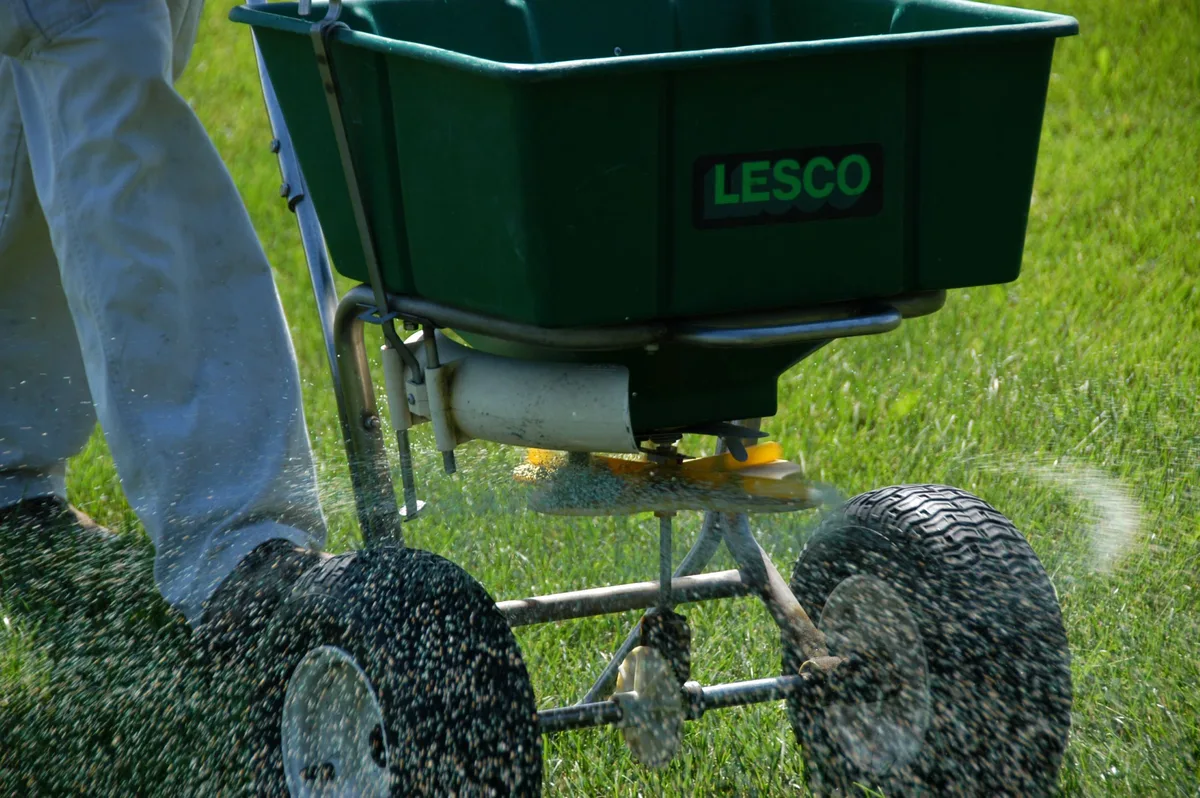
The way you spread the seed matters as much as the rate you choose. A broadcast spreader flings seed in a fan pattern. The edges of the fan are thinner than the center.
If you make one pass and call it done, you’ll end up with dark green stripes of thick grass separated by lighter, thinner strips.
The fix is the half-rate pass trick. Split your total seed into two equal piles. Set your spreader to half the recommended opening.
Walk the lawn in one direction with the first pile. Then walk it again at a 90-degree angle with the second pile. North-south first.
East-west second. You get even coverage across the whole lawn.
Before you load the spreader, calibrate it. Weigh out exactly 1 pound of seed. Set the spreader to the lowest setting that lets seed through.
Walk a 100-square-foot test area. See how much seed you used. Adjust the setting until you’re hitting roughly half your target rate per pass.
It takes five minutes. It saves you from running out of seed halfway through or dumping a heavy stripe right down the middle of the lawn.
A drop spreader is more precise but slower. It drops seed straight down between the wheels with no fling. You don’t need the two-pass trick with a drop spreader because there’s no overlap issue.
But you do need to line up each pass perfectly. Overlap by even an inch and you’ll double-seed the seams. Leave a gap and you’ll have bare lines.
The Fall Seeding Advantage (and Why Spring Is a Gamble)
Tall fescue is a cool-season grass. It germinates best when soil temperatures sit between 50 and 65 degrees Fahrenheit. In most of the country, that window opens in late August and runs through early October.
Fall is the sweet spot.
Seeding in fall gives you three advantages. First, the soil is still warm from summer. Germination happens fast.
You’ll see seedlings in 7 to 10 days. Second, weed pressure drops off. Crabgrass and other summer annuals are done germinating.
Your tall fescue gets a clean start without fighting for real estate. Third, the young grass has all of fall and the following spring to develop a deep root system before it faces summer heat.
Spring seeding is possible. It’s just harder. Soil temperatures are climbing toward the germination zone but they’re rising alongside weed seeds.
Crabgrass germinates at 55 degrees. Tall fescue germinates at 50 to 65 degrees. They wake up at the same time.
A pre-emergent herbicide, which would stop the crabgrass, also stops your grass seed. You can’t use it. So you’re racing the weeds from day one.
If you do seed in spring, bump your rate by 10 to 15 percent. Expect lower survival. Plan to overseed again in fall.
Think of spring seeding as a temporary fix, not a permanent solution.
Mistakes That Waste Seed, Money, and Time
Skipping the soil test is the most expensive shortcut. Tall fescue needs a soil pH between 6.0 and 7.0. Below 5.8, phosphorus availability drops and seedlings struggle.
You can dump 12 pounds of seed per 1,000 and still get a thin lawn if the pH is off. A soil test costs about $15 from your local extension office. Do it before you buy seed.
Not killing existing weeds before seeding a new lawn is another common error. Perennial weeds like dandelions and plantain regrow from root fragments. They’ll push right up through your new seedlings.
Spray a non-selective herbicide two weeks before you plan to seed. Wait for everything to die. Then rake out the debris and seed into clean soil.
Seeding too deep is just as bad as leaving seed on the surface. Tall fescue seed needs to be about 1/4 to 1/2 inch deep. Any deeper and the seedling runs out of energy before it reaches sunlight.
Rake the seed in lightly. Don’t bury it.
Letting the seedbed dry out, even once, can wipe out a new seeding. The first two weeks are critical. Water lightly two or three times a day.
Just enough to keep the top half-inch of soil damp. Not soggy. Once the grass reaches 2 inches tall, start backing off to once-daily watering and increase the volume per session.
Mowing too soon pulls young seedlings out of the ground. Wait until the new grass hits 3.5 to 4 inches. Then mow it back to 3 inches with a sharp blade.
A dull blade rips seedlings out by the roots. Sharpen it before the first cut.
Cheat Sheet: A Simple Decision Chart for Your Tall Fescue Seeding Rate
| Your Situation | Rate per 1,000 sq ft | Notes |
|---|---|---|
| New lawn, bare soil, fall, good prep | 8 lbs | Standard. Adjust for PLS. |
| New lawn, spring or compacted soil | 10 lbs | Add10% for spring. |
| Overseeding existing lawn, light thin | 3 lbs | Mow short and bag clippings first. |
| Overseeding, noticeable bare areas | 5 lbs | Core aerate before seeding. |
| Bare spot repair | 1–2 lbs per 1,000 sq ft of patch area | Loosen soil, rake seed in, mulch lightly. |
| Maintenance overseeding (yearly touch-up) | 1–2 lbs | Keep it light so seedlings don’t smother. |
| Slit seeding (overseeding) | 2–3 lbs | Higher germination from precise seed placement. |
Frequently Asked Questions
How do I calculate seed for a 2,000-square-foot lawn?
Divide your area by1,000 and multiply by the rate. For a new lawn at8 lbs per1,000 sq ft, a2,000 sq ft lawn needs 16 lbs of seed. Always adjust for pure live seed.
Can I mix tall fescue with other grass seed?
Yes. Blends with 90% tall fescue and 10% Kentucky bluegrass improve spread and repair. Use the same total seeding rate, split between varieties.
What if I use too much seed?
Seedlings compete for light and water. Many die. Survivors are weak and prone to disease.
Stick to the recommended range.
How long after seeding can I walk on the lawn?
Keep foot traffic off until the first mow, roughly 4, 6 weeks. Light watering passes are fine. Avoid heavy use until roots establish deeply.
Does coated seed need a different spreader setting?
Yes. Coated seed is heavier and bulkier. Open the spreader setting slightly wider to compensate, then calibrate with a test pass.
The half-rate trick still applies.