How to Drain Gas From Lawn Mower: My Proven Tips
Old fuel is the number-one reason a mower refuses to start after a long nap. If you’re figuring out how to drain gas from lawn mower tanks safely, relax. The whole job takes about 15 minutes and one cheap tool.
The catch is that three things decide the method: your mower, your reason, and your hardware.
Timing matters more than most people expect. Untreated E10 gasoline starts breaking down in about 30 days. Stale fuel is the most commonly reported cause of gummed carburetors and spring no-starts.
Here’s every drain path, so you can pick the right one.
How to Drain Gas From Lawn Mower
Here’s how to drain gas from lawn mower tanks without spills or drama. Park on level ground with a completely cold engine. Pull the spark plug wire off before you touch any fuel line.
Siphon the tank with a hand pump, or open the fuel shutoff valve. Catch the fuel in an approved container for disposal.
Why Drain Gas From a Lawn Mower at All? (And When You Can Skip It)
You drain it so old fuel can’t turn into varnish that clogs a carburetor. Modern pump gas contains ethanol, which quietly pulls moisture out of the air. That water settles at the bottom of the tank and corrodes bare metal from the inside.
At the same time, the fuel loses the light, volatile compounds that help it fire on the first pull.
The clock matters. Untreated E10 starts going stale in roughly 30 days, and treated fuel stretches to about 12 months, according to manufacturer fuel guidance from Briggs & Stratton. As fuel degrades, it leaves sticky, lacquer-like deposits on jets and passages.
That’s the gunk that turns a two-pull starter into a twenty-pull ordeal by May.
So when does draining actually earn its keep?
- The mower will sit for a full season or longer
- The tank already holds fuel that’s a month or more old
- The gas looks dark and smells like varnish
- You’re pulling the carburetor or tipping the mower on its side
- You’re hauling it in a truck bed or storing it indoors
And when can you skip it? Short storage, honestly. Two or three months is fine with fresh gas and a dose of stabilizer.
Pick the right fuel from the start, too. If you’re unsure, which fuel your engine actually needs is worth a quick look, because some engines tolerate ethanol far better than others.
You can also dodge the job entirely by running the carb dry. Close the fuel valve, let the engine stall, and the bowl sits empty all winter. That protects the carburetor but leaves bare tank walls exposed to condensation.
It suits short storage better than deep winter.
What Decides Your Method: Mower Type, Tank Hardware, and Your Reason
Three things decide your method: your reason for draining, the mower you own, and the fittings on the tank.
Your reason comes first. Storage drains are about prevention, so a stabilizer routine often replaces them entirely. Repair and transport drains are about physics, so the tank has to end up empty or near-empty.
The same mower can need two different approaches in one year.
Mower type comes second. Riding mowers and zero-turns usually carry a 2 to 4 gallon tank with an inline fuel shutoff valve. That valve is your friend: switch it off, pull the line at the carb end, and gravity does the work.
Push mowers hold a quarter to one gallon, and as of 2026 plenty of new ones still ship with no drain fitting at all.
Hardware comes third, and it’s the real fork in the road.
| What your tank has | Fastest method |
|---|---|
| Riding mower with a fuel shutoff valve | Gravity drain: valve off, line pulled at the carb, fuel into a can |
| Push mower with a plain filler neck | Hand siphon pump, typically $8 to $15 |
| Filler neck with an anti-siphon screen | Drain from the fuel line at the carb end instead |
| Carb bowl drain screw present | Open it last to catch the final few ounces |
| Small tank, small job | Turkey baster, roughly an ounce per draw |
The if/then is simple. If your tank has a shutoff valve, you never need to siphon. If it doesn’t, the pump earns its keep in one job.
And if you only need the bowl empty, that little screw beats everything else combined.
Path 1: Winterizing (Drain the Tank or Use Fuel Stabilizer?)
For most mowers, a stabilized full tank beats a full drain. That sounds backwards until you picture the empty alternative. An empty steel tank breathes: warm days load the air with moisture, cold nights squeeze it out, and droplets form on bare walls inside.
A near-full tank of treated gas leaves almost no room for that cycle.
The stabilizer routine takes about ten minutes:
- Start with fresh gas, not whatever’s already in the tank
- Add fuel stabilizer at the label rate
- Fill the tank to near the shoulder
- Run the engine five minutes so treated fuel reaches the carb and bowl
- Then shut it down for the season the right way
If/then logic applies here. If the fuel in the tank is already past the one-month mark, drain it first, then refill with fresh, stabilized gas. Stabilizer preserves good fuel.
It can’t resurrect stale fuel, so dosing an old tank just slows the rot.
Full drain wins in three cases. Indoor storage, because a dry tank means no gasoline fumes in your basement or crawl space. Already-stale fuel, for the reasons above.
And any mower you can’t run after filling, which rules out the run-it-through step.
| Factor | Stabilize and fill | Full drain |
|---|---|---|
| Time | About 10 minutes | 15 to 30 minutes, plus a disposal trip |
| Carb protection | Bowl stays wet with treated fuel | Empty after a stall run |
| Tank walls | Coated, minimal rust risk | Bare, watch for condensation |
| Best for | Storage up to 12 months | Stale fuel, indoor storage, repairs |
Fuel is only part of winter prep, of course. The full off-season routine also covers oil, blades, and spark plug care before you tuck the mower in.
Path 2: Stale Gas, Carb Repair, or Transport (When a Full Drain Is the Only Fix)
A full drain is non-negotiable when the fuel itself is bad, the carburetor comes apart, or the mower will tip past sideways.
Stale fuel announces itself. The gas darkens to iced-tea brown and smells like varnish or turpentine. The engine surges, hunts at idle, or only starts with a spray of starting fluid.
At that point, draining isn’t optional, because fresh gas poured on top of old just waters down the problem.
Here’s what a winter or two of stale fuel does inside the carb:
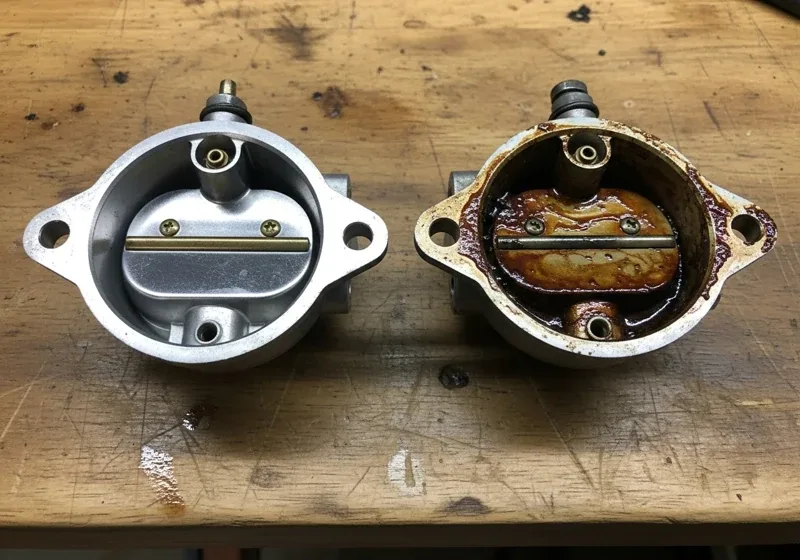
A bowl gummed up like that needs to come off the engine for cleaning. Which brings us to the second case.
Pulling a carburetor means opening the float bowl, which still holds a few ounces even after the tank runs dry. Pinch the fuel line with a spring clamp or a dedicated line clamp before you loosen anything. Then open the bowl drain screw over a pan and let the last of it escape.
Work slow, because gasoline finds every gap.
Transport and tipping are the third case, and the riskiest. Lay a mower on its side with gas in the tank and fuel migrates into the air filter and cylinder. Expect a smoky first restart after storage mistakes at best, and a flooded cylinder at worst.
Run the tank low before the mower goes on its side or into a truck bed.
Never siphon by mouth. Swallowed gasoline can aspiration-pool in the lungs, and doctors treat it as a genuine emergency.
Whatever comes out needs a legal home afterward, which we’ll cover next.
How to Drain a Push Mower: Hand Siphon Pump, Gravity Drain, or Carb Bowl Screw
The prep work is identical no matter which method you pick. Park on level pavement with a stone-cold engine. Pull the spark plug wire off the plug and tuck it away from the metal.
Then set a shallow drain pan underneath and work outdoors, well away from water heaters or anything with a pilot flame.
Here’s your short shopping list:
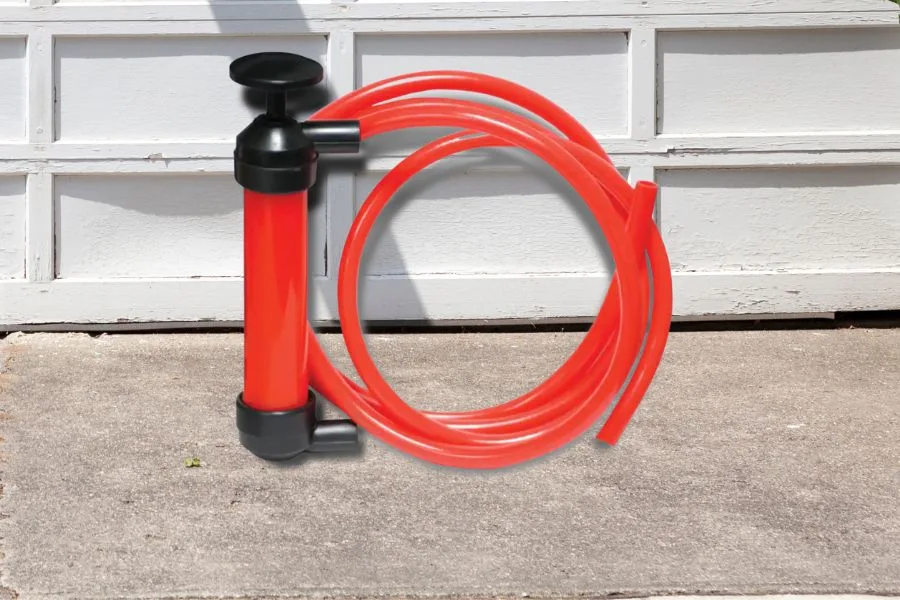
- Hand siphon pump with intake and outlet tubes
- UL-listed or FM-approved gas can
- Shallow drain pan
- Spring clamp or a dedicated fuel line pinch tool
- Nitrile gloves, safety glasses, and a few rags
Now check the filler neck before you commit to a method. Shine a flashlight in there. Some tanks have a plain open neck, while others hide an anti-siphon screen or a deep internal baffle.
That one glance tells you whether Method 1 will work or you’re jumping straight to Method 2.
Method 1: The hand siphon pump (easiest for most tanks)
- Slide the intake tube into the filler neck until it reaches the lowest corner of the tank.
- Set your empty can on the ground, well below the tank. Once flow starts, gravity carries it.
- Pump the handle or squeeze the bulb until gas climbs the tube and reaches the outlet.
- Hold the intake steady near the tank bottom and let it run until the tube sucks air.
- Lift the outlet tube out to break the flow, then cap the can.
A basic hand pump empties a quarter-to-one-gallon push mower tank in under two minutes, based on the flow rates manufacturers publish. If nothing moves after a minute of pumping, you’ve hit an anti-siphon screen. Don’t fight it.
Method 2 handles that tank.
Method 2: Gravity drain through the fuel line (no pump needed)
- Trace the rubber fuel line from the tank down to the carburetor.
- Slide the spring clamp a few inches back from the carb fitting.
- Set the can under the line, then twist the hose off the fitting.
- Let the tank empty completely. It takes just a couple of minutes at this tank size.
- Push the hose back on, seat the clamp, and you’re done.
This works because the tank always sits above the carb on a walk-behind mower. No pump, no lifting, no mess. The only trick is a gentle twist when pulling the hose, since old fuel lines crack if you yank them straight off.
Method 3: The carb bowl drain screw (empties the last few ounces)
- Find the small screw at the lowest point of the float bowl. Some are hex head, others wear a knurled knob.
- Position the drain pan directly beneath it.
- Back the screw out one or two full turns counterclockwise. Fuel weeps first, then streams.
- Snug it back up once the bowl empties. Hand-tight plus a small nudge. These soft screws strip easily.
Finish every job the same way. Reconnect the plug wire, start the engine, and let it run until it stalls from fuel starvation. That pulls the last ounces out of the bowl and line.
Then pull the wire again, wipe the deck, and label the can with the date. Total elapsed time: about 15 minutes.
How to Drain a Riding Mower With (or Without) a Fuel Shutoff Valve
If your rider has a fuel shutoff valve, you never need to siphon. This little valve, sometimes called a petcock, sits in the fuel line between the tank and carburetor, usually under the tank near the filter. Manufacturer layouts vary, but the function doesn’t: turn it off and the tank is sealed from the engine.
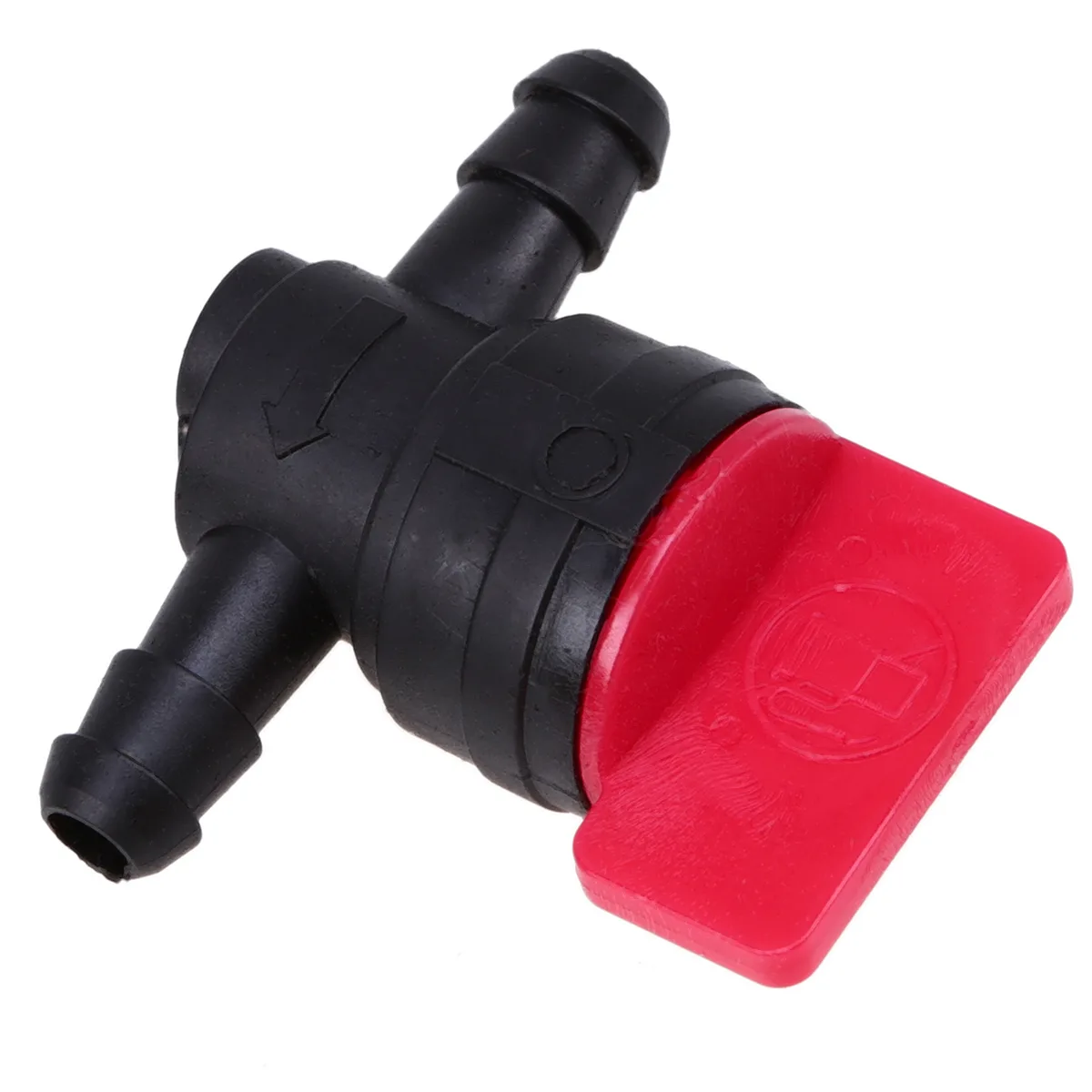
With a valve, here’s the whole job:
- Park on level ground, set the brake, and pull the key.
- Turn the valve to OFF. Most are quarter-turn knobs or levers.
- Pull the fuel line off the carb inlet or filter outlet and aim it into your can. Screw clamps loosen with a flathead. Spring clamps squeeze closed with pliers.
- Open the valve. Two to 4 gallons gravity-drains in a few minutes.
- Close the valve, reconnect the line, then run the engine until it stalls to empty the bowl.
One tip saves you a mess here. If the line runs through an inline fuel filter, always disconnect on the tank side of it. That way the filter stays full and you don’t chase a puddle around the deck.
No valve on your model? The wide filler necks on riders make a hand siphon pump even easier than on a push mower. Feed the tube in, pump, done.
Plenty of owners also install an inline brass shutoff valve, a common five-dollar part. The ten-minute install turns every future drain into the gravity method above.
Either way, keep two habits. Never pull a fuel fitting on a warm engine, since residual vapor escapes under pressure. And never let a loose hose end dangle over the frame, because gasoline finds every seam on its way down.
Old Gas Disposal: Where It Legally Goes and What Never to Do With It
Old gasoline goes to a household hazardous waste facility or a county collection event. Nothing else is legal in most states. Pouring it on the ground, into a storm drain, down a sink, or into the trash contaminates groundwater, and regulators treat all four as violations.
The EPA’s household hazardous waste guidance places gasoline squarely in the hazardous category, right alongside paints and solvents. Treat every drop that leaves your tank that way, whether it’s dark and sour or just a season old.
Now, some of it doesn’t need disposal at all. If the drained fuel still looks and smells fresh, you can stretch it into your car. Pour a quart or two into a nearly full car tank so the dilution is heavy.
Fuel that’s iced-tea brown or smells like varnish belongs at the drop-off instead. And two-stroke mix never goes in any car engine, because the oil fouls injectors and oxygen sensors fast.
Finding a drop-off is easier than most people expect:
- Search your county or city solid waste website for “household hazardous waste”
- Call local fire stations, since many accept old fuel
- Ask at auto parts stores, some of which take it for a small fee or free
- Most municipal drop-offs cost nothing, though a few counties charge a few dollars per visit
Transport it safely. Use an approved can with a tight lid, keep it upright, and carry it in a truck bed or trunk with ventilation rather than the passenger cabin. Label the contents and date so nobody guesses.
And if the mower itself is the thing that’s dead, not just the fuel, [retiring the whole machine] has its own set of rules worth following.
Mistakes to Avoid: Flooded Air Filters, Hot Mufflers, and Mouth Siphons
Most drain jobs go wrong in one of five predictable ways. All five are avoidable, and most cost you nothing but a few minutes of patience to sidestep.
Tipping the mower with a wet tank. Fuel runs straight into the air box and cylinder, and the engine hogs and smokes on restart. A soaked filter needs replacing, and you’ll want to [inspect that sopping filter media] before cranking again. Run the tank near-empty first, and always tilt carb-side up.
The same trap catches anyone tipping the mower [to pull the blade for sharpening].
Working near a hot engine. A recently run muffler stays hot enough to ignite spilled fuel vapor long after the engine quiets. Give it 15 to 30 minutes minimum. Spilled gas on a hot muffler is the single fastest way to turn a maintenance chore into a fire.
Siphoning by mouth. Just don’t. Swallowed gasoline can pool in the lungs, and emergency rooms treat it as a genuine crisis. An $8 hand pump removes every reason to try.
Pulling the cord with the line open. The engine sucks fuel and sprays it out the open fitting. Your cylinder floods, the plug fouls, and now you’re drying a wet plug instead of finishing the job.
Burying the fuel can. An overfilled can sitting in a hot garage builds vapor pressure with nowhere to go. Leave headspace, label it, and store it away from sun-baked walls.
One more sneaky one: draining the tank but skipping the bowl. Those last few ounces still varnish over winter. Run the engine dry or open the bowl screw, or you’ll be back under the carb in spring.
The Final Call: Your Drain-or-Don’t Cheat Sheet (+ FAQs)
Here’s the whole decision in one place:
| Your situation | Your move |
|---|---|
| Storing 3 to 12 months, fuel is fresh | Fill with stabilized gas, run 5 minutes, no drain |
| Tank fuel is past 30 days old | Drain it, refill fresh, add stabilizer |
| Pulling the carburetor for cleaning | Full drain, pinch the line, open the bowl screw |
| Tipping or hauling the mower | Run the tank near-empty before it tilts |
| Rider with a fuel shutoff valve | Valve off, line off, gravity drain in minutes |
| Sitting for just a few weeks | Skip the drain, stabilize only if the gas is old |
Treat a full drain as your cue for the other seasonal jobs too, like [fresh oil before storage] and a plug check. Doing them together turns one garage session into a complete tune-up.
Can you drain a lawn mower without a siphon pump?
Yes, three ways work. Pull the fuel line off at the carburetor end and let the tank gravity-drain into a can. Use a turkey baster for small tanks.
Or run the engine dry by closing the fuel valve. Every method still needs an approved container and a completely cold engine.
How long can gas sit in a lawn mower?
Roughly 30 days untreated. E10 starts oxidizing within a month, which is why engines hesitate on old fuel. Fuel stabilizer stretches that window to about 12 months, and ethanol-free gas lasts longer still.
If you’re unsure, smell the tank. A varnish odor means drain it.
Is it better to drain gas or run the mower out of gas?
It depends on the job. For storage, a stabilized full tank protects the carburetor and tank walls better than emptying. For repairs, tipping, or transport, run or drain the tank near-empty first.
The stall-run method empties the bowl and line cleanly, but it leaves bare tank walls behind.
Can I put old lawn mower gas in my car?
Only if it still looks and smells fresh. Pour a small amount into a nearly full car tank, since heavy dilution matters. Fuel that’s dark, sour, or waterlogged belongs at a hazardous waste site instead.
Never add two-stroke mix to any car, because the oil fouls injectors and sensors.
How do you dispose of old gasoline safely?
Take it to a household hazardous waste facility or a county collection event. Seal it in an approved can, keep it upright in transit, and label the contents. Some auto parts stores and fire stations also accept it.
Never pour it on the ground, down a drain, or into the trash.
Why won’t my mower start after I drained and refilled it?
Three usual suspects. The float bowl is still empty, so give the cord several firm pulls. The spark plug wire may still be off the plug.
Or stale residue in the carburetor jets survived the fresh fill. If pulls fail after a minute, the carb needs cleaning, not more fresh gas.