What Does Kentucky Bluegrass Look Like? Simple Guide
If you’ve ever asked “what does kentucky bluegrass look like” while staring at your lawn, you already know the frustration. Text descriptions sound simple on the screen. Out in the yard, everything blurs together.
A mower deck cuts off the very clues that field guides tell you to look for. You’re left squinting at a sea of green, wondering if that grass is the premium turf you hoped for or an impostor taking over.
Kentucky bluegrass (Poa pratensis) covers an estimated 10 to 15 percent of all maintained lawn acreage in the northern United States, according to university turfgrass extension surveys. It’s prized for its fine texture, dense carpet-like growth, and rich color. Nailing the ID matters because misidentification leads straight to bad lawn care decisions, wasted inputs, and a lot of heartache.
Let’s walk through exactly what to look for, starting with why this grass is so stubbornly hard to pin down without a picture.

The Real Problem With Identifying Kentucky Bluegrass by Text Alone
Words fail fast when you try to describe a grass plant in the field. Descriptors like “blue-green” and “fine-textured” mean nothing without a side-by-side reference. What looks blue-green in one light may read as ordinary dark green in another.
Fine texture compared to what? Tall fescue? Perennial ryegrass?
Our brains need a visual anchor.
The bigger issue is that lawn mowing hides the most reliable field marks. At a typical 2.5-inch cut, the boat-shaped leaf tip that textbooks highlight gets sliced off every week. All you see are upright leaf blades that could belong to several different species.
To make a confident ID, you need to let a small patch grow unmowed for a week or two and then examine the uncut leaves. Even better, pull a few whole plants including the crown and roots.
Our research through extension service identification keys shows that most casual observers mix up Kentucky bluegrass with perennial ryegrass, annual bluegrass, or even fine fescues. The confusion is so common that turfgrass diagnostic labs routinely receive samples labeled “KBG” that turn out to be something else entirely. Without hands-on examination of vernation, auricles, and below-ground parts, the name on the seed bag is just a guess.
Quick Answer
Kentucky bluegrass has a boat-shaped leaf tip, folded vernation, and no auricles. The leaf blade feels smooth with a distinct midrib. Below ground, thin white rhizomes run horizontally.
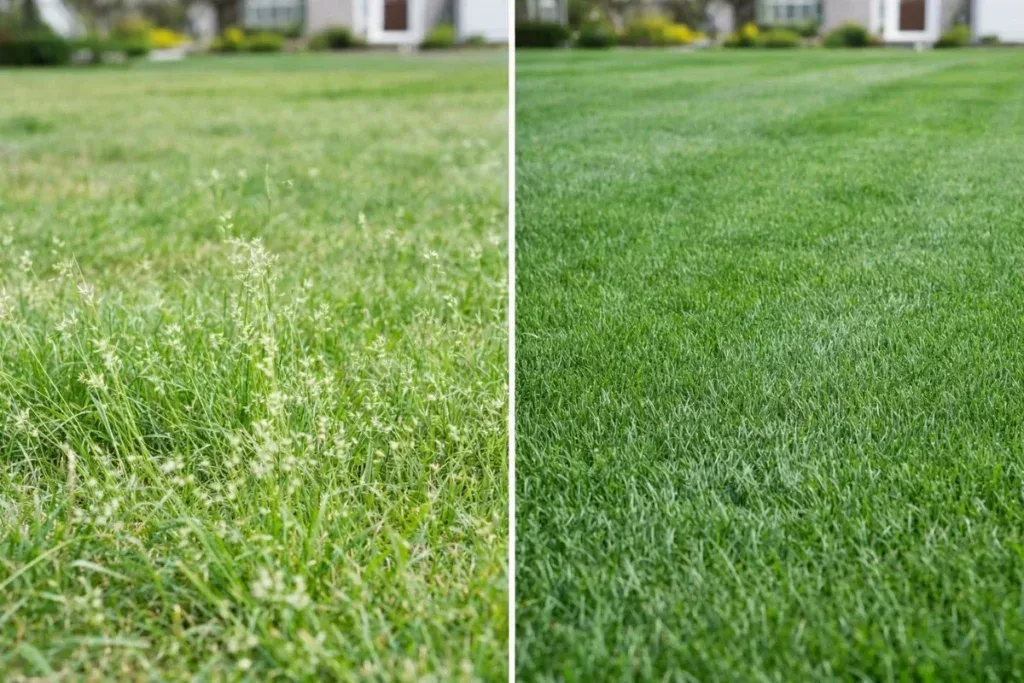
Unmowed, it forms an open pyramid-shaped seed head. The color shifts from dark blue-green in cool weather to duller green or straw-brown during summer heat stress.
Why a Boat-Shaped Leaf Tip Is Your Number One Clue
Among all the physical traits of Kentucky bluegrass, the boat-shaped leaf tip is the one you absolutely cannot skip. It’s the single most distinctive feature that separates this grass from the rest of the cool-season pack. If you find a grass with a blunt, canoe-like tip that looks like someone pinched the very end shut, you are almost certainly looking at a Poa species.

To see it clearly, pluck a mature, unmowed leaf blade. Hold it up against a light background. The tip won’t come to a sharp point the way tall fescue or ryegrass does.
Instead, the two edges of the blade converge and form a tiny boat hull with the sides slightly curled upward. Under a 10x hand lens, the keeled midrib is visible right down the center of the leaf, running all the way to the very end. It’s subtle on very young leaves but unmistakable once you train your eye.
The catch is that annual bluegrass (Poa annua) shares this boat-shaped tip. So you can’t stop there. That’s a common trap, especially in older lawns where Poa annua has crept in alongside the desired turf.
Kentucky bluegrass leaves tend to be slightly wider and a darker, more muted blue-green. Annual bluegrass often looks lighter, apple-green, and its leaf blades near the base may show a rippled or crinkled texture. But color alone is too variable to trust.
The boat shape points you to the right genus. The next two tests separate the desirable KBG from its weedy cousin.
A university extension tip worth remembering: if you can, examine the leaf tip on the youngest fully expanded leaf. That’s where the boat shape is most pronounced, before foot traffic, mowing, and weather wear it down.
The Folded Vernation Test That Most People Miss
Vernation refers to how the youngest, unopened leaf is arranged inside the shoot. Kentucky bluegrass has folded vernation, meaning the leaf is creased down the middle like a closed book. This trait divides the turfgrass world.
If you find rolled vernation, the grass is in a different group entirely and can’t be KBG.

Performing the test takes seconds. Find a healthy grass shoot and cut a cross-section through the crown area with a sharp knife or razor blade. Look at the cut face under magnification.
The central, unemerged leaf will appear either V-shaped (folded) or circular/rolled like a tiny scroll. Kentucky bluegrass always folds. Tall fescue, fine fescues, and bentgrass always roll.
Perennial ryegrass also has folded vernation, which is why it’s the most frequent misidentification. But here’s the difference: ryegrass leaves emerge with a glossy underside, have prominent clasping auricles, and never produce rhizomes. KBG leaves are dull underneath, auricles are absent, and rhizomes are always present.
According to the USDA Plants Database, Poa pratensis is characterized by its extensively creeping rhizomes and folded vernation, a combination shared by few other common lawn grasses. When faced with a folded-vernation grass that lacks auricles, the rhizome check becomes the tiebreaker.
You need a hand lens or a pocket microscope to see vernation clearly on narrow leaf blades. A 10x jeweler’s loupe is enough, but a 60x illuminated pocket scope makes the test effortless. If you don’t have one handy, try gently pulling the youngest leaf out of the sheath and examining how it’s folded.
With practice, you can feel the flat pleat under your fingernail.
Rhizomes Underground: The Hidden Proof of Kentucky Bluegrass
Rhizomes are the feature that really seals the deal. Kentucky bluegrass spreads by underground stems that run horizontally just below the soil surface, sending up new shoots at the nodes. Digging up a small plug of grass and washing the roots clean reveals these pale, wiry strands.
They’re unmistakable once you see them. No rhizomes, no KBG.

Use a garden knife to extract a 3- to 4-inch-deep chunk of turf from the section of lawn you want to identify. Dunk it in a bucket of water and gently swish until the soil washes off. If the grass is Kentucky bluegrass, you’ll see slender, white to yellowish horizontal stems crisscrossing through the root mass.
They have distinct nodes and scale-like leaves. These rhizomes knit the sod together and let KBG fill in bare spots without reseeding.
Annual bluegrass, perennial ryegrass, tall fescue, and fine fescues are all bunch-type or have only very limited rhizomes. Perennial ryegrass shows zero rhizomes. Tall fescue produces short rhizomes only on a few modern turf-type cultivars, but they’re stubby and rare.
A robust, tangled rhizome network points squarely to Kentucky bluegrass.
One caution: creeping red fescue does produce short rhizomes, and it can sometimes cause confusion in shady sections where it’s often mixed with bluegrass. But its leaf blades are needle-fine, rolled in vernation, and lack a boat-shaped tip. So the combination of tests keeps you on track.
If the grass has folded vernation, no auricles, a boat-shaped leaf tip, and an obvious underground rhizome system, you have Kentucky bluegrass with near certainty.
This below-ground clue also explains why your lawn bounces back after summer stress. The dormant top growth may look dead, but those rhizomes are loaded with energy reserves, ready to push new green shoots as soon as moisture returns. Recognizing that resilience is part of what makes a correct ID so valuable.
You’ll stop treating your lawn like a sick fescue stand and start managing it as the self-repairing bluegrass it is.
A Step-by-Step ID Routine You Can Do With a Hand Lens
When you want to stop guessing and know for sure, follow a consistent sequence. Jumping around between leaf color, seed heads, and growth habit just muddies the answer. Stick to a method that starts above ground, moves below ground, and rules out look-alikes one trait at a time.
Let a small patch of the mystery grass grow unmowed for 10 to 14 days. That gives you uncut leaf tips and enough stem structure to work with. Gather a 10x hand lens, a sharp garden knife, a white index card or piece of paper, and a clean bucket of water.
- Step 1: Vernation first. Slice through the crown of a shoot with the knife. Look for a folded, V-shaped new leaf. If it’s rolled, you can stop. It isn’t Kentucky bluegrass.
- Step 2: Check the leaf tip on an uncut blade. Find the youngest fully expanded leaf. The tip should look blunt and canoe-shaped, not tapered to a point.
- Step 3: Inspect the auricle area. Pull the leaf blade gently away from the stem. You’re looking for tiny ear-like projections. Kentucky bluegrass has none. Perennial ryegrass does.
- Step 4: Scan the ligule. On KBG it’s a very short, flat, whitish membrane, hard to see without the lens. Poa annua has a longer, more pointed ligule.
- Step 5: Dig a small plug and wash the roots. Swoosh the plug in the water bucket until soil clears. Rhizomes present means KBG or a rhizomatous fescue. No rhizomes at all rules KBG out completely.
None of these steps alone seals the case. The combination of folded vernation, boat-shaped tip, absent auricles, a short truncate ligule, and vigorous white rhizomes gives you a definitive match. If your lawn checks all five boxes, you’ve got Kentucky bluegrass.
Once you know what’s growing, you can make sharper decisions about the right window to thicken up thin areas. That matters because KBG establishment from seed is slow. Overseeding at the wrong time wastes both effort and expensive seed.
Kentucky Bluegrass vs. Annual Bluegrass: Two “Boats,” Very Different Grass
Both grasses have boat-shaped leaf tips. That shared trait trips up more homeowners than anything else. Stop right there if you’ve spotted the canoe tip.
You now know you’re dealing with a Poa species. The question becomes which one.
Annual bluegrass (Poa annua) is a lighter, brighter green, often described as apple-green. Kentucky bluegrass leans darker with a muted blue-green cast, especially in spring and fall. Relying on color alone can mislead you because fertility and water levels shift the shade of both species.
But a couple of structural differences don’t change with growing conditions.
Annual bluegrass is a bunch-type grass. Dig a small plug and you’ll never find rhizomes. It also has a longer, pointed ligule that tapers to a tip.
Under 10x magnification, the leaf blades of Poa annua often show a crinkled, wavy texture near the base. That rippling is absent on Kentucky bluegrass. And the seed head tells a different story too.
Annual bluegrass produces a flatter, more spreading panicle, often at very low mowing heights. KBG seed heads stand taller and more pyramidal.
The practical difference is lifespan. Annual bluegrass dies out in summer heat, leaving bare patches. KBG rhizomes survive dormancy and regrow.
If your lawn thins in July and you’re seeing lighter green patches that collapse after a few hot weeks, managing invasive Poa annua requires a specific approach. Knowing the difference between these two is the first step to keeping the good grass and heading off the weedy one.
Kentucky Bluegrass vs. Perennial Ryegrass: Folded Leaves Aren’t Enough
Another classic mix-up happens because both Kentucky bluegrass and perennial ryegrass show folded vernation. A quick vernation test puts them in the same camp. But after that, they split hard.
Perennial ryegrass leaves never have a boat-shaped tip. The blade tapers to a sharper, narrower point. Hold the leaf backlit against a white card and you’ll see the difference immediately.
Ryegrass also has prominent, clasping auricles at the collar. These look like tiny white arms wrapping around the stem. KBG has no auricles at all.
Flip the leaf over. Perennial ryegrass has a noticeably glossy, shiny underside. Kentucky bluegrass has a dull, matte finish.
It’s a small detail that becomes obvious once you’ve seen both placed side by side.
The below-ground story is the final word. Perennial ryegrass is a bunch-type grass. Dig up a mature plant.
You’ll find a robust fibrous root system but zero rhizomes. That means ryegrass won’t fill in bare spots the way KBG does. It’s also why ryegrass lawns look patchy after a tough summer, while a KBG lawn knitted together by rhizomes often recovers on its own.
If your folded-vernation grass is spreading laterally year over year, you’re looking at bluegrass.
Kentucky Bluegrass vs. Tall Fescue and Fine Fescues: Why Texture and Tips Decide
Fescues are easy to eliminate once you know what you’re looking for.
Tall fescue has rolled vernation. The vernation test alone separates it from Kentucky bluegrass. But even without that test, you’ll notice the blades are wider and coarser.
Run a finger along the leaf margin. Tall fescue feels rough, almost like fine sandpaper. The leaf tip comes to a tapered point, not a boat shape.
Clumps are distinct and bunch-type, though some modern turf-type cultivars produce very short rhizomes. Those are uncommon and nowhere near as extensive as KBG rhizomes.
Fine fescues, like creeping red, Chewings, hard, and sheep fescue, also have rolled vernation. Their blades are so narrow they look almost needle-like. Texture alone makes them easy to tell apart from Kentucky bluegrass.
Creeping red fescue does produce short rhizomes, and that can confuse people who stop at the dig test. But fine fescue leaves lack a boat-shaped tip entirely and have rolled vernation. Two negatives rule them out fast.
If you have a shady part of the lawn where fescue might be the better choice anyway, identifying what’s already growing tells you whether to lean into its strengths or transition to a different grass over time. Mix-ups between fescues and KBG often lead to the wrong mowing height, water schedule, and fertilizer plan.
Visual ID When the Grass Is Mowed Short or Brown From Summer Stress
A mowed lawn hides the boat-shaped tip. At 2 inches, you’re looking at leaf blades that were cut below their characteristic ends. That’s the single biggest reason people misidentify their own turf.
Let a small section grow out for two weeks before you bother with any identification steps. The uncut leaves will give you the unfiltered view you need.
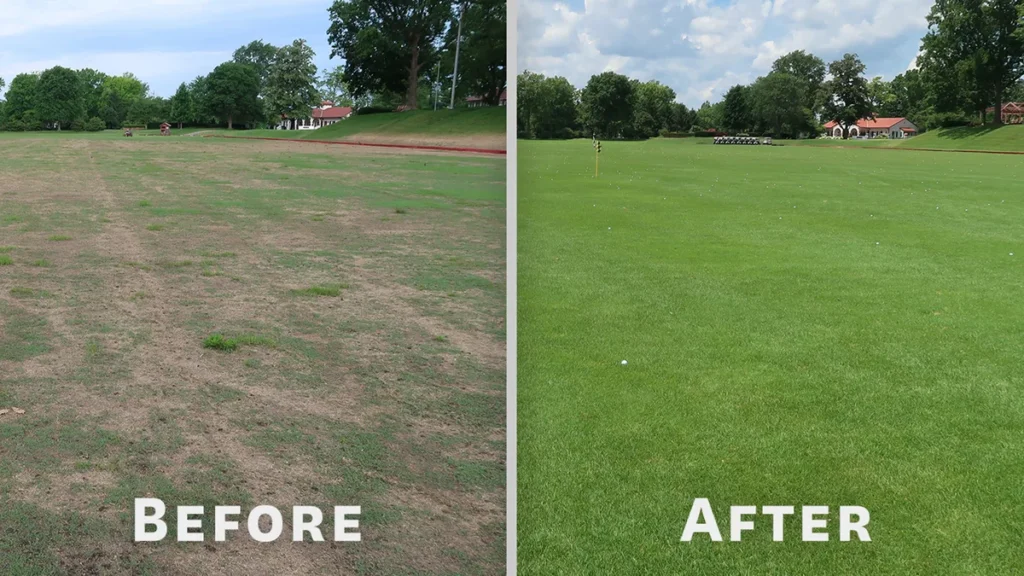
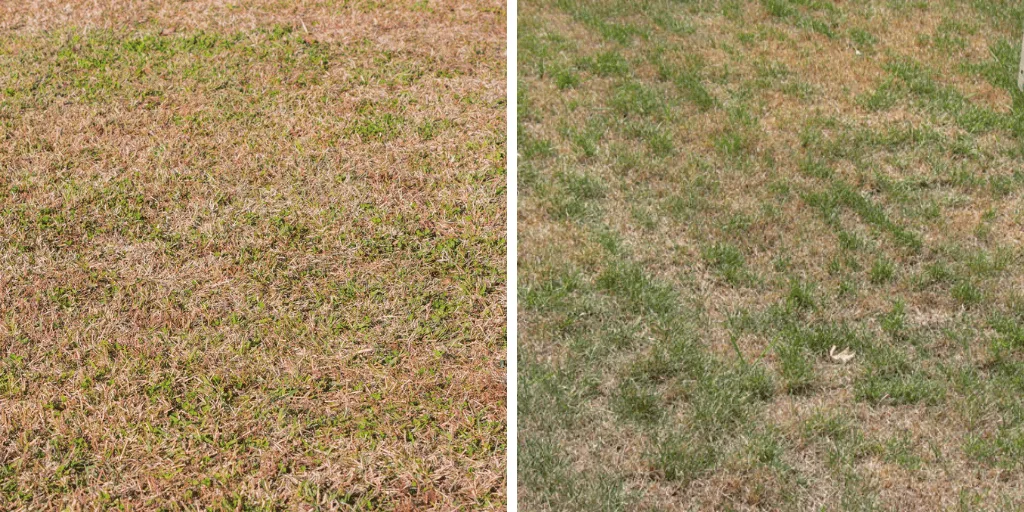
Summer dormancy creates a different kind of confusion. Kentucky bluegrass turns a dull green, then straw-brown, as air temperatures stay high and soil moisture drops. You might think it’s dead.
It’s not. The rhizomes below ground are still alive, waiting for cooler nights and rain. Tug on a brown patch.
Dead grass pulls up easily with no resistance. Dormant KBG holds firm, anchored by a dense root and rhizome network.
Don’t jump to reseeding during a hot, dry spell. Give it water. If you’ve been running the sprinklers regularly but not long enough, the roots may be shallow and the dormancy response is simply the plant protecting itself.
Adjust the irrigation before you assume the stand is lost.
Brown patches can also mean grub feeding underneath the surface. Grub-damaged turf lifts up like a loose carpet because the roots are chewed off. Dormant KBG won’t do that.
If the turf peels back easily, inspect for grubs right away so you don’t misdiagnose insect damage as heat stress. The treatment path is completely different, and waiting only gives grubs more time to do harm.
The 5 Most Common Misidentifications (and How to Avoid Them in Your Own Lawn)
Misreading your grass type leads to the wrong mowing height, fertilizer timing, and water schedule. These five mix-ups happen constantly in northern lawns.
- Mistaking Poa annua for KBG: The boat-shaped tip looks identical, but Poa annua has a longer ligule, no rhizomes, and crinkled basal leaves. Dig a plug. No rhizomes means it isn’t KBG.
- Calling perennial ryegrass KBG: Both have folded vernation. Ryegrass has auricles, a shiny leaf underside, and a pointed tip. A quick collar check separates them instantly.
- Thinking tall fescue is young KBG: Coarse texture, rolled vernation, and rough leaf edges rule it out. No boat-shaped tip, ever.
- Calling creeping red fescue KBG: Rhizomes can mislead you, but the leaves are needle-fine and rolled. No boat shape, no folded vernation.
- Assuming any dark green lawn is KBG: Color is the weakest identifier. Shadows, nitrogen, and cultivar genetics shift greens across species. Trust structure, not shade.
If you’ve been fighting a patch that doesn’t respond to fungicide treatments, make sure the grass you think you’re treating is actually the grass that’s sick. ID errors waste product and time.
A Visual Reference Checklist: What to Photograph and Compare Side by Side
Your phone camera can be a solid ID tool if you capture the right details. Snap each of these and compare them against extension service photo libraries or a trusted app.
- An uncut leaf tip held against a white piece of paper
- A cross-section of a shoot showing the folded or rolled vernation
- The auricle area, pulled back from the stem
- A washed rhizome network from a small plug
- The overall lawn texture with a coin for scale
Side-by-side comparison is the key. A single frame of a random leaf won’t tell you much. But the boat-shaped tip next to a known perennial ryegrass leaf, for instance, makes the structural difference jump out.
Take all the photos in morning light. Harsh midday sun washes out fine details.
When to Call an Extension Lab or Use a Turfgrass ID App
If the step-by-step routine still leaves you uncertain, send a sample to your state’s university turfgrass diagnostic lab. Most offer this service for a small fee. They’ll identify the species, and often the cultivar, under a microscope.
That removes all doubt.
Include a 4-inch square of turf, roots and soil intact, wrapped in a damp (not wet) paper towel inside a plastic bag. Ship it early in the week so it doesn’t sit in a hot warehouse over the weekend. Extension pathologists can also check for disease while they have the sample.
Turfgrass ID apps have improved a lot as of 2026. They use your photos to narrow down possibilities. Use them as a second opinion, not a final answer.
The boat-shaped tip detail can get lost in compression if your shot isn’t crisp. Always cross-check the app’s suggestion with an auricle and rhizome check. Apps are directionally useful but not perfect.
Frequently Asked Questions
Can Kentucky bluegrass have a different color in different seasons?
Yes. It often looks a rich blue-green in spring and fall. In summer it may dull to a muted green or, under drought stress, turn straw-brown during dormancy.
Nitrogen availability also deepens or lightens the hue.
What does a Kentucky bluegrass seed head look like?
The seed head is an open, pyramid-shaped panicle with multiple spreading branches. Each spikelet holds 2 to 5 small florets. It appears in late spring when unmowed grass is allowed to reach 18 to 24 inches tall.
Is Kentucky bluegrass supposed to look brown in summer?
Temporary summer dormancy is normal without irrigation. The grass isn’t dead. Rhizomes store energy underground and push green growth again when temperatures drop and moisture returns in late summer or early fall.
How can I tell Kentucky bluegrass from weeds?
Look for the combination of boat-shaped leaf tip, folded vernation, absent auricles, and underground rhizomes. Most lawn weeds lack rhizomes entirely, or they have very different leaf structures. A quick dig test often clears up confusion fast.
Does Kentucky bluegrass look different when it’s young versus mature?
Seedling KBG is very fine and wispy, with narrow blades. It takes a full growing season to develop the dense, carpet-like texture and darker color of a mature stand. Patience is normal, because KBG germinates slowly and spreads by rhizomes over time.