What Kind of Oil Does a Lawn Mower Use? My Simple Breakdown
Wondering what kind of oil does a lawn mower use? You’re not alone. It’s the first question almost every new owner asks, and the wrong answer damages more engines than any rock or stick ever will.
The short version: most gas mowers take SAE 30, 10W-30, or synthetic 5W-30, depending on your engine and climate. Two-strokes play by completely different rules.
Manufacturer specifications confirm the right grade comes down to two factors: engine type and your lowest expected temperature, per the same SAE viscosity ratings used in car oil. As of 2026, nothing about that has changed. We’ll sort out your engine first, then match the oil to your weather, then cover the checking, changing, and mistakes that matter most.
What Kind of Oil Does a Lawn Mower Use
Most 4-stroke gas mowers use SAE 30 oil in warm weather. Multi-grade 10W-30 covers a wider temperature range. Full synthetic 5W-30 works in nearly every climate.
Older 2-stroke mowers carry no crankcase oil at all. They burn 2-cycle oil premixed into the fuel at a 50:1 ratio.
Here’s the ten-second version: 4-stroke engine, add the grade your manual lists. 2-stroke engine, mix oil into the gas and never pour it in the crankcase. Everything else in this guide just fills in the details.
First, Figure Out What Engine You Actually Have
Every other decision branches from this one, so let’s settle it before anything else.
4-Stroke vs. 2-Stroke: The Gas Cap Test
Open the fuel area and count the caps. Two caps (one for gas, one for oil) means you have a 4-stroke engine. One cap plus a sticker reading “50:1” or “fuel/oil mix” means it’s a 2-stroke.
| Clue | What It Means |
|---|---|
| Two caps (gas + oil) | 4-stroke: oil goes in the crankcase |
| One cap, “50:1” sticker | 2-stroke: oil mixes into the fuel |
Four-strokes dominate now. Nearly every push mower, riding mower, and zero-turn built in the last two decades runs one. These engines hold oil in a crankcase, exactly like a car, and it never touches the fuel.
Two-strokes are older and lighter. They have no oil reservoir, so lubrication comes from oil mixed straight into the gasoline. Since the fuel does double duty, what belongs in the tank matters as much as the oil grade you’d pick.
Why the Two Types Are Never Interchangeable
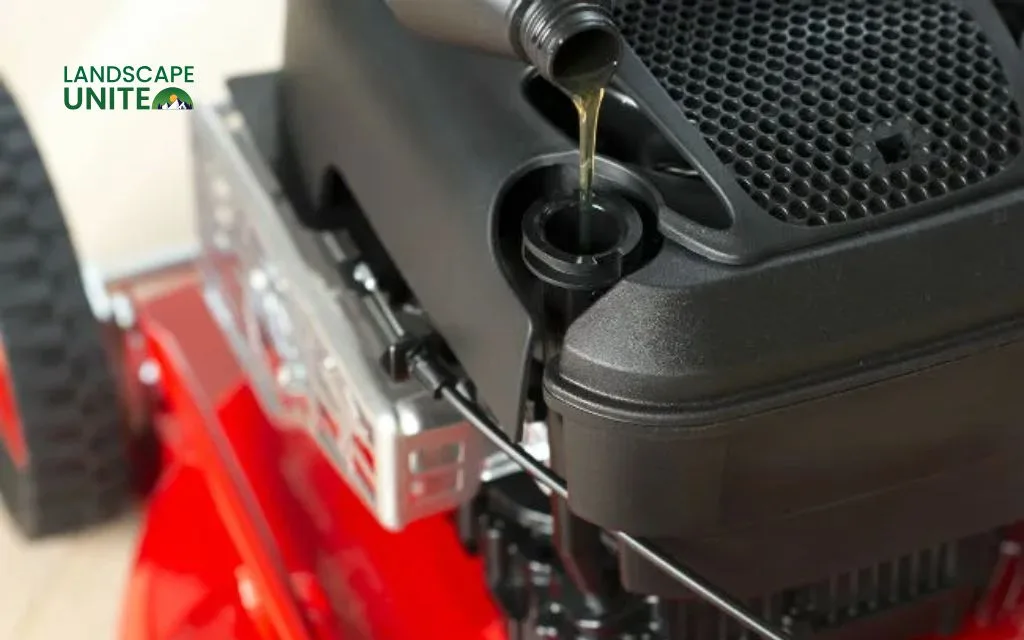
Pour 2-cycle oil into a 4-stroke crankcase and it fouls the spark plug, then burns into carbon deposits. Run straight gas in a 2-stroke and the piston can seize within minutes because nothing is lubricating it. There’s no partial credit on this one.
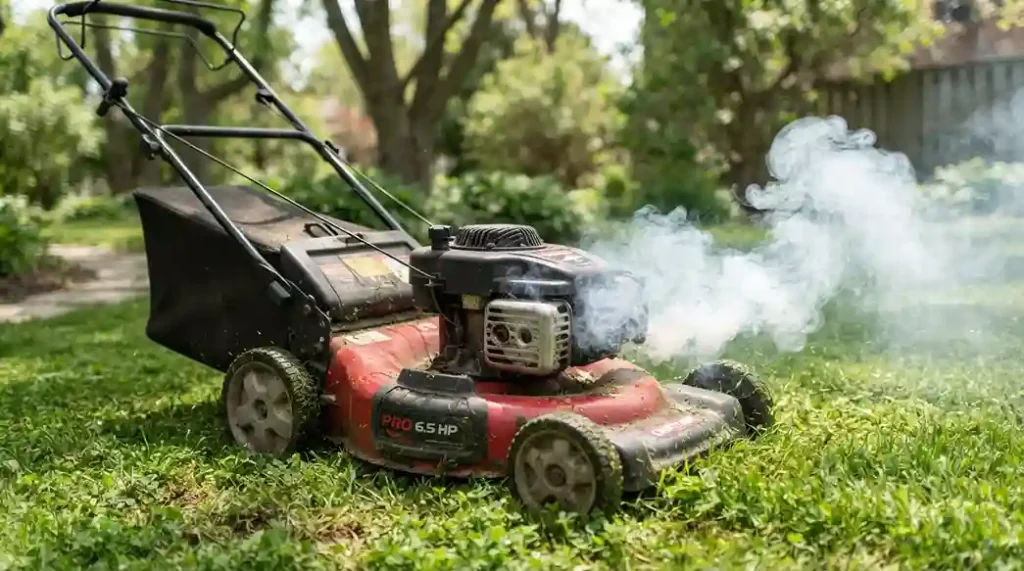
If your mower suddenly puffs blue-white smoke after a fill-up, mixed-up fluids are the first suspect.
What If You Don’t Have the Manual Anymore?
The engine will still tell you what it needs, even secondhand. Check the housing for labels first. Most 2-strokes carry a mix-ratio sticker near the fuel cap, while 4-strokes list their oil grade embossed near the fill or on a deck sticker.
If those labels have worn away, find the engine model number stamped on the recoil housing (the part you pull to start). Briggs & Stratton, for one, publishes oil specifications by engine model right on its official site. Honda and Kawasaki do the same.
Matching Oil Grade to Your Climate (The Temperature Chart)
Once you know you have a 4-stroke, temperature picks the grade for you.
SAE 30: The Warm-Weather Classic
SAE 30 is the factory fill on countless engines for good reason. It’s a single-grade oil that stays thick and stable in summer heat. If you live somewhere that rarely drops below 40°F, straight 30-weight is what your manual lists first.
10W-30: The Middle-Ground Choice
That “W” stands for winter, and it describes cold-start flow. A 10W-30 pours like thin 10-weight oil at startup, then protects like a 30-weight once the engine warms up. If your spring mornings sit below 40°F, SAE 30 gets too thick to circulate quickly, and that’s where multi-grade earns its keep.
5W-30 and Full Synthetic: The All-Season Answer
5W-30, especially full synthetic, is the easiest oil to own. It flows at roughly -20°F and holds protection through summer heat. If you want one bottle that handles a frosty March tune-up and a July heat wave, this is the pick.
Synthetic also resists thermal breakdown longer, which helps when a change slides past its due date.
Viscosity Grades Side by Side
All these ratings come from the SAE J300 viscosity standard, the same system used for car oil. Here’s how the common grades stack up.
| Grade | Cold-Start Floor | Warm Ceiling | Best For |
|---|---|---|---|
| SAE 30 | ~40°F | 100°F+ | Hot climates, steady summer use |
| 10W-30 | ~0°F | ~100°F | Most temperate regions, spring to fall |
| 5W-30 | ~-20°F | ~100°F | Cold winters, all-season use |
| Synthetic 5W-30 | ~-20°F | 100°F+ | One-bottle simplicity, longer intervals |
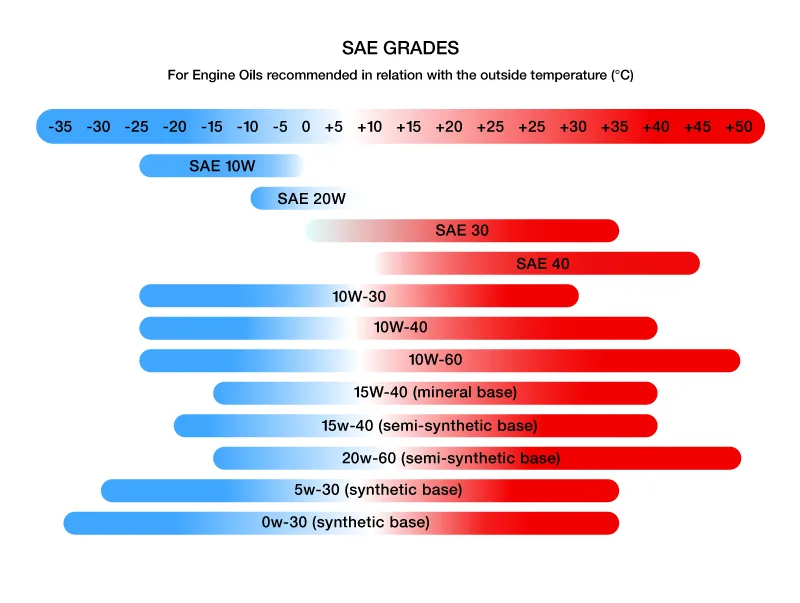
Here’s the if/then logic in one line. If your lowest expected temperature stays above 40°F, SAE 30 is fine. If it dips below that, choose 10W-30 or 5W-30.
If you’d rather never think about it again, synthetic 5W-30 covers every branch.
How to Check and Top Off Your Oil the Right Way
Between changes, a two-minute dipstick check catches most problems early.
Reading the Dipstick Correctly
Park on level ground first. A sloped driveway gives you a false reading. Check the oil cold, or let the engine sit a few minutes after shutdown so oil drains back into the sump.
Pull the dipstick, wipe it clean with a rag, and reinsert it the way your engine expects. Honda dipsticks rest in the tube, so you read the level without threading them. On many Briggs engines you need the dipstick screwed fully down before pulling it for a true reading.
You want oil sitting between the ADD and FULL lines.
Below the low mark, add a couple of ounces at a time and recheck after each. Overfilling is the bigger danger, because excess oil gets whipped into foam that can blow past seals.
Top Off vs. Full Change: Knowing the Difference
Top off only when the level reads low and the oil still looks amber to light brown. If it’s black, gritty, or older than a season, topping off just dilutes bad oil with good. That’s the moment for a proper drain-and-refill instead.
Capacity matters here, too. Most push mowers hold only 15 to 20 ounces total, so one extra splash can push you into overfill territory. When in doubt, add less than you think and recheck the level.
How to Change Lawn Mower Oil Step by Step
Push Mowers: The Tilt-and-Drain Method
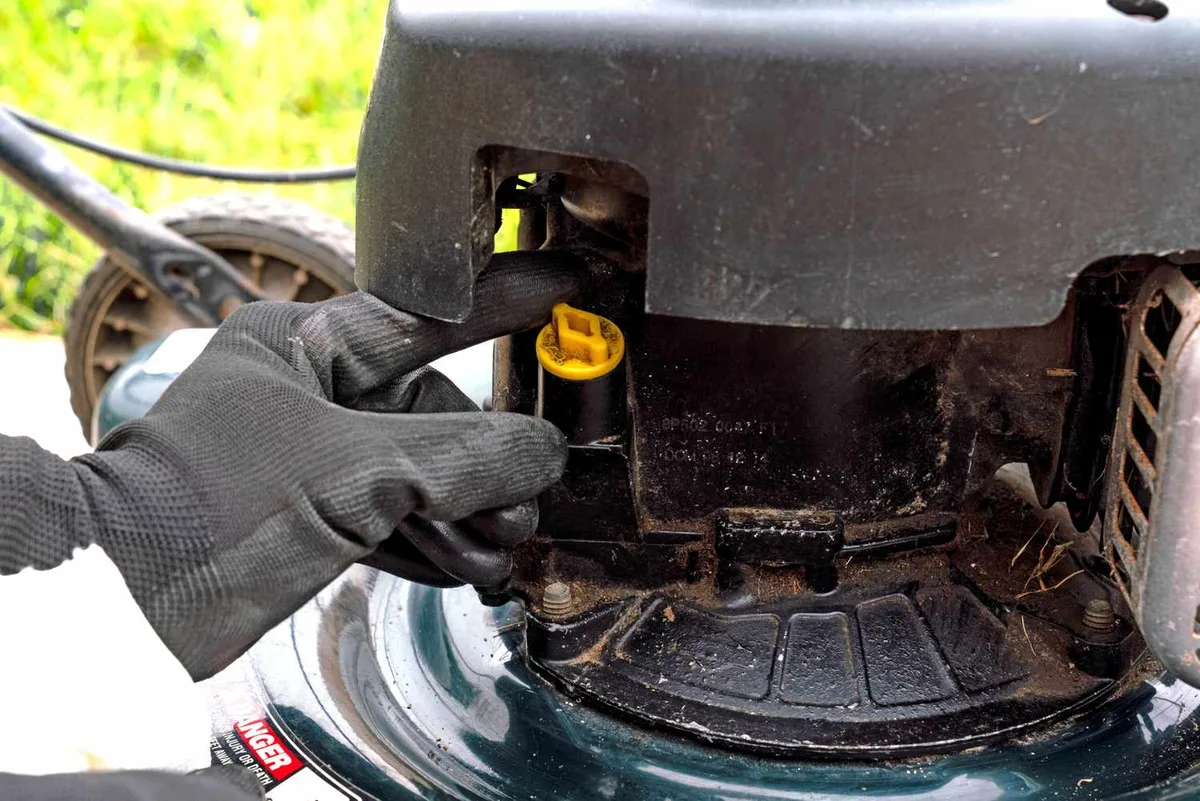
Push mowers have no drain plug, so you tip them. Do it in this order:
- Run the engine 2-3 minutes to warm the oil. Warm oil drains faster and carries more sludge with it.
- Pull the spark plug wire so the engine can’t kick over.
- Set a drain pan beside the mower, then tilt it with the spark plug side up. Tilting carburetor side down dumps fuel into the air filter.
- Drain the oil through the fill tube into the pan.
- Set the mower level again and refill slowly, checking the dipstick as you go.
- Reconnect the plug, run the engine for a minute, then confirm the level and look for leaks.
Refill gradually. Push mower sumps are tiny, and it’s easy to overshoot the mark.
Riding Mowers and Zero-Turns: Drain Plug Procedure
Riding engines make this easier with a drain plug under the crankcase, and many include a tube you can route through the deck. Warm the engine, open the plug, and let it drain into a wide pan. Larger riding and zero-turn engines often add an oil filter.
Replace it at the same time, and pre-fill it partway before spinning it on.
How Often to Change Oil (Break-In, Seasonal, Hour-Based)
Manufacturer guidance lines up across brands. Change the break-in oil after the first 5 operating hours on a new engine, then every 50 hours or once per season, whichever comes first. For a typical homeowner mowing weekly, that’s one change a year, done in spring.
Mowing in dusty conditions? Cut that interval roughly in half, because dust shortens oil life faster than the hour meter shows.
One last note before you close the hood. Used motor oil must be recycled, and the EPA’s rules are clear that drains and trash cans are off limits. Most auto parts stores take it for free.
Car Oil vs. Small Engine Oil: What’s Actually Safe to Use
Here’s the surprise most owners don’t expect: car oil works in most 4-stroke mowers. Both products follow the same SAE J300 viscosity standard and the same API service classifications. The catch hides in one line on the bottle’s back label.
When Automotive Oil Works Fine
If your manual calls for 10W-30 with an API service class of SF or higher, any car oil on today’s shelf qualifies. Current oils carry SN or SP ratings, and SP became the standard in 2020. That’s decades above the old SF floor, per the American Petroleum Institute’s engine oil licensing program.
Splash-lubricated push engines are especially forgiving here. They have no clutches or filters to protect, just a crankcase that wants clean detergent oil of the right weight.
When It Doesn’t: The Energy-Conserving Problem
Flip the bottle around and find the API “donut” symbol. If the bottom half reads Energy Conserving or Resource Conserving, think twice before pouring it into a riding mower. Those friction modifiers help cars hit fuel-economy targets, but they can make the wet clutch in hydrostatic tractors and zero-turns slip.
Push mowers don’t share that weak point. Riding mowers do. That’s the whole branch.
| Your Engine | Car Oil Verdict |
|---|---|
| Push mower, splash lubrication | Yes, if grade and API class match |
| Riding mower or zero-turn, wet clutch | Only if the label is not Energy Conserving |
| Any 2-stroke | Never. Oil mixes into the fuel only |
Skip non-detergent oil, too. It’s the stuff labeled ND for compressors, and it lets sludge settle instead of suspending it.
OEM Bottles vs. Generic Oil
Here’s the open secret: OEM bottles are usually blended by major oil companies and relabeled. You’re paying for certainty, not chemistry. A generic oil that matches your manual’s grade and API class does the same job.
Price gap is small anyway. OEM bottles run about $6 to 10 for 18 to 20 ounces, while generic equivalents run $4 to 7. Keep the receipt either way, because most warranty language only asks for proof you used a compliant grade.
The Mistakes That Kill Mower Engines
Most dead mower engines die from fluids in the wrong place, not old age. These four failures account for the worst outcomes, and each has a fix if you catch it early.
Overfilling and Underfilling
Overfilling sounds harmless. It isn’t. The spinning crankshaft whips extra oil into foam, foam can’t carry lubrication, and the mess blows past the rings into the combustion chamber.
You get blue exhaust, fouled plugs, and pushed-out seals.
Underfilling is worse and faster. Splash-lubricated engines fling oil at the rod bearing with a dipper, and that only works at the exact fill level. A few ounces low means metal touching metal, then a seized crankshaft.
Small sumps punish both directions.
Fix an overfill by draining a couple of ounces and rechecking. If you’ve been running smoky for weeks, what that exhaust smoke actually means sorts out whether oil is the culprit.
Pouring Oil in the Gas Tank (and Vice Versa)
Oil in a 4-stroke tank produces a wall of gray-white smoke within seconds. Drain the tank, fill fresh fuel, and fit a new plug. A gummed carburetor may need cleaning too.
The reverse happens on riders. If the oil level keeps rising and smells like gasoline, a leaking fuel pump or a tipped-over mower has diluted the oil. Thinned oil can’t protect bearings, so drain and refill before the next run.
And use the right fuel for your tank, because fluid mix-ups usually start at the filler.
Tipping the Mower the Wrong Way
Tilt the mower with the spark plug side up. Always. Carburetor-side-down tilts dump gas into the intake and push oil into the cylinder.
If you’ve already flooded it, remove the plug, pull the cord a few times outdoors, and replace a soaked intake filter before restarting.
Running Straight Gas in a 2-Stroke
A 2-stroke run on unmixed fuel seizes within minutes. The piston scores the cylinder wall, and that engine is usually finished. Pre-mix in a dedicated labeled can, every time, and never grab the straight-gas can by habit.
When a seizure does happen, most owners replace rather than rebuild, and retiring a dead mower has its own safe procedure.
Oil Capacity and Specs by Engine
Capacities run small here, so precision matters more than in a car. A push mower takes ounces, not quarts, and one heavy pour blows past the full line.
Common Push Mower Capacities (Honda GCV160, Briggs & Stratton)
| Engine | Oil Capacity | Typical Grade |
|---|---|---|
| Honda GCV160 / GCV190 | 0.40 to 0.47 L (13.5 to 16 oz) | SAE 10W-30 |
| Briggs & Stratton 140 to 190cc | 0.44 to 0.59 L (15 to 20 oz) | SAE 30 or 10W-30 |
| Kawasaki FJ180V (commercial walk-behind) | about 0.53 L (18 oz) | SAE 10W-30 |
Pour in stages. Add half the expected amount, recheck the dipstick, then add the rest slowly. Your model’s exact fill quantity is worth confirming before the bottle comes out.
Riding Mower and Zero-Turn Capacities
| Engine | Capacity (with filter) |
|---|---|
| Briggs & Stratton Intek single-cylinder | about 1.4 L (48 oz) |
| Kawasaki FR series (FR651V, FR691V) | about 2.0 L (67 oz) |
| Kohler 7000 series | about 1.9 L (64 oz) |
Engines with an oil filter need slightly more fresh oil to fill the canister, and pre-filling the filter shortens the dry-start window after a change. Brand-specific machines add their own quirks, so for a Husqvarna tractor, a full brand service checklist covers everything beyond oil alone.
2-Stroke Mix Ratios Explained (50:1 vs. 40:1)
Most modern 2-strokes run 50:1, which is 2.6 ounces of oil per gallon of gas (100 mL per 5 L). Older or commercial units often spec 40:1, or 3.2 ounces per gallon. A few vintage machines still ask for 32:1.
The golden rule is simple. Richer is survivable, leaner is lethal. Extra oil makes smoke but keeps lubrication flowing.
Mix in a dedicated can, shake it well, and use the blend within about 30 days.
Storage, Cold Weather, and Off-Season Oil Care
The best habit here is counterintuitive: change the oil in fall, before storage, not in spring. Ordering matters more than most owners realize.
Pre-Winter Prep
Used oil carries combustion acids and moisture. Let that sit on bearing surfaces for four months in a cold shed and corrosion starts without the engine even running. A 15-minute fall drain and refill costs far less than one rusted bearing.
Order of operations:
- Run the engine 2 to 3 minutes to warm the oil.
- Drain it fully, then refill with fresh oil to the full line.
- Stabilize the fuel, or run the carburetor dry.
- Store the mower level, never tilted.
One myth to kill: never store an engine “drained and dry.” That old advice leaves bare metal exposed all winter. Fresh oil in the crankcase is the protection, not the problem. Our complete off-season routine walks the full checklist, fuel included.
Deal with the drained oil properly, too. The EPA’s used-oil recycling rules ban dumping it in drains or trash, and most auto parts stores accept it free.
Spring Startup in Cold Climates
Check the dipstick before the season’s first pull. Then expect one quirk: a brief puff of blue smoke on the first start is normal. That’s residual oil burning off the cylinder wall from storage, and it should clear within a minute or two.
If it doesn’t clear, treat it as a real problem. Persistent smoke points to an overfill, a worn ring, or mixed-up fluids.
This is also the branch where your grade choice pays off. A shed sitting near 30°F in March makes straight SAE 30 flow like honey at startup. Synthetic 5W-30 keeps protecting through those first cold seconds.
If you skipped the fall change, open the season with a fresh drain and refill, then set a reminder for 50 hours.
FAQs About Lawn Mower Oil
Can I use 10W-30 car oil in my lawn mower?
Yes, in most 4-stroke push mowers, as long as it matches the grade and API service class in your manual. Current car oils rated SN or SP far exceed the old SF minimum. For riding mowers with wet clutches, skip bottles marked Energy Conserving, since friction modifiers can cause clutch slippage.
What happens if I overfill the oil?
The crankshaft whips excess oil into foam, which lubricates poorly and blows past the rings into the combustion chamber. Expect blue smoke, fouled plugs, and possible seal leaks. Drain a couple of ounces, recheck the dipstick, and run the engine until the exhaust clears.
Is synthetic oil worth it in a lawn mower?
Usually, yes. Full synthetic 5W-30 flows at around -20°F, resists heat breakdown, and stretches your margin if a change runs late. It costs a few dollars more per bottle.
For cold climates or anyone who wants one oil all year, it’s the easy call.
What oil does a Honda GCV160 take?
Honda specifies SAE 10W-30 with an API service class of SF or higher, which every current oil meets. The crankcase holds about 0.40 L (13.5 oz). In consistently warm climates above 40°F, straight SAE 30 also appears on Honda’s approved chart.
How do I tell if my mower is 2-stroke or 4-stroke?
Count the caps. Two separate caps, one for fuel and one for oil, means a 4-stroke. One cap with a 50:1 mix label means a 2-stroke, and its oil goes into the fuel, never into a crankcase.
When labels are worn off, look up the engine’s model number.
Can I mix SAE 30 and 10W-30?
Yes, for a top-off it’s fine, since both are detergent oils meeting the same API classes. The blend behaves roughly between the two grades. In cold weather, favor the 10W-30 side, then plan a full change at your next service.
Final Decision Guide: Pick Your Oil in Three Questions
Everything above collapses into three questions. Answer them in order, and the right oil picks itself.
Question 1: How many fill caps does your engine have?
If there are two caps, one for gas and one for oil, you have a 4-stroke and everything below applies. If there’s one cap with a 50:1 or 40:1 label, you have a 2-stroke, so your only job is mixing oil into fresh fuel at the labeled ratio. Stop there.
Question 2: How cold does it get where you mow?
- If your lowest temperature stays above 40°F, SAE 30 is the traditional and cheapest choice.
- If it dips below 40°F but rarely under 0°F, 10W-30 covers spring through fall.
- If winters hit -20°F or you want one bottle year-round, synthetic 5W-30 wins every branch.
Question 3: What kind of machine is it?
If it’s a push mower, any car oil matching your grade and API class works, and there’s no reason to pay extra for the OEM bottle. If it’s a riding mower or zero-turn with a hydrostatic drive, flip the bottle and skip anything marked Energy Conserving so the wet clutch never slips. If it’s brand new, remember the break-in change at 5 hours, then the 50-hour or seasonal cycle.
That’s the whole decision. Our research across manufacturer manuals keeps pointing to the same bottom line: match the engine type, respect your climate, and change the oil on schedule. Do those three things and a typical mower engine, which costs about $8 a season to protect, will easily outlast the deck it sits in.