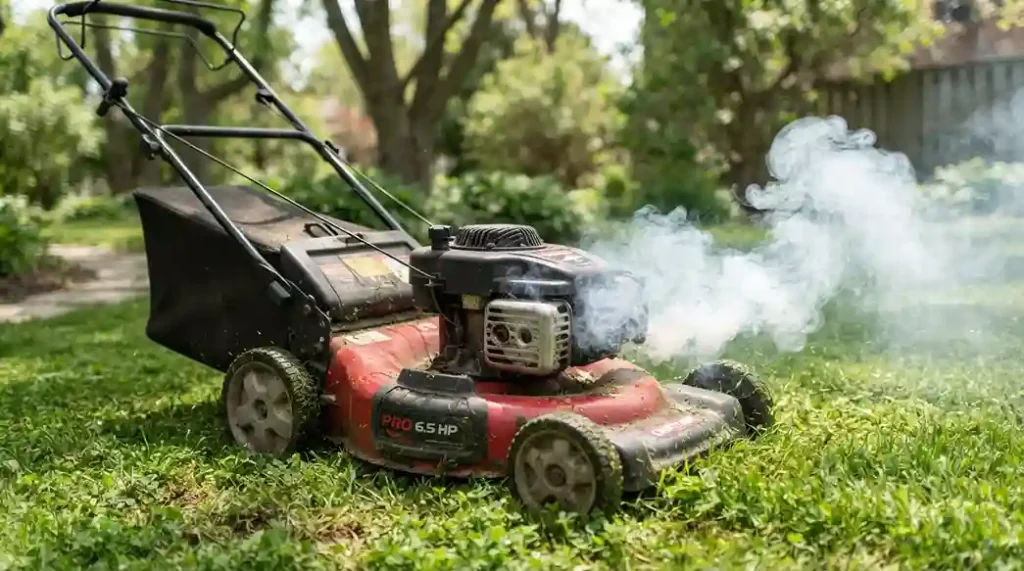
How Many Volts Is a Lawn Mower Battery? The Truth
If you’re asking how many volts is a lawn mower battery, you’re probably staring at a dead rider or a cryptic battery label right now. The short answer: most modern riding mowers use a 12-volt battery. But that number only covers one of four mower types.
Vintage garden tractors run 6 volts, cordless electric mowers carry 40V to 80V lithium packs, and most push mowers have no battery at all.
There’s another wrinkle worth knowing upfront. A fully charged 12-volt lead-acid battery actually rests at about 12.6 volts, and the engine’s charging system pushes 13.5 to 14.5 volts while running, per standard lead-acid chemistry. Which number matters for you depends entirely on which machine is in your garage.
So let’s sort the four types first, then get you a reading you can actually trust.
How Many Volts Is a Lawn Mower Battery
A lawn mower battery is 12 volts on most riding mowers and zero-turns. Vintage garden tractors built before the mid-1980s often run 6 volts. Cordless electric mowers use 40V to 80V lithium packs instead.
Push mowers with pull starts carry no battery. As of 2026, 12 volts remains the standard for gas riding mowers.
The Four Mower Types and What Each One Actually Uses
Before you test, buy, or charge anything, identify which of the four machines you own. Each one plays by completely different voltage rules.
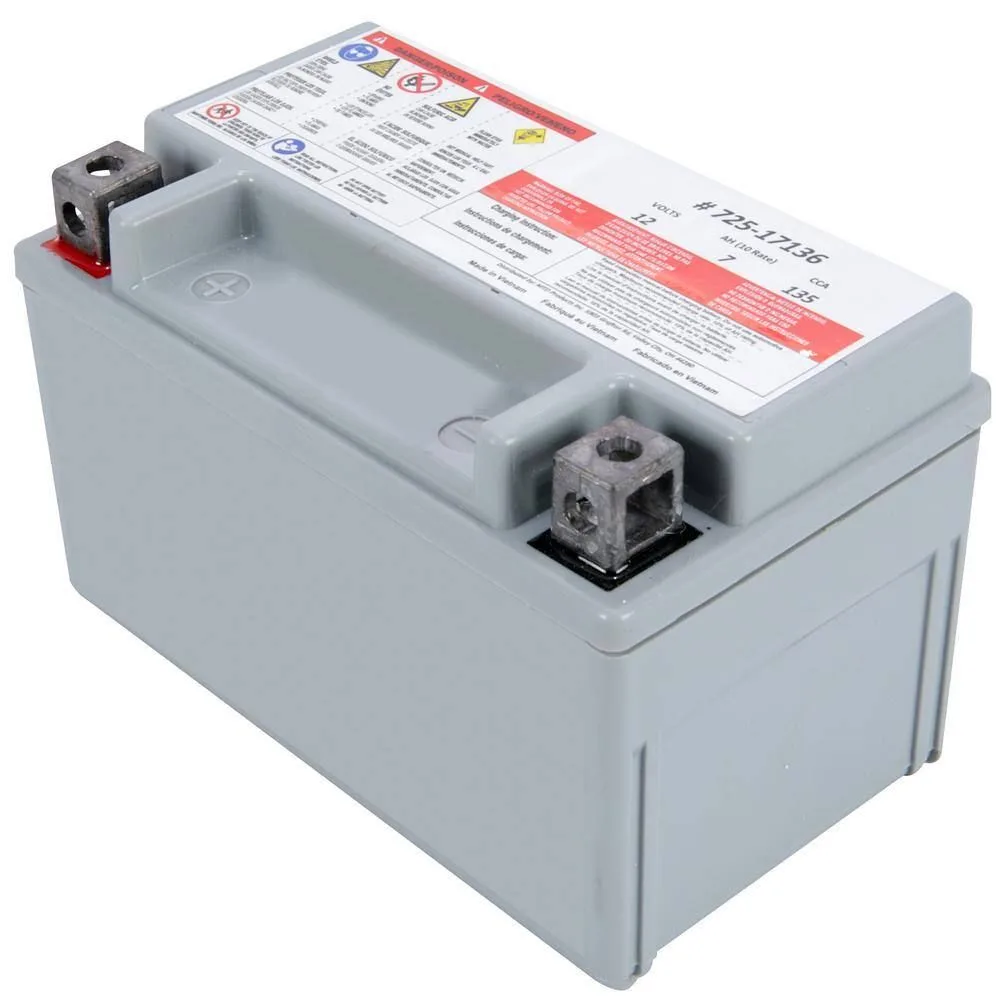
Image source: Web (Bing) / pinterest.com
Riding Mowers and Zero-Turns: The 12-Volt Standard
Riding mowers, lawn tractors, and zero-turns almost all carry a 12-volt flooded lead-acid battery in BCI Group U1 size. Manufacturer specifications from John Deere, Toro, Husqvarna, and Cub Cadet consistently call for 12 volts and roughly 200 to 355 cold cranking amps. That battery has one job: feed the starter motor and solenoid enough current to spin the engine over.
Once it fires, the engine’s charging system takes over and keeps everything topped up.
Zero-turns work the same way electrically. The voltage matches a lawn tractor, and the difference is deck design and drive layout, not the battery. If you’re new to that style of machine, it helps to understand what actually sets a zero-turn apart before you start diagnosing anything on it.
Vintage Garden Tractors: Why Some Still Run 6 Volts
Walk through a barn full of pre-1980s equipment and you’ll find 6-volt systems everywhere. Older Wheel Horse, Bolens, and early Cub Cadet tractors shipped with 6-volt batteries, and some of the oldest units were positive-ground. A healthy 6-volt battery rests at about 6.3 to 6.4 volts fully charged, exactly half of its 12-voltcounterpart.
Charging rules differ here too, and they matter more than any spec sheet. A 6-volt battery needs a 6-volt charger, full stop. Hooking a modern 12-volt charger to one boils the electrolyte and can warp the plates within minutes.
Parts availability adds a second headache. Big-box retailers stock 12-volt U1 batteries on every shelf, but 6-volt replacements usually come from specialty suppliers or salvage yards. That’s why many vintage owners convert the entire system to 12 volts.
It’s a real project, though, since the coil, bulbs, and voltage regulator all have to change with it.
Cordless Electric Mowers: 40V, 56V, 60V, and 80V Power Packs Explained
If you own a battery-powered mower, forget everything above. These machines don’t use a starting battery at all. They carry a lithium-ion power pack that runs the motor directly, and the voltage on the label describes the pack’s nominal rating.
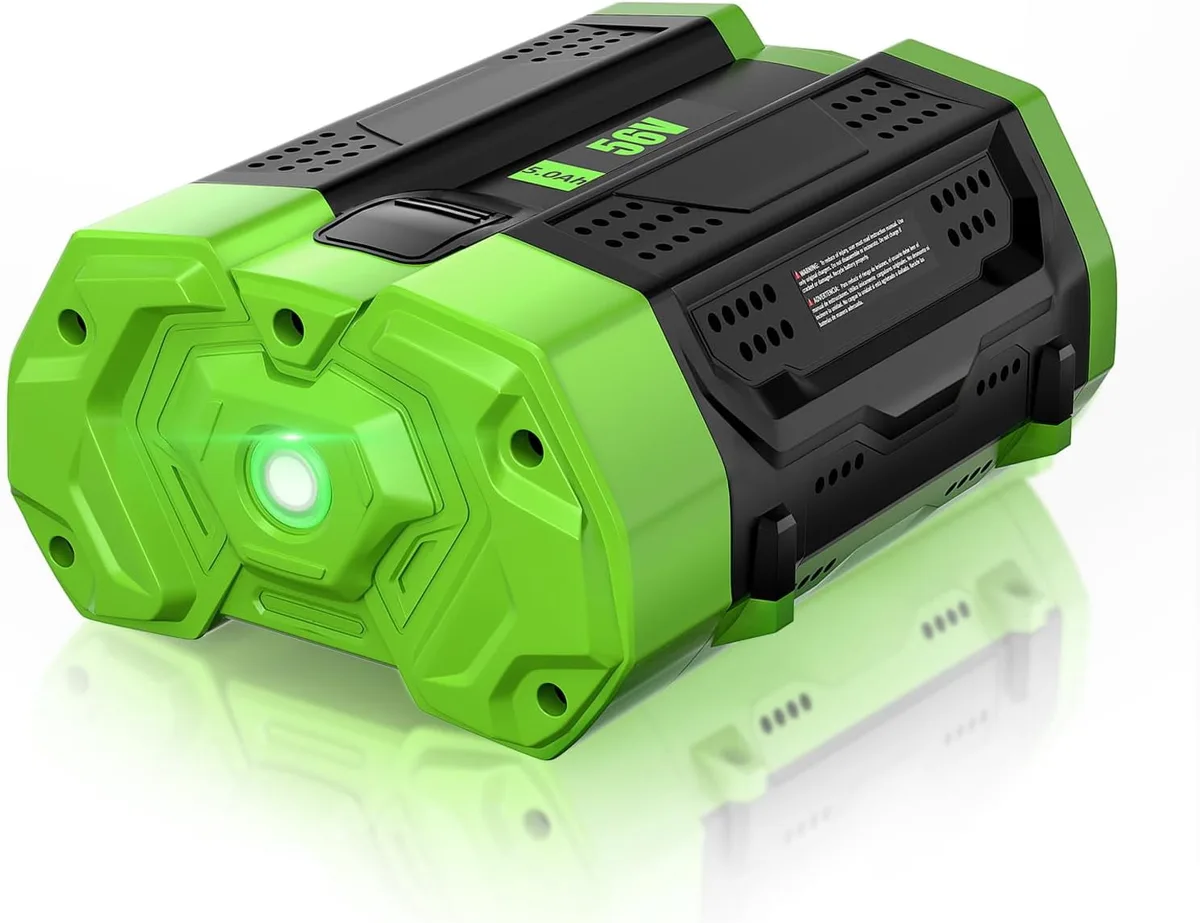
Image source: Bing (Web (fair-use with source credit))
Here’s where the label math comes from. A lithium cell holds about 3.6 to 3.7 volts nominal, and manufacturers stack cells in series to build the pack. Ten or eleven cells gets you a “40V” pack.
Fourteen cells lands near “56V,” which is why EGO built its whole platform around that number.
The nominal label also sits below what you’ll actually measure. A 40V Greenworks pack reads about 42 to 46 volts right off the charger. Ryobi’s 40V packs behave the same way.
That’s normal, not a defect. If you test a fresh pack and see numbers above the label, the battery is healthy.
Two numbers matter when buying a replacement: platform voltage and amp-hours. The voltage must match your mower’s platform, because an EGO 56V pack won’t run a Ryobi 40V tool no matter what an adapter claims. Amp-hours decide runtime.
A 5.0Ah pack runs roughly twice as long as a 2.5Ah on the same machine.
Push Mowers With Pull Starts: No Battery at All
If your mower starts with a yank on a rope, you can stop reading voltage charts right now. Recoil-start push mowers carry no battery, no solenoid, and no starting circuit. The engine’s magneto generates the spark on its own, which is why these machines fire up even after sitting all winter.
A small group of push mowers does carry a 12-volt battery, usually older electric-start models or premium units with headlights and key switches. Check for a key or starter button. No key and no button means no battery to test or buy.
And if you’d rather skip engine electrics entirely, a gas-free reel mower removes the whole equation. No battery, no pull cord, no charging system, nothing to maintain but blades.
Nominal vs. Measured Voltage: Why a “12-Volt” Battery Reads 12.6 (or More)
Nominal voltage is the nameplate number describing the battery’s chemistry. Measured voltage is what your multimeter actually sees, and it changes with state of charge. That gap trips up more mower owners than any other detail.
A 12-volt lead-acid battery holds six cells at roughly 2.1 volts each, which adds up to 12.6 volts fully charged. That’s why a healthy battery never reads exactly 12.0 at rest. Use this chart instead:
| State of Charge | 12V Battery Reading | 6V Battery Reading |
|---|---|---|
| 100% | 12.6 to 12.8V | 6.3 to 6.4V |
| 75% | about 12.4V | about 6.2V |
| 50% | about 12.2V | about 6.1V |
| 25% | about 12.0V | about 6.0V |
| Discharged | 11.9V or less | 5.9V or less |
Timing matters when you test. A battery fresh off the charger or straight from a running engine carries a surface charge, an inflated reading of 13 volts or more that fades within a few hours. Let the battery rest before you trust the number.
There’s one more reading worth knowing. With the engine running, the mower’s charging system pushes 13.5 to 14.5 volts into the battery. Charging-system specs published by Briggs & Stratton confirm that range across their engine lines.
If you see resting battery voltage while the engine runs, the stator or regulator has failed and the battery dies a little more with every mow.
How to Test Your Mower Battery Voltage With a Multimeter
A basic $15 multimeter answers in five minutes whether your battery is charged, dead, or fine with a bad charging system hiding behind it. Here’s the full workflow.
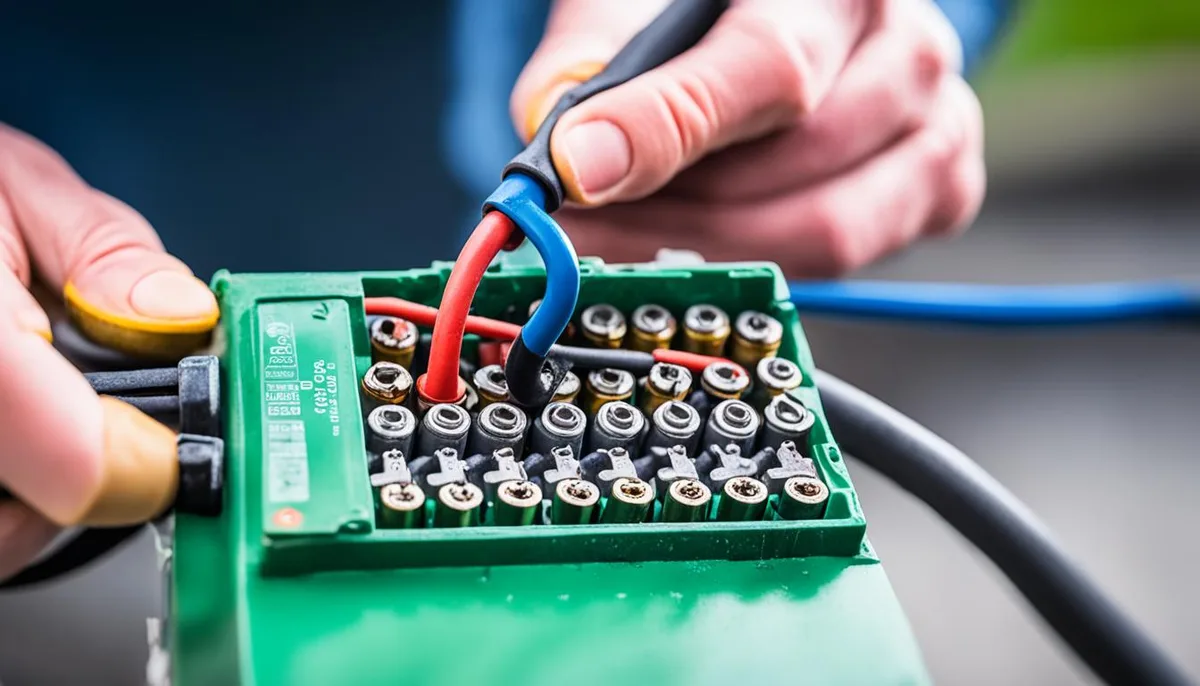
Image source: Web (Bing) / machineanswered.com
Reading the Battery Label Before You Test
Pop the seat or hood panel and find the battery. The label tells you three things: voltage (12V on nearly all modern riders), cold cranking amps (usually 200 to 355), and group size, which is U1 for the overwhelming majority. Snap a photo of the label and the terminal positions before you disconnect anything.
That photo saves you a return trip to the parts store.
Step-by-Step: DC Voltage Test With the Engine Off
Work through this in order:
- Shut the engine down completely and pull the key. If the shutdown sequence isn’t second nature yet, it’s worth reviewing safe engine shutoff steps before touching terminals.
- Set the multimeter to DC volts on the 20V range.
- Touch the red probe to the positive terminal, black probe to negative. The positive cable is the one feeding the solenoid.
- Hold steady for three seconds, then read the display.
Clean the terminals first if you see white or green crust. Corrosion alone can fake a dead-battery reading.
Interpreting Your Reading: The State-of-Charge Chart
Match your display against the chart above. At 12.6 volts or higher, the battery holds a full charge. Between 12.0 and 12.4, recharge it fully before judging its health.
Below 11.9, it’s deeply discharged and needs a slow 2-amp charge, which takes 12 to 24 hours. If it won’t hold above 12.4 after a full overnight charge, the plates are sulfated and the battery is done.
The Crank Test and Charging System Check (13.5-14.5V)
Voltage at rest only tells half the story. Have a helper crank the engine while you watch the meter. A healthy battery shouldn’t sag below about 9.5 volts under load.
A reading that plunges to 7 or 8 means the battery has lost its cranking muscle, even if the resting number looked fine.
Then check the charging side. Start the engine, run it at full throttle, and retest. Expect 13.5 to 14.5 volts.
If the display shows roughly the same voltage as the resting reading, your battery isn’t the problem, the charging system is. That points to a stator or regulator/rectifier failure, and it helps to understand how mower charging and alternator systems work before you order parts.
Which Battery Does Your Mower Need? The Decision Guide
Match your machine to the right branch:
- Riding mower or zero-turn, 1980s or newer: 12-volt Group U1 battery. Match or exceed the CCA on the old label.
- Vintage tractor on a 6-volt system: Buy a matching 6-volt battery from a specialty supplier, or commit to a full 12-volt conversion covering the coil, regulator, and bulbs.
- Cordless electric mower: Buy your platform’s pack. Match the voltage exactly, then pick amp-hours for your lawn size.
- Pull-start push mower: Nothing to buy. There’s no battery in the machine.
Matching Voltage, BCI Group Size (U1 vs. U1R), and Terminal Orientation
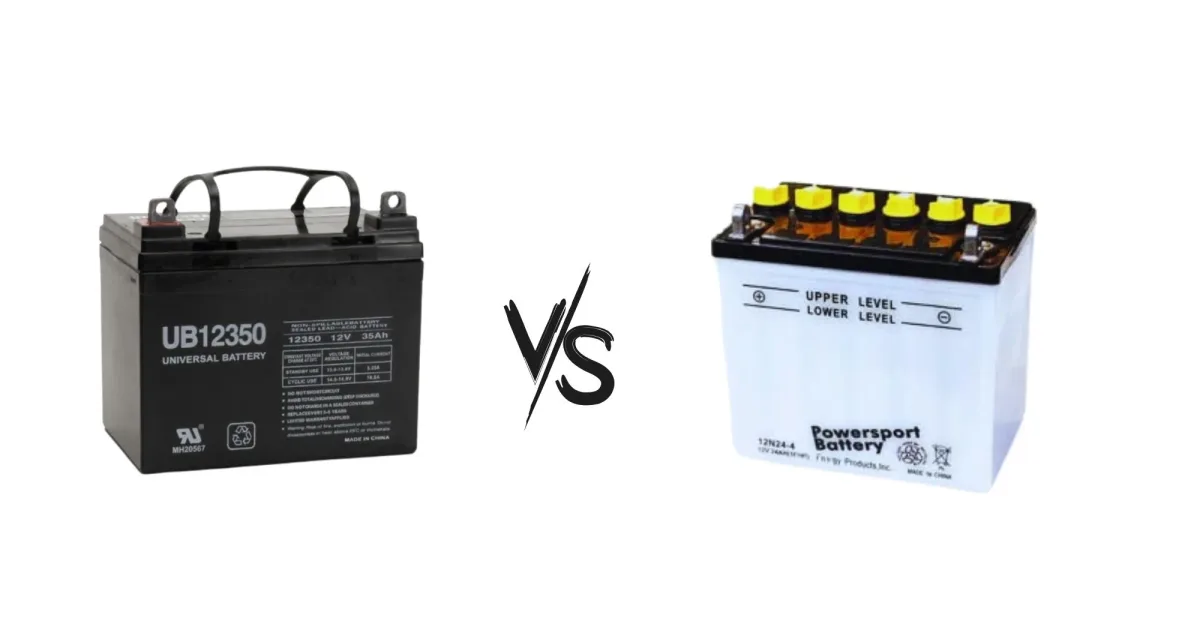
Image source: Web (Bing) / londondaily.news
Group U1 is a Battery Council International standard that fixes the footprint at roughly 7.75 by 5.1 inches. The twist is terminal direction. Viewed with the terminals facing you, a U1 puts the positive post on the left, and a U1R puts it on the right.
Get this wrong and the cables won’t reach, no matter how cleanly the battery fits the tray. Compare your old battery’s photo and you can’t miss.
Lead-Acid vs. AGM vs. Lithium: What Each Costs and Lasts
| Type | Typical Price | Lifespan | Trade-offs |
|---|---|---|---|
| Flooded lead-acid | $30 to 60 | 3 to 5 years | Cheapest, can spill, needs fluid checks |
| AGM | $45 to 75 | 3 to 5+ years | Spill-proof, sealed, no maintenance |
| Lithium LiFePO4 | $80 to 150 | 5+ years | Lightweight, verify charger compatibility |
For most riders, AGM hits the sweet spot. It costs a little more up front and never asks for a fluid check. Flooded batteries still make sense if you want the lowest price and don’t mind the upkeep.
Electric Mower Replacement Packs: What the Voltage Label Really Means
Replacement packs run roughly $100 to 400 depending on platform and amp-hours. Stick with your mower’s own brand pack whenever possible. Third-party packs exist, but the voltage, connector, and battery-management communication all have to line up, and a mismatch can leave you with a pack that fits the slot yet refuses to power on.
One last habit protects whatever you buy. Batteries fail fastest when they’re ignored between seasons, and staying on top of seasonal maintenance, including a full charge before storage, is what stretches a 3-year battery into a 5-year one.
Common Mistakes That Kill Batteries (and Sometimes Mowers)
Most mower batteries don’t die of old age. They die from one of three preventable mistakes, and two of them can damage more than the battery.
Charging a 6V Battery With a 12V Charger
A 12V charger forces twice the voltage a 6V battery can accept. The electrolyte heats up and gasses hard, the plates warp, and in a bad case the battery case itself cracks. That damage starts within the first hour.
If your charger’s dial only shows 12V settings, it never goes anywhere near a vintage battery. Buy a selectable 6V/12V smart charger instead. They cost roughly the same as single-voltage units, and they won’t surprise you.
Jump-Starting From a Running Car
If you jump a mower from a car, keep the donor engine off. A running alternator can spike past 15 volts, and the mower’s small regulator/rectifier isn’t built for that input. One spike can fry the regulator and take the ignition module down with it.
Use the same order you’d follow on a car. Positive to positive first, negative to a bare engine or frame ground last, then pull them off in reverse. And a 6-volt tractor never sees a 12V jumper, not even for a second.
Surface Charge, Parasitic Drain, and Other False Readings
Three readings lie to you:
- Surface charge. A battery fresh off the charger reads 13 volts or more and holds that lie for a few hours. Let it rest overnight before you trust the number.
- Parasitic drain. If a full battery goes flat again in a week, something is pulling current with the key off. Sticky safety switches and shorted diodes in the charging circuit are the usual suspects. A multimeter in amps mode, wired in series with the negative cable, catches the drain. If you’d rather skip the extra steps, disconnect the negative terminal between mows.
- Crusty terminals. White or green corrosion adds resistance and mimics a dying battery. Scrub it off with baking-soda paste and a wire brush, retighten the clamps, then retest before you spend a dime on a replacement.
Run those checks in order and misdiagnosis gets rare.
Safety Warnings: Hydrogen Gas, Acid, and Reverse Polarity
A mower battery is small, but it carries the same two hazards as any lead-acid battery: explosive gas and sulfuric acid. Respect both.
Hydrogen gas. A charging battery vents hydrogen while the electrolyte breaks down, and hydrogen ignites from a single spark. OSHA spells out battery-charging precautions for industrial shops, and the core rules are the same in your garage. Charge in a ventilated space with every ignition source moved away.
No smoking, no grinding, no spark tests near the battery.
Sulfuric acid. The liquid inside is diluted sulfuric acid, and it burns skin, eyes, and clothing.
- Wear safety glasses and acid-resistant gloves when handling a flooded battery or opening its caps.
- Neutralize spills with baking soda before wiping them up.
- Skin contact gets flushed with plain water for at least 15 minutes.
Reverse polarity. Clamp the charger backward and the spark arrives before you notice anything wrong. Reversed charging wrecks the battery, often the charger too, and it can ignite a gassed-up battery outright. Connect the clamps to the correct posts first, then plug the charger into the wall.
Unplug it before you remove a single clamp.
Two habits worth locking in. Take rings and watches off before working near the posts, because a ring across both terminals turns white-hot. And pull the negative cable first, reinstall it last, so a dropped wrench on the positive side can’t short against the frame.
Winter Storage and Long-Term Battery Care
Lead-acid batteries hate two things: sitting discharged and sitting cold. Together they cause sulfation, where lead sulfate crystals harden on the plates and permanently shrink capacity. A battery stored below 12.4 volts for a whole winter often comes out beyond saving.
Get it ready first:
- Charge fully, verified at 12.6 volts or more at rest.
- Top off flooded cells with distilled water so the plates stay covered.
- Wipe the case and terminals clean, since grime slowly bleeds charge.
Then pick a storage path:
| Storage Method | Best For | What It Requires |
|---|---|---|
| Remove and shelf-store | Unheated sheds, vintage tractors | Recharge every 6 to 8 weeks |
| Maintainer left plugged in | Modern riders parked in place | An automatic maintainer floating near 13.2V |
The maintainer is the low-effort winner. It watches the battery and replaces the slow self-discharge that happens all winter. Never leave a manual charger running unattended on a small battery, because it can boil the electrolyte dry.
Cold matters more than most people expect. A fully charged battery won’t freeze until far below zero Fahrenheit. A discharged one can freeze around 20°F, and a frozen battery cracks its case and ruins the plates.
That’s the strongest argument for a full charge before the first hard freeze.
The routine pays for itself in seasons. Cared-for lead-acid batteries regularly reach 4 to 5 years, while neglected ones often quit in 2. While the battery is off the mower, it’s the natural window for getting the whole engine ready for storage full off-season engine prep.
Before spring, run the rest of the annual service routine too.
FAQs: Lawn Mower Battery Voltage Questions Answered
Quick answers to the voltage questions mower owners ask most.
Is a lawn mower battery 6 or 12 volts?
Nearly every riding mower sold since the mid-1980s uses a 12-volt battery. Only vintage garden tractors from the 1950s through the 1970s commonly run 6 volts. Check the battery label or owner’s manual if you’re unsure, since the voltage is printed right on the case.
Cordless electric mowers sit outside both numbers, using 40V to 80V lithium packs.
Can I use a car battery in my lawn mower?
No, and voltage isn’t the problem. A car battery is 12 volts, but it’s physically too large for a U1 tray, uses different terminals, and weighs three times as much. Mower charging systems are also sized for small batteries and can’t keep a car battery properly topped off.
Stick with Group U1.
Can I charge a lawn mower battery with a car charger?
Yes, if the charger has a 2-amp or low-amp mode. Never use the 10-amp or engine-start setting on a U1 battery, because that much current overheats the small plates fast. Smart chargers with selectable 6V/12V modes are the safest option, since they shut off automatically at full charge.
How long does a lawn mower battery last?
Most lead-acid mower batteries last 3 to 5 years with proper care. Skip the maintenance and expect closer to 2. Lithium replacements often stretch past 5 years.
Slow cranking and a resting voltage that won’t climb above 12.4 after a full overnight charge are the classic end-of-life signs.
How do I get rid of a dead mower battery?
Take it to an auto parts store, battery retailer, or household hazardous waste site, never the trash. The EPA regulates used lead-acid batteries as universal waste because they’re among the most recycled products in the country. Many retailers hand back a core credit when you trade the old one in.
If the whole mower is done too, retiring the worn-out machine responsibly is worth planning ahead for.