What Is Self Propelled Lawn Mower? My Practical Guide
Pushing a mower across a half acre in July is a workout nobody signed up for. Somewhere around lap three, most people start searching “what is self propelled lawn mower” and wondering if the upgrade is worth it. Here’s the short version: a self-propelled mower is a walk-behind machine with a drive system that turns its own wheels.
It pushes itself while you steer, set the pace, and handle the turns.
That drive hardware isn’t free, though. Manufacturer specs show it adds roughly 15 to 30 pounds and a few hundred dollars over a comparable push mower. Whether that trade pays off depends on your lawn size, your slope, and your body.
Let’s start with where the fatigue actually comes from.
Why Push Mowers Wear You Out (And When That Actually Matters)
A push mower gets nothing from its engine except blade spin. Every inch of forward travel comes from you, and you’re also squeezing the operator bail the whole time just to keep the engine running. On a flat, small lot, that’s no big deal.
Most owners clear a yard under 5,000 square feet in 15 to 20 minutes and never think about it twice.
The effort compounds when conditions stack. Slope, thick spring growth, and a full grass bag each add load. Aggregate buyer reviews of push mowers repeat the same complaints on bigger lots.
Forearm burn, a pace you can’t hold, and a 20-minute job that runs past an hour.
A tired operator also mows sloppy. Missed strips and scalped spots cluster in the last third of the job, right when your legs are done. That’s worth remembering, because cut quality is part of the price you pay for pushing.
So where’s the line? Our decision breaks down like this:
- If your lawn is flat, under 5,000 square feet, and you mow weekly, a push mower is the better buy. It costs less, weighs less, and has fewer parts to fail.
- If one tough condition joins the picture, such as slopes, dense grass, or heavy bagging, expect genuine fatigue by mid-season.
- If two or more stack up, or mowing leaves you drained enough to skip weekends, that’s the moment a drive system stops being a luxury.
There’s a human side too. Buyers with joint, back, or stamina limits often rule push mowers out entirely, whatever the lot size. And on genuinely tiny lawns, some owners skip the engine altogether and pick a hand-push reel mower, which wins on weight, noise, and simplicity even though your legs supply the power.
What Is a Self-Propelled Lawn Mower? The Straight Answer
A self propelled lawn mower is a walk-behind mower with powered drive wheels. A separate transmission pushes the machine forward while the engine spins the blade. You steer and set the walking pace.
No pushing force is required, only light guidance. Most models handle lawns from 5,000 to 20,000 square feet.
That’s the core of it, but the definition trips people up in two ways. First, a self-propelled mower is not a robot. It doesn’t navigate, turn itself, or dock anywhere.
You walk every pass with it, hands on the handle.
Second, it’s not a riding mower. Self-propelled sits in the middle of the category: all the control and precision of a walk-behind, none of the pushing. Once your lot passes roughly half an acre, walking stops making sense for most people, and the zero-turn route takes over from there.
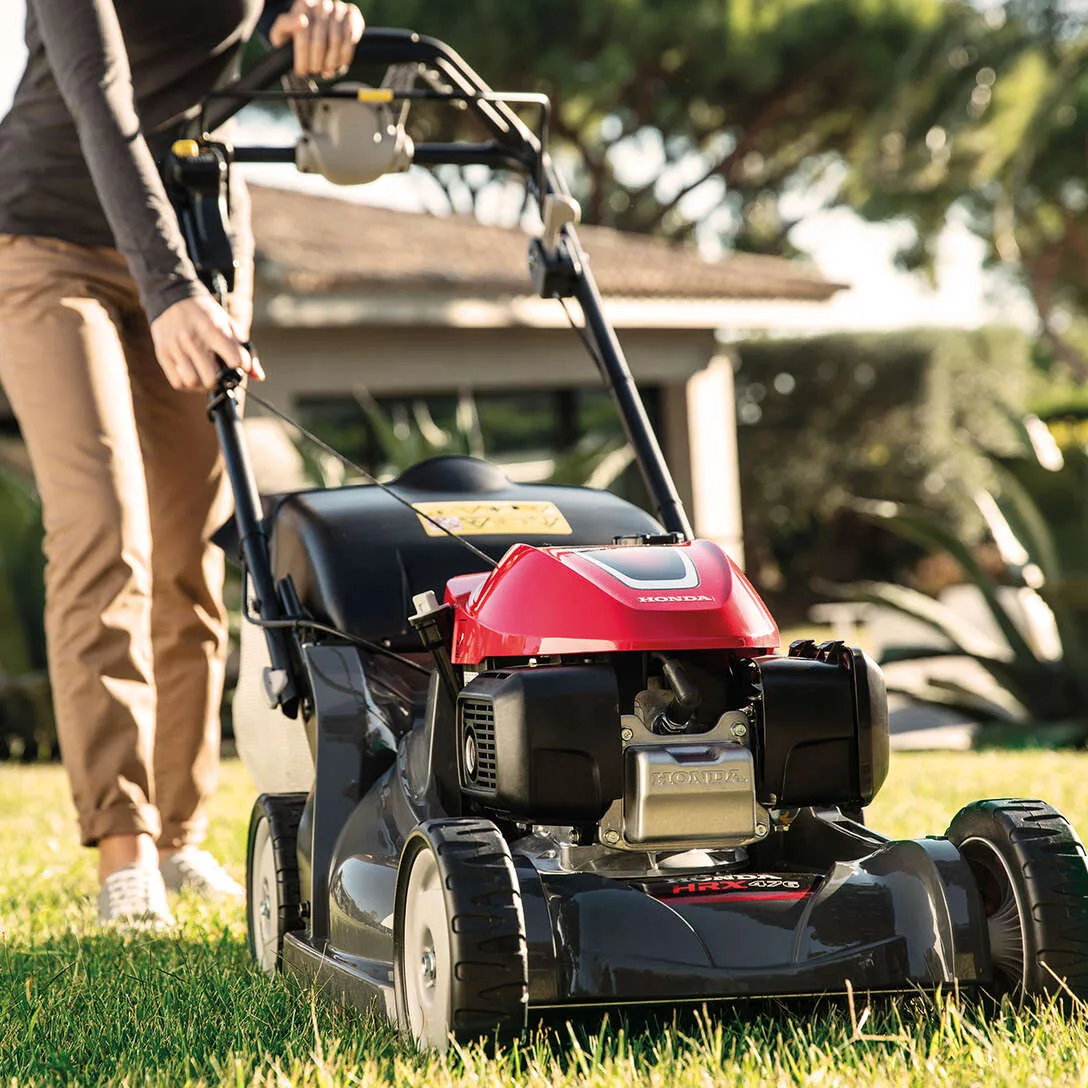
What you’re actually paying for is the drive assembly: a transmission, a drive belt, and the controls that engage them. Anchor models like the Honda HRX, the Toro Recycler line, and Ego’s Power+ series all package that assembly differently. That’s why two mowers labeled “self-propelled” can feel nothing alike in your hands.
Expect the hardware to add heft. Gas self-propelled units typically run 70 to 100 pounds versus 55 to 70 for a push mower, per manufacturer specifications. You trade that weight for a machine that moves under its own power.
On anything beyond a small, flat yard, it’s a trade worth making.
How the Self-Propel Drive Actually Works: Belt, Transmission, and the Bail
Here’s the power flow on a gas model, and battery mowers follow the same logic with a motor in place of the engine. The crankshaft spins a pulley. A drive belt runs from that pulley down to a transmission or gearbox on the axle.
When the drive engages, that transmission turns the wheels. The blade spins off its own separate pulley the entire time, completely independent.
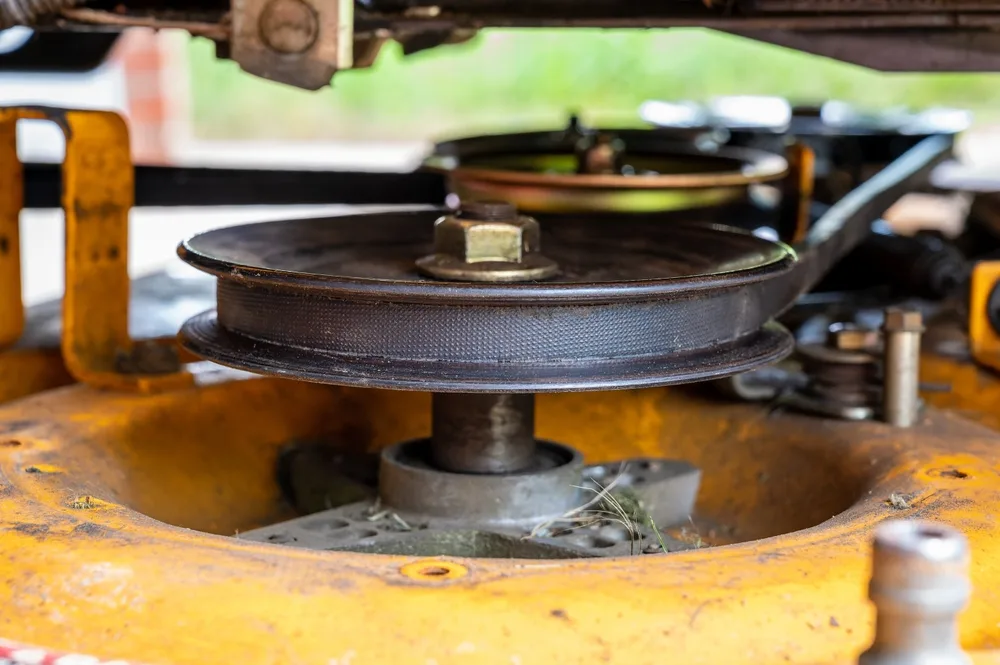
The image above traces that path from pulley to axle. Engagement happens through the bail, the lever you squeeze against the handle. Most gas machines carry two: a blade bail that lets the engine run, and a drive bail that clamps the belt and starts the wheels turning.
Release either one and that function stops instantly. That two-control layout isn’t a marketing choice. It’s how the ANSI/OPEI B71.1 walk-behind safety standard expects these machines to behave.
Two drive designs sit under the hood. Belt-and-gear drives use a stretchable belt running on variable pulleys, which is how most variable-speed systems work. Hydrostatic transmissions use fluid pressure instead and show up mainly on heavier premium units.
The belt design is cheaper and lighter. The hydrostatic design is smoother and lasts longer, but it costs far more to repair when it fails.
This anatomy also explains the category’s two most common failures. Drive cables stretch with use, and a stretched cable means a drive that slips or won’t engage. Belts wear, glaze, and eventually snap, typically every two to four seasons.
Both are cheap fixes. Knowing what’s under the deck cover is what makes the maintenance section later actually useful.
The Three Decisions That Pick Your Mower
Every self-propelled mower on the market is some combination of three choices: where the power goes, what generates it, and how you control the speed. Get these three right and the drive feels invisible. Get them wrong and you’ll fight the machine every Saturday.
Front-Wheel, Rear-Wheel, or All-Wheel Drive: Match It to Your Slope
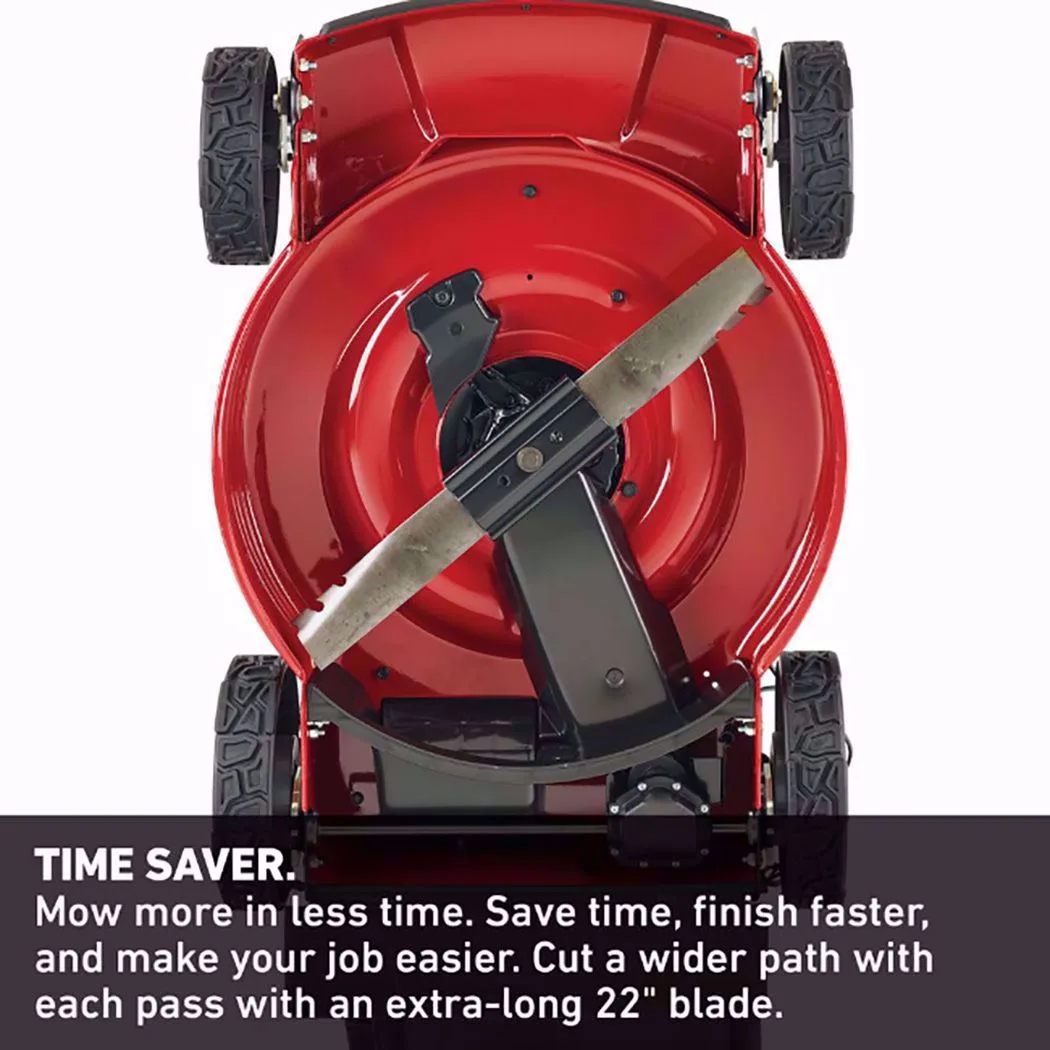
Front-wheel drive puts power up front. It’s cheaper and pivots on a dime, which makes trimming around flower beds easy. The weakness is traction.
Go uphill or let the grass bag fill, weight shifts rearward, and those driven front wheels go light. If your lot is flat and full of obstacles, FWD is the efficient pick.
Rear-wheel drive fixes that. Driven rear wheels, usually paired with 11- or 12-inch back tires, hold traction uphill and under a heavy bag. If your yard has slopes steeper than gentle, RWD is the default answer.
It costs a bit more and turns slightly wider.
All-wheel drive adds a driven front axle on top, and it grips best on steep, mixed terrain. It also adds weight, price, and a thin model selection. If you’re shopping AWD, price a rider too, because that’s the crossover point for many buyers.
One slope rule applies no matter which drive you choose. Mow across the face of a hill, never straight up and down. Manufacturer manuals flag serious caution above roughly 15 degrees, and wet grass cuts those margins in half.
Gas vs. Battery Self-Propelled: Match It to Your Yard and Your Habits
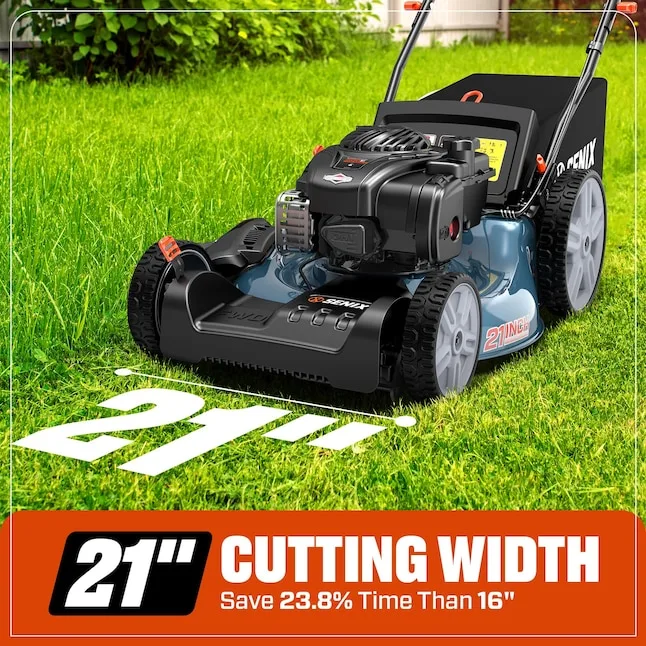
Gas still owns thick-grass torque and unlimited runtime. Refuel and keep going, which matters as lots push past 15,000 square feet. The costs are noise at the handle (85 to 96 dB), routine oil and filter service, and fuel you have to store safely.
Battery models have closed the gap fast. As of 2026, 40V to 80V platforms with 5.0 to 7.5 Ah packs deliver 45 to 75 minutes of cutting, and noise drops to a conversation-friendly 75 to 82 dB. The catch is heavy grass.
Dense or wet growth can cut runtime by a third, so big lots want a second pack on the charger. California’s small-engine rules have accelerated the shift, and most new residential development now lands on battery.
Maintenance tells the same story. Gas means oil changes, spark plugs, and fuel stabilizer before storage. Battery means charging and little else.
If you mow long sessions in thick grass, gas earns its keep. If you hate tinkering, go battery, and stick to UL-certified packs and chargers while you’re at it.
Variable Speed vs. Single Speed: Match It to Your Stride
Single-speed drives walk at one fixed pace, usually around 3 mph, take it or leave it. That’s fine if your natural stride happens to match, and it saves money. The friction shows at turns and obstacles, where you want to slow down and the machine won’t.
There are ways of dialing back a too-fast drive, but it’s a workaround, not a fix.
Variable speed puts you in charge. Toro’s Personal Pace senses your grip pressure, Honda’s Smart Drive uses a slide lever, and most others use a dial with ranges from 0 to 4 mph. If more than one person mows the yard, or the yard has enough obstacles that you’re constantly slowing, variable speed is worth the premium.
It’s also the single most-praised feature in owner reviews.
Price Bands, Weight, and Specs: What You Actually Get
Money maps cleanly onto this category. The 2026 bands look like this:
| Class | Typical price | Weight | What you get |
|---|---|---|---|
| Push mower (baseline) | $200 to $350 | 55 to 70 lbs | No drive, fewer parts |
| Gas self-propelled | $350 to $800 | 70 to 100 lbs | Belt drive, 159 to 190cc engines |
| Battery self-propelled | $450 to $900 | 60 to 75 lbs | Brushless motor, 40 to 80V platform |
| Premium / AWD | $800 to $1,100+ | up to 110 lbs | Variable speed, blade brake, hydrostatic |
The jump from push to self-propelled runs roughly $100 to $300 plus those 15 to 30 pounds. Inside the self-propelled bands, price buys four things in order: variable speed, rear-wheel drive, electric start, and the blade brake clutch that stops the blade while the engine keeps running.
A few specs matter more than others. Cutting decks run 21 to 22 inches on nearly everything mainstream, so deck width rarely decides anything. Engine displacement ranges from 159cc to 190cc on gas, and the bigger number mainly helps in tall, thick grass.
On battery platforms, voltage drives blade torque while amp-hours drive runtime, so don’t judge a mower by voltage alone.
One last practical note. Those prices assume you’re starting fresh, but most buyers already own something. If an upgrade is in your future, your old mower still has value, and there’s a right way to retire an old machine responsibly that doesn’t involve the curb.
Long-Term Ownership: Maintenance Intervals and Repair Math
The drive system is what changes the ownership story, and it rewards cheap prevention. Two parts run the show: the drive cable and the drive belt. Stay ahead of both and the machine lasts a decade.
Ignore them and a $25 part can take the transmission down with it.
| Task | Interval | Typical DIY cost |
|---|---|---|
| Drive cable adjustment | As needed, when drive slips | Free, about 10 minutes |
| Blade sharpening | Every 20 to 25 hours | $0 to $15 |
| Engine oil change | Every 25 hours or yearly | About $10 |
| Air filter check | Every 25 hours | $8 to $15 |
| Spark plug | Once per season | $5 to $10 |
| Drive belt | Every 2 to 4 seasons | $15 to $25 |
| Fuel stabilizer | Before winter storage | About $10 |
On the gas side, the engine schedule drives most of the work. Start with the annual oil change, then check the plug, filter, and blade as the season winds down. None of it takes more than an hour.
The battery side strips that list down to almost nothing. No oil, no plugs, no fuel system. You sharpen the blade, clean the deck, and keep the pack topped up.
Packs do age, though. Most are rated for 300 to 500 charge cycles, which works out to 3 to 5 seasons before runtime starts dropping.
Now the repair math, because this is where cheap mowers die. A stretched cable adjustment costs nothing. A belt runs $15 to $25 and takes under an hour with basic tools.
A failed transmission is the fork in the road at $100 to $250 installed, which is half the sticker price of a budget mower. At that point, replacement beats repair on anything under $500. On a $700 Honda or Toro, the transmission is usually worth fixing.
When the season ends, stabilized fuel plus a proper storage routine protects the engine until spring. Do that much and first pull starts in April are the norm, not the exception.
Common Self-Propelled Mower Mistakes (And the Drive Problems Behind Them)
Most self-propelled failures announce themselves weeks in advance. The mistake owners make is mowing through the warning signs until a $25 belt job becomes a transmission conversation. Here are the patterns that show up over and over.
1. Mowing through a slipping drive. The first symptom is small: the drive hesitates for a second on hills, or needs a full-strength bail squeeze. That’s a stretched cable.
Adjust the tensioner that day. Keep running it and the slipping belt glazes, then slips under any real load.
2. Pivoting with the drive engaged. Sharp turns with the drive spinning grind the belt and tear up turf. Release the drive bail, pivot, then re-engage.
It feels slow for exactly one mow, then becomes automatic.
3. Breaking the one-third rule. Never cut more than a third of the grass height in a single pass. Scalping bogs the blade, bogs the drive, and stretches the cable under load.
4. Mowing wet grass. Clumps pack under the deck, traction drops, and every drive engagement strains a wet belt. The cut quality suffers too.
5. Washing the deck, then storing it wet. Water works into the belt path and wheel bearings. Run the machine five minutes after washing to dry the drive area.
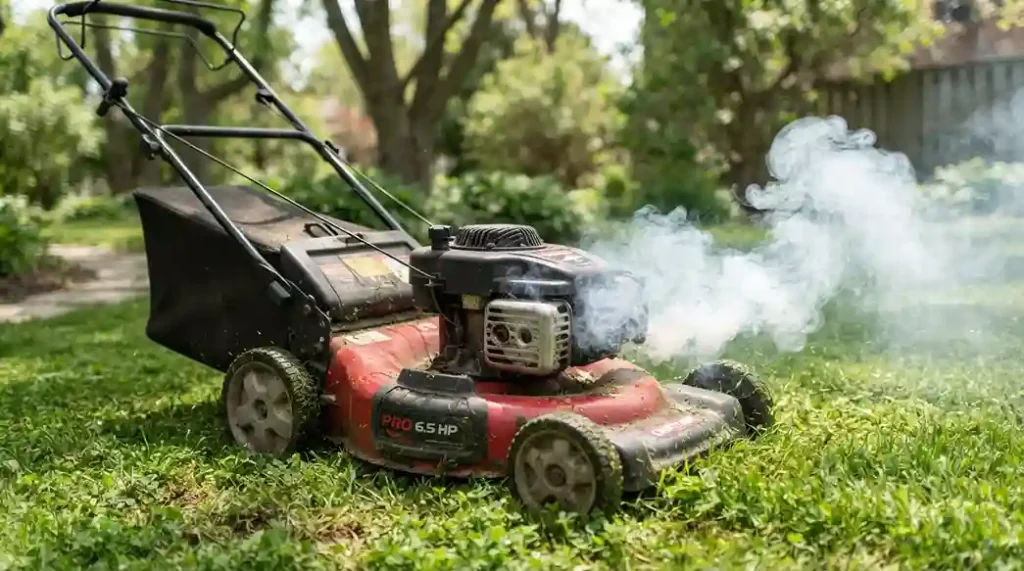
6. Dismissing engine symptoms. If you notice smoke from the exhaust, stop mowing and diagnose before the next pass. Overfilled oil is the classic trigger, and it’s a ten-minute fix if you catch it early.
When something does fail, the diagnosis order stays the same. Work down this list from cheapest to most expensive.
| Symptom | Most likely cause | First move |
|---|---|---|
| Drive slips uphill only | Stretched drive cable | Adjust the cable tensioner |
| No drive at all | Snapped or worn belt | Replace the belt |
| Whining, wheels don’t turn | Failed transmission | Price repair vs. replace |
| Drive grabs at half squeeze | Overtightened cable | Restore the free play |
Nine times out of ten, you stop at the first or second row, and the fix costs pocket change.
Safety Non-Negotiables: The Bail, Slopes, Kids, and Your Hearing
Adding a drive system adds torque to an already hazardous tool. The safety rules matter more here, not less, and four areas cover nearly everything that goes wrong.
The bail is a safety device, not a nuisance. Releasing it kills blade and drive within seconds. That’s the operator presence control doing its job. Never zip-tie it, wedge it, or bypass a stiff bail with a “clever fix.” CPSC injury data counts roughly 80,000 emergency-treated mower injuries a year, and defeated shutoffs show up repeatedly in the worst cases.
Learn which lever controls the blade and which controls the drive before your first mow.
Slopes. Mow across the face of a hill, never up and down. Past roughly 15 degrees, most manufacturer manuals tell you to switch to a string trimmer. Wet grass cuts that margin in half.
And nobody should ride a walk-behind mower downhill to save time.
Kids and bystanders. The American Academy of Pediatrics recommends no mower operation under age 12, and no passengers on any mower, ever. Walk the yard for toys and stones first. Thrown objects can travel 50 feet or more, so send the kids inside before the blade spins.
Hearing. Gas units measure 85 to 96 dB at the handle. Hearing damage risk climbs sharply past 85 dB, so earplugs or muffs aren’t optional equipment. Battery models run 75 to 82 dB, easier on the ears but still loud enough to matter on long sessions.
Shutdown. End every mow deliberately: release both bails, let the blade stop completely, then follow the right shutdown routine before storage or blade work. On blade-brake-clutch models, an engine that keeps running after the blade stops is working exactly as designed.
Your Decision Guide: Which Mower for Which Yard
Here’s the entire decision tree on one screen. Three questions decide it: how big is the yard, how steep is it, and how do you feel when the mowing’s done. Find your row.
| Your situation | Best setup | Why it wins |
|---|---|---|
| Under 5,000 sq ft, flat | Push mower | A drive is money you won’t get back |
| 5,000 to 10,000 sq ft, flat, tight obstacles | Battery FWD, variable speed | Quick pivots, quiet, near-zero upkeep |
| 10,000 to 20,000 sq ft | Gas RWD, or battery with two packs | Traction plus real runtime |
| Noticeable slopes | RWD or AWD, 11 to 12 inch rear wheels | Grip where the weight shifts |
| Joint, back, or stamina limits | Variable speed, electric start, RWD | The machine carries the load |
| Half acre or more, open ground | Rider or zero-turn | Walking becomes the bottleneck |
Three ordering rules make the final call easier.
- If two rows describe your yard, buy for the harder one. Slope plus size beats size alone as your spec target.
- Spend in this order: variable speed first, then rear-wheel drive, then engine or battery capacity. Deck extras come last, every time.
- If you’re torn between tiers, borrow a push mower and time your yard. If the job leaves you dreading next weekend, that’s your answer.
Whichever row you land in, the right drive should disappear in use. You stop fighting the machine and start thinking about the mowing pattern, the cut height, and how the lawn looks when you finish. That’s the entire point of the upgrade.
Self-Propelled Mower FAQs
These are the questions that surface in every buying thread and repair conversation.
Can you push a self-propelled mower with the drive off?
Yes. Disengage the drive bail and the wheels freewheel, so you can push it like any mower. Two caveats: it weighs 15 to 30 pounds more than a push model, and a few designs drag slightly because the transmission stays engaged.
Most current models roll freely when parked.
Is front-wheel or rear-wheel drive better for hills?
Rear-wheel drive, and it’s not close. RWD keeps traction as weight shifts uphill and as the grass bag fills, which is exactly where driven front wheels go light. AWD exists for steep mixed terrain, but it costs more and offers fewer models to choose from.
How long does a self-propelled mower last?
Gas models commonly reach 8 to 10 years with regular oil changes and belt care. The transmission is usually the first expensive part to fail. Battery models run 5 to 7 years, with packs typically dropping off after 3 to 5 seasons of charge cycles.
Why has my self-propelled mower stopped pulling?
Check three things in order: the drive cable, the belt, then the transmission. A stretched cable is the most common cause and costs nothing to adjust. A snapped belt is a $15 to $25 part.
A transmission that whines but won’t turn the wheels usually ends the repair on budget machines.
Is a self-propelled mower worth it for a small lawn?
Usually not. Under about 5,000 square feet of flat ground, a push mower finishes the job in 15 to 20 minutes, and the drive’s added cost and weight buy you very little. The upgrade earns its price once slope, thick grass, or hour-long sessions enter the picture.
Do self-propelled mowers use more fuel or battery?
Slightly more. The drive transmission adds load, so gas use edges up versus the same engine in a push chassis. Battery runtime drops fastest when the drive works hardest, which means thick growth and hills.
Keep a charged spare pack if your lot runs long.