Why Perennial Ryegrass Is Turning Yellow: My Proven Checks
Your ryegrass was deep green a month ago. Now it’s pale, patchy, and you’re not sure whether you’ve been overwatering it, starving it, or losing it to disease. The honest answer to why perennial ryegrass is turning yellow is that yellow is a symptom, not a diagnosis.
Ryegrass is the most heat-sensitive cool-season turf most of us plant, so the same shade of yellow can mean four different things in June and October.
Start with chemistry you can actually measure. Land-grant turf programs generally put the target soil pH for ryegrass at 6.0 to 7.0, and most recommend 1 to 1.5 inches of water a week including rainfall. Those two numbers alone rule out a surprising share of yellow lawns.
But before you dig a single sample, read the shape of the damage.
Why Perennial Ryegrass Is Turning Yellow
Perennial ryegrass turns yellow for a handful of repeat reasons. The usual suspects are nitrogen shortage, heat stress, and poor drainage. Thatch buildup and fungal disease round out the list.
Gray leaf spot and Pythium blight hit ryegrass harder than other cool-season grasses. Mower damage and herbicide injury cause streaks and tan tips. Read the pattern first, then confirm the cause.
Why Perennial Ryegrass Yellows Faster Than Bluegrass or Fescue
Bunch-type growth, shallow roots, and zero heat escape
Perennial ryegrass (Lolium perenne) is a bunch-type grass. It spreads by tillers instead of rhizomes, so it can’t creep into a bare spot and knit it back together. Kentucky bluegrass fills gaps from underground stems.
Ryegrass just thins and stays thin, which is why patchy yellow so often turns into permanent bare ground without help from you.
Root architecture explains the rest. Ryegrass roots are fine and fibrous, and most of the feeding mass sits in the top few inches of soil. Fast to establish, fast to crash.
When that top layer dries out, the plant has nowhere else to drink from.
Heat is the real story. Ryegrass has no true summer dormancy the way bluegrass does. It keeps pushing growth through July and August while soil temperatures climb past 80°F, burning reserves it can’t replace.
Bluegrass browns evenly and waits it out. Ryegrass yellows, thins, and dies in patches.
Cultivar choice moves the needle more than most people expect. The National Turfgrass Evaluation Program publishes multi-year turf quality and disease ratings, and the spread between the best and worst entries is genuinely wide. A cultivar with weak gray leaf spot resistance will yellow every August no matter how well you feed it.
The difference between a symptom and a diagnosis
Chlorosis is the technical word for what you’re looking at. It means a loss of chlorophyll, the pigment that runs photosynthesis. Chlorophyll breaks down for a long list of reasons, and the plant shows you the same yellow either way.
That’s the trap. Fertilizer fixes chlorosis caused by low nitrogen. It also makes Pythium blight measurably worse.
Water fixes drought chlorosis and suffocates roots that were already sitting too wet.
So work in order. If the yellowing is even across the whole lawn, suspect nutrition, pH, or uneven irrigation coverage. If it’s patchy, suspect disease, drainage, or pests.
If it runs in lines, suspect the mower, a spreader overlap, or a spill.
Read the Pattern First: What the Shape of the Yellowing Is Telling You
Stand back before you kneel down. The outline of the damage narrows the list faster than anything you’ll find on a shelf.
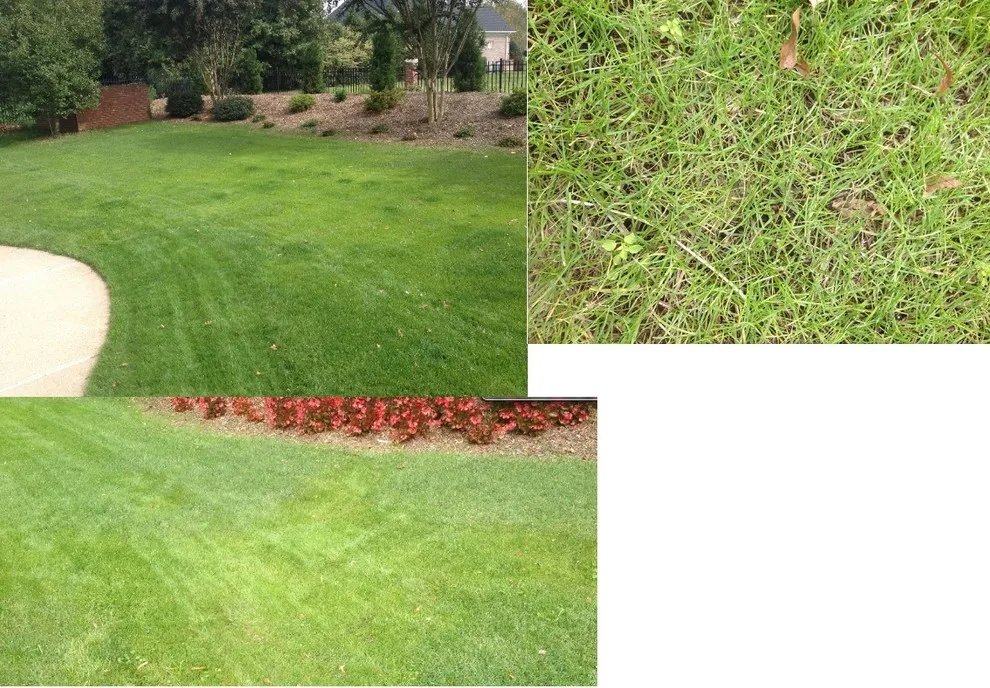
Image source: Web (Bing) / houzz.com
Uniform, patchy, streaked, ring-shaped, or low-spot
Each shape points somewhere different, and the table below is the fastest triage tool in this whole article.
| Pattern | Most likely direction | First thing to check |
|---|---|---|
| Even pale green, whole lawn | Nitrogen, pH, low iron | Recent feed and soil test |
| Round patches, greasy edges | Pythium or brown patch | Morning dew and drainage |
| Lines and wheel tracks | Spreader overlap, dull blade, spill | Blade sharpness, passes |
| Ring shapes | Fairy ring, yellow tuft | Thatch and surface moisture |
| Low spots only | Drainage, compaction | Probe depth, standing water |
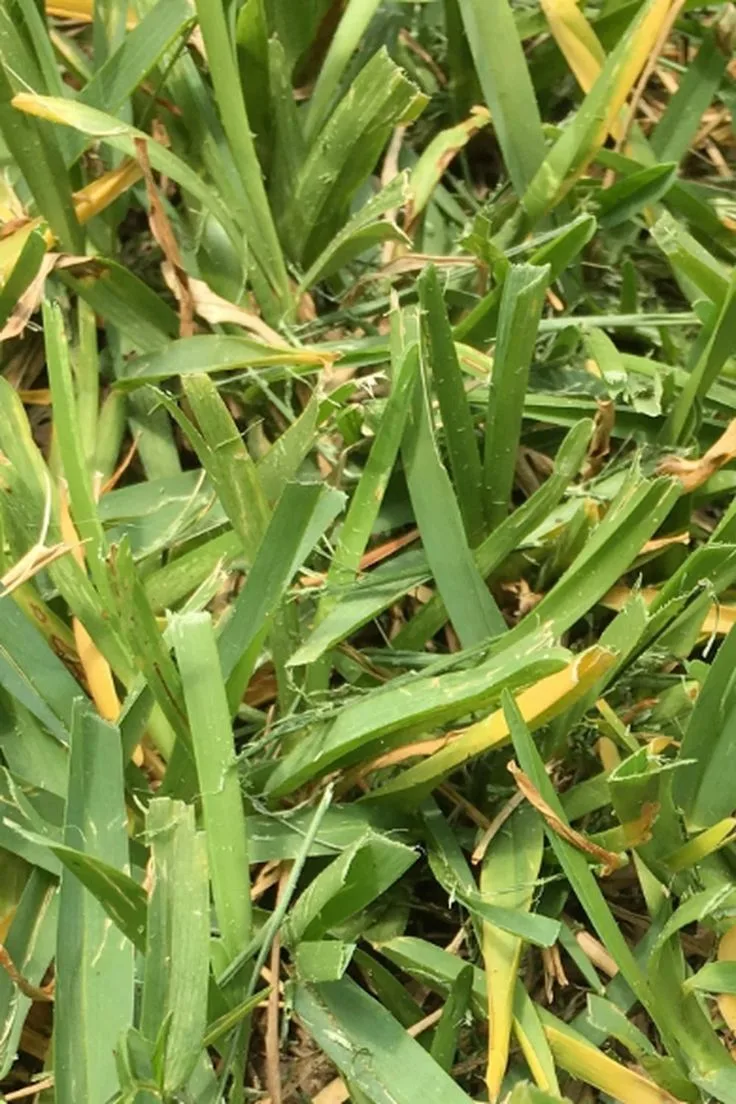
Image source: Web (Bing) / storage.googleapis.com
Where to look on the blade: tips, margins, or between the veins
Interveinal chlorosis means the tissue between the veins yellows while the veins stay green. It’s the classic iron signature.
Nitrogen behaves differently because it’s mobile inside the plant. The plant robs older blades to feed new ones, so the bottom of the canopy goes first. Potassium burns the margins and tips.
A dull mower shreds leaf ends and leaves a tan, frayed fringe across the whole canopy right after cutting.
The five-minute site walk: thatch, drainage, shade, mower height
Push a soil probe in. If it fights back, you’ve found compaction. Dig a small square and measure the thatch layer, because anything past 0.5 inch blocks water and air from reaching roots.
Check how much shade the spot gets and whether air moves through it. Then measure your actual cut. Most home ryegrass lawns want the right cutting height of 2.5 to 3.5 inches, and a deck set too low stresses the plant every single week.
The Timeline Test: Weather, Watering, and Recent Applications
Yellow tells you what. Timing tells you why. Pin the first day you noticed color loss against what the lawn went through in the two weeks before it.
When it started versus what the weather did next
If yellowing arrived after a stretch of 90°F days with high humidity, disease and heat lead the list. If it followed two dry weeks, drought stress leads. If it showed up after heavy rain or a stuck sprinkler valve, think drainage and Pythium.
| Timing clue | Likely direction |
|---|---|
| Right after a heat and humidity spike | Gray leaf spot, Pythium |
| After a dry, windy stretch | Drought, localized dry spot |
| Within a week of fertilizing | Nitrogen burn, overlap |
| After a herbicide application | Drift, carryover, root pruning |
| Weeks two to four after new sod | Roots never knitted in |
Fertilizer, herbicide, and fungicide history
Quick-release nitrogen can scorch blades within three to seven days of application. Overlapping spreader passes leave a visible zigzag of damage that tracks your walking line.
Herbicides leave signatures too. 2,4-D and dicamba cause twisting and strapping before color loss. Mesotrione bleaches new growth white to yellow. Preemergents like prodiamine prune roots and show up as thinning on shallow soils.
Aminopyralid and clopyralid carryover is the sneaky one. Contaminated compost, manure, or straw causes cupped, strappy, yellow growth months later, and it can persist in soil for a year or more.
Irrigation changes, new sod, and spring transition
New sod that yellows in weeks two to four usually has roots that never knitted into the soil underneath. Lift a corner and look.
Overseeded ryegrass in the South is a different animal. It yellows in late spring as bermudagrass breaks dormancy and outcompetes it. That’s a transition problem, not a disease, and no fungicide will touch it.
If you’re planning the next round, the best window for sowing matters more than anything you do afterward.
Nutrient Deficiencies, pH, and Soil Chemistry
A big share of yellow ryegrass cases come down to nutrition or pH. Both are cheap to rule out and easy to misread from the surface.
Nitrogen versus iron: telling them apart by pattern
Nitrogen is mobile. The plant pulls it from older blades to feed new growth, so the lower canopy yellows first and the whole lawn looks uniformly pale. Iron is immobile.
New blades emerge yellow between green veins, and the oldest growth stays dark.
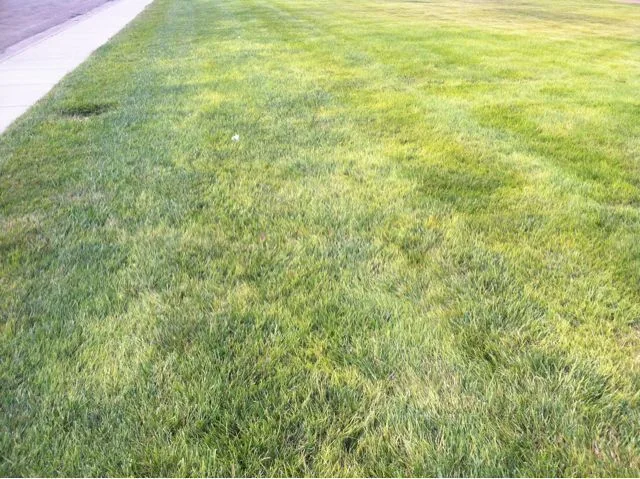
Image source: Web (Bing) / pinterest.com
Iron chlorosis shows up most on high-pH soils and on cool, wet spring growth. It also appears where irrigation water is high in bicarbonate.
Potassium, magnesium, sulfur, and manganese
Potassium deficiency burns leaf margins and tips. Magnesium causes interveinal yellowing on older leaves. Sulfur yellows new growth without responding to nitrogen.
Manganese shows interveinal yellowing on sandy, high-pH soils.
| Deficiency | Where it shows | Typical setting |
|---|---|---|
| Nitrogen | Whole lawn, older blades first | Thatch, wood mulch, heavy rain |
| Iron | New growth, between veins | pH above 7.2 |
| Potassium | Margins and tips | Sandy soils, heavy clipping removal |
| Magnesium | Older leaves, between veins | Acidic, leached soils |
Why high pH, thatch, and wood mulch lock nutrients up
Above pH 7.2, iron and manganese tie up and stop being plant-available even when a soil test shows plenty in the ground. Thatch and undecomposed wood mulch pull the same trick with nitrogen, because soil microbes borrow it to break down carbon.
Soil test versus guessing
Pull 10 to 15 cores to 6 inches, mix them in a bucket, and send a composite sample. As of 2026, most state labs still run Mehlich-3 extraction for plant-available phosphorus and micronutrients, which gives you numbers you can act on rather than a guess. Penn State Extension publishes a clear walkthrough of the sampling process if you’ve never pulled cores before.
Once you have results, line your feeding schedule up with the season rather than the calendar.
Heat, Drought, Drainage, and Root-Zone Stress
Summer decline and why ryegrass has no dormancy escape
Ryegrass keeps growing when it should shut down. Soil temperatures above 80°F push it past the point where roots can keep up with top growth, and the plant starts cannibalizing older tissue for survival. That’s the pale, thin look of August decline.
Mowing high through the heat helps. So does skipping nitrogen when the lawn is already struggling, because pushing growth in a heat wave just adds stress.
Localized dry spot, compaction, and hydrophobic soil
Some patches repel water outright. Localized dry spot shows up as wilted, yellowing circles that don’t respond to normal irrigation, and the soil under them is often hydrophobic. A drop of water beading on the surface tells you everything.
Compaction causes the same symptom for a different reason. Roots can’t push through, water runs off, and the turf thins. Core aerating when the grass is actively growing fixes both problems over a few weeks.
Wet feet, poor drainage, and salt damage
Roots need air. Waterlogged soil suffocates them, and the yellowing that follows looks almost identical to drought stress from above. If the soil is soggy two days after rain, drainage is your problem.
Salt damage from de-icing products or poor-quality irrigation water shows up as marginal burn and thinning along pavement edges. It’s common on boulevard strips and driveway aprons.
Watering deep and infrequent beats daily sprinkling every time. Most lawns need about an inch a week, and how much water it actually needs changes with soil type and weather. Run a catch-can test to see what your system really delivers, because most runtimes are set by feel rather than measurement.
Diseases and Pests That Single Out Ryegrass
Gray leaf spot, Pythium blight, and brown patch
Gray leaf spot (Pyricularia oryzae) is the disease that targets ryegrass more than any other cool-season turf. It starts as small olive-gray flecks, then spreads into elongated lesions that kill whole blades. Give it heat, long leaf wetness, and plenty of nitrogen, and it will level a lawn in a week.
If your yellowing begins as speckling on individual blades, think gray leaf spot. Evening irrigation and heavy summer feeding are the two accelerants you control.
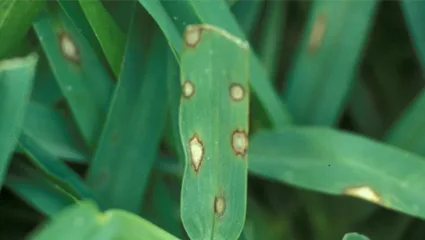
Image source: Web (Bing) / thelawninstitute.org
Pythium blight behaves nothing like that. It collapses turf in greasy, dark, sunken circles overnight, usually in hot, humid weather and often along a drainage line or low corner. Brown patch (Rhizoctonia solani) gives you tan circles with a dark smoky ring at the edge, and it loves warm nights and heavy dew.
Dollar spot, red thread, rust, and leaf spot
Dollar spot (Clarireedia jacksonii) makes small tan spots the size of a coin, and they merge into bleached sheets when pressure is high. It’s a hunger signal as much as a disease, since low nitrogen plus long dew periods is its favorite setup.
Red thread (Laetisaria fuciformis) shows as pinkish-red threads on blade tips in cool, wet, underfed turf. Rust appears as orange powder that coats your mower deck and shoes in late summer. Leaf spot and melting out (Bipolaris, Drechslera) thin crowns from the base up.
Yellow tuft, anthracnose, and snow molds
Yellow tuft (Sclerophthora macrospora) produces clustered, thickened, yellowish shoots in wet, compacted, poorly drained spots. Anthracnose basal rot attacks stressed crowns in heat. Snow molds (Microdochium, Typhula) take over in winter under long cover.
Grubs, billbugs, webworm, and nematodes
Here’s the fastest field test for insects. Grab a yellow patch and tug. If it lifts like loose carpet, roots are gone.
White grubs, billbugs, and sod webworm all sever roots from below. Nematodes in sandy soils thin turf in irregular patches that follow soil texture rather than irrigation lines. If your yellowing runs in bands, get both a soil sample and a nematode assay.
Mower Damage, Herbicide Injury, and Pet Spots
Dull blades, scalping, and clipping problems
A dull blade tears instead of slicing. Frayed leaf ends lose water fast and turn tan within a day or two, which reads as yellow from standing height.
Pull a blade and look at the cut end. A clean slice stays green. A shredded, whitish fringe means it’s time to sharpen or replace.
Scalping does the same thing in bigger blocks. Decks that dip into high spots or grass cut too short after a wet week lose color fast. The one-third rule still applies, and staying on top of the schedule matters most during spring growth.
Heavy clippings left in clumps on wet turf smother the blades underneath. Those patches yellow, then thin.
Herbicide drift, carryover, and root-pruning preemergents
Herbicides each leave a signature. 2,4-D and dicamba cause twisting, strapping, and yellowing within days. Glyphosate drift yellows then browns from the edge inward. Mesotrione bleaches new growth white to yellow.
Preemergents like prodiamine and dithiopyr prune roots. On shallow soils that shows up as slow thinning and pale color weeks after application.
Aminopyralid and clopyralid carryover is the one that stumps people. Contaminated compost, manure, or straw produces cupped, strappy, yellow growth months later, and it can persist in soil for a year or more.
Dog urine, spills, and fertilizer burn
Dog urine leaves a yellow center wrapped in a dark green ring. The ring is the nitrogen load, the center is the salt burn.
Fertilizer burn shows up within three to seven days and follows your walking pattern. Overlapping spreader passes leave a zigzag of damage. Gasoline and oil spills leave small, sharply defined dead spots that never spread.
What to Do Once You Know the Cause, and the Mistakes That Make It Worse
Cultural fixes first
Raise the deck before you buy anything. Summer height for home ryegrass sits at 3 to 3.5 inches, which shades the crown and cools the soil surface.
Sharpen your blade, core aerate while the grass is actively growing, and dethatch only when the layer passes 0.5 inch. Those three moves fix more yellow lawns than any bottle on the shelf.
Watering and feeding by the numbers
Target 1 to 1.5 inches a week including rainfall, delivered deep and early in the morning. Run a catch-can test so you know your real output instead of guessing at runtimes.
On nitrogen, stay at 0.5 to 1 lb per 1,000 sq ft per pass. Spoon-feed small doses through summer. Stop pushing nitrogen when disease is active, because fast growth feeds the fungus.
Overseeding and renovating thin ryegrass
Ryegrass can’t spread into bare spots on its own, so thin areas need seed. Use 6 to 10 lb per 1,000 sq ft for a fresh start, or 3 to 5 lb when overseeding into existing turf.
Aerate or slice first, then keep the top inch moist until seedlings hit two inches. Thickening a thin stand is mostly about seed-to-soil contact. If the repair area is large, getting the seedbed right saves you a second round.
The recovery timeline, week by week
| Timeframe | What you should see |
|---|---|
| Week 1 to 2 | Color stops declining, no new yellowing |
| Week 3 to 4 | New tillers push from crowns, thin spots fill |
| Week 5 to 8 | Uniform green, mowing normal again |
| Fall | Full recovery, best window to overseed |
Mistakes that make it worse
Feeding a Pythium patch is the classic. So is soaking an already saturated lawn because the top looked dry. Adding lime without a soil test pushes pH higher and locks iron out harder.
Decision Guide: Match the Symptom, Pick the Fix
Use this as your working checklist. Find the symptom, follow the branch, and only then reach for a product.
| Symptom | Likely cause | Move to make |
|---|---|---|
| Uniform pale green | Nitrogen, pH | Soil test, then feed |
| Yellow between green veins | Iron, high pH | Check pH before chelating |
| Greasy collapsed circles | Pythium | Improve drainage, fungicide |
| Tan spots with dark rings | Brown patch | Cut nitrogen, improve airflow |
| Speckled blades in heat | Gray leaf spot | Reduce leaf wetness, treat |
| Tan frayed tips after mowing | Dull blade | Sharpen or replace |
| Lines matching spreader passes | Burn or overlap | Water deeply, reduce rate |
| Yellow center with green ring | Dog urine | Flush with water |
| Patches that lift like carpet | Root-feeding insects | Dig and confirm, then treat |
When the damage shifts from yellow to brown, the culprit list narrows fast and the repair gets more urgent.
When to call a pro or send a sample to a lab
Call for help if you’ve corrected water, height, and nutrition for three weeks with no improvement. Also call if patches keep expanding despite treatment.
Send a sample to a diagnostic lab when you suspect nematodes, anthracnose, or herbicide carryover. A tissue test plus a soil test costs less than two wasted fungicide applications. Most state extension labs turn results around in one to two weeks.
Frequently Asked Questions
Is yellow ryegrass dead or dormant?
Yellow ryegrass is usually stressed, not dead. Perennial ryegrass has no true summer dormancy, so it stays active and thins instead of browning out cleanly like bluegrass. Test a patch by tugging it.
Firm roots mean the crown is alive and can recover with water, shade, and patience.
Why did it turn yellow right after I fertilized?
Fertilizer burn is the usual answer, especially with quick-release nitrogen. Scorching shows within three to seven days and follows your spreader pattern. Overlapping passes make it worse.
Water deeply to dilute the salts and skip the next scheduled feeding until new growth looks normal again.
Will it green up on its own in fall?
Often, yes. Cool nights and shorter days favor ryegrass, and fall is when it grows hardest. Disease pressure drops and root growth resumes.
If bare spots remain by mid-fall, that’s the window to overseed rather than wait for spring.
Can I overseed into a yellow lawn?
Only after you know why it yellowed. Overseeding into active disease or herbicide residue wastes seed. Fix the cause, confirm new growth, then seed.
Keep the top inch moist and expect germination in five to ten days at 60 to 65°F soil temperature.
Does ryegrass come back after summer heat?
Some of it does, if the crowns survived. Bunch-type growth means it can’t fill bare ground by itself, so recovery depends on tillers that stayed alive. Aerate, water correctly, and overseed the dead patches in early fall for a full reset.