How Much Fertilizer for Perennial Ryegrass Lawn: My Safe Plan
Figuring out how much fertilizer for a perennial ryegrass lawn is less about one magic number and more about a yearly budget you split into smaller doses. Get that budget right and the grass thickens, crowds out weeds, and holds its color deep into fall. Get it wrong and you’re either burning brown stripes into the turf or paying for nitrogen that washes straight down the drain.
Perennial ryegrass (Lolium perenne) is a cool-season bunch grass, and most university extension guidance puts a home lawn at roughly 2 to 4 pounds of actual nitrogen per 1,000 square feet per year. That’s the whole year, not per feeding. Here’s how to turn that range into an exact bag weight for your own yard, season by season.
How Much Fertilizer Does Perennial Ryegrass Actually Need?
Short answer: more than a fine fescue lawn, less than a sports field, and never in one big dump. Perennial ryegrass is a moderate-to-high nitrogen grass. It germinates fast, greens up fast, and answers every feeding with visible growth within a week or so.
That responsiveness is exactly why people overdo it.
Here’s the structural problem. Perennial ryegrass grows in bunches. It has no rhizomes, so it can’t creep sideways and patch a bare spot the way Kentucky bluegrass does.
Density comes from tillering, and tillering needs steady, moderate nitrogen. Starve it and the lawn thins into clumps with weeds in the gaps. Flood it and you get soft, lush top growth that’s a magnet for gray leaf spot and winter kill.
So the real question isn’t “how much fertilizer” in the abstract. It’s “how much, how often, and in what form” for your specific lawn. A mature, irrigated lawn in a cool coastal climate can handle the top of that range.
A shaded lawn in the transition zone can’t handle half of it in July.
If you’re still deciding whether this grass deserves space in your yard at all, it’s worth reading up on how it performs as a lawn grass before you build a feeding program around it. And if your lawn came up patchy and clumpy, check you’re not dealing with the annual lookalike, which behaves completely differently and won’t persist.
How Much Fertilizer for Perennial Ryegrass Lawn
Here’s the short answer for a perennial ryegrass lawn. Figure 2 to 4 pounds of nitrogen per 1,000 square feet yearly. Split that into three to five feedings.
Keep each quick-release dose at 1 pound or less. Slow-release blends allow up to about 1.5 pounds. Check the bag’s nitrogen percentage before you spread.
Image source: Web (Bing) / lawnstarter.com
That annual number shifts with how the lawn is used and how much stress it takes:
| Lawn situation | Nitrogen per 1,000 sq ft per year |
|---|---|
| Established home lawn | 2 to 4 lb |
| High-traffic family lawn | 3 to 4 lb |
| Shaded or drought-stressed lawn | 1.5 to 2.5 lb |
| Sports turf or school field | 4 to 6 lb |
| Newly seeded area (single dose at seeding) | 0.5 to 1 lb |
Those ranges track extension guidance on cool-season turf nitrogen, adjusted for how perennial ryegrass actually responds. The grass doesn’t read the calendar, though. It reads soil temperature and moisture, which is why the same 3 pounds a year gets split differently in Minnesota than in Virginia.
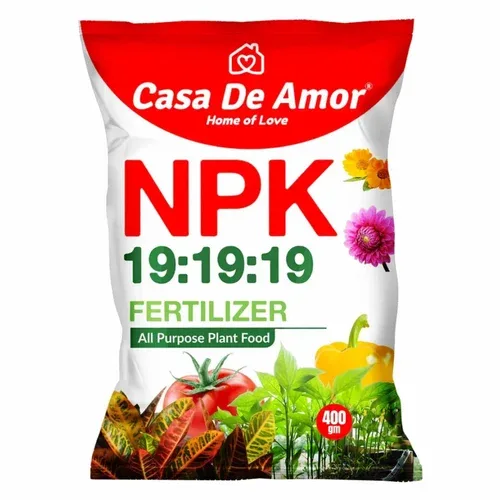
Image source: Web (Bing) / indiamart.com
Read that label carefully. The first number is the percentage of nitrogen by weight, and it’s the only number that matters for this calculation. A 27-0-4 bag is 27% nitrogen.
A 10-10-10 bag is 10%. Same bag weight, wildly different nitrogen delivery.
Why the “1 lb of N” Rule Is Misunderstood
The advice everyone repeats is “put down 1 pound of nitrogen per 1,000 square feet.” It’s good advice. It’s just incomplete, and the missing half causes most of the damage we see.
Three things get lost in the retelling.
It’s per application, not per year. Applying 1 pound every four weeks from April to September puts down 6 pounds of nitrogen. That’s double the top of the recommended range for a home lawn. Expect thatch, disease pressure, and a mower you can’t keep up with.
Pounds of product isn’t pounds of nitrogen. This is the arithmetic error that burns lawns. A 40-pound bag of 10-10-10 holds 4 pounds of actual nitrogen. Spread it over 1,000 square feet and you’ve just applied 4 pounds of N in one shot, four times the safe single dose.
The formula is simple:
- Pounds of product = pounds of N you want ÷ (nitrogen % ÷ 100)
- Want 1 lb of N from a 21-0-0 bag? 1 ÷ 0.21 = 4.8 pounds of product
- Want 1 lb of N from a 46-0-0 bag? 1 ÷ 0.46 = 2.2 pounds of product
- Want 1 lb of N from a 10-10-10 bag? 1 ÷ 0.10 = 10 pounds of product
The 1-pound ceiling assumes quick-release nitrogen. Urea, ammonium sulfate, and other fully soluble sources release a burst of salts into the soil. That’s what scorches blades and roots. A polymer-coated or sulfur-coated product trickles nitrogen out over 6 to 10 weeks, so the safe single dose climbs to roughly 1.5 pounds per 1,000 square feet.
There’s a bigger reason not to overshoot, and it isn’t just your grass. Nitrogen that the plant can’t use doesn’t sit politely in the soil. It leaches into groundwater or runs off into storm drains, and that’s a documented water quality problem the EPA tracks closely in lakes, rivers, and coastal waters.
You paid for that nitrogen twice, once at the register and once in the environmental cost.
The 3 Variables That Change Your Rate
Everything else is detail. These three factors move your number the most, and they interact.
1. Establishment stage
If the lawn is brand new from seed, cut the rate hard. Seedlings have tiny root systems and can’t process a full dose. Apply 0.5 to 1 pound of nitrogen per 1,000 square feet at seeding using a starter-type product, then wait until the grass has been mowed three or four times before feeding again.
If the lawn is mature and thick, work from the annual budget and split it across the growing season. If it’s thin and you’re overseeding into it, drop to a low rate. Too much nitrogen pushes the existing turf to shade out the seedlings you just paid for.
2. Season and climate
If you’re in a cool, humid climate like the Pacific Northwest, the UK, or the upper Midwest, perennial ryegrass grows hard in spring and fall. Push 1 pound per application in those windows and let the summer dose shrink or disappear.
If you’re in the transition zone, summer is the danger season. The grass slows down, roots retreat, and nitrogen feeds disease instead of growth. Go slow-release only, or skip the summer feeding entirely and put the budget into September.
If you’re on fast-draining ground, smaller doses more often beat big ones. Sandy soils hold almost no nutrients, so a heavy application just keeps traveling. There’s more on that in our notes on fast-draining ground.
3. Product form
If the bag is mostly quick-release, plan on more frequent, smaller applications. If it’s 50% or more slow-release, you can spread the doses further apart and push the rate slightly. Check the water-insoluble nitrogen (WIN) figure on the label.
That’s the slow-release portion, stated as a percentage of the total nitrogen.
One more variable worth naming: water. Nitrogen only works if the grass is actually growing, and perennial ryegrass shuts down when it’s thirsty. Get keeping it hydrated in July sorted before you spend money on fertilizer.
Step-by-Step: Calculate the Exact Amount for Your Lawn
Grab a tape measure, a calculator, and the bag label. Ten minutes here saves a season of guessing.
Step 1: Measure the actual turf area
Length times width, minus beds, driveway, and patio. A 1,000 square foot patch is roughly 25 by 40 feet, which helps you sanity-check the number. Write it down.
Every rate below is scaled to 1,000 square feet, so you’ll need the decimal anyway.
Step 2: Set your annual nitrogen budget
Pick from the table above. A normal family lawn in a cool climate: 3 pounds per 1,000 square feet per year. A shaded, lightly used lawn: 2 pounds.
Write the number down as your yearly ceiling.
Step 3: Divide it into applications
Three to five feedings across the season, weighted toward fall. A typical split for 3 pounds a year is 0.75 in late spring, 1.0 in early fall, and 1.0 in late fall. If summer heat is brutal where you live, move the spring share into September instead.
Step 4: Convert nitrogen to product weight
Use the formula from earlier. For a 5,000 square foot lawn wanting 0.75 pounds of N per 1,000, you need 3.75 pounds of actual nitrogen total. Divide by 0.27 for a 27-0-4 product and you get about 13.9 pounds of fertilizer.
| Lawn size | Target N per 1,000 | Product needed (27-0-4) | Product needed (10-10-10) |
|---|---|---|---|
| 2,000 sq ft | 1.0 lb | 7.4 lb | 20 lb |
| 5,000 sq ft | 0.75 lb | 13.9 lb | 37.5 lb |
| 10,000 sq ft | 0.75 lb | 27.8 lb | 75 lb |
Step 5: Calibrate the spreader before you touch the lawn
Never trust a setting copied from a forum. Prill size, bulk density, and walking speed all vary. Do a catch test on 200 to 500 square feet, weigh what came out, and adjust the dial until the output matches your target.
Manufacturer spreader charts are a starting point, nothing more.
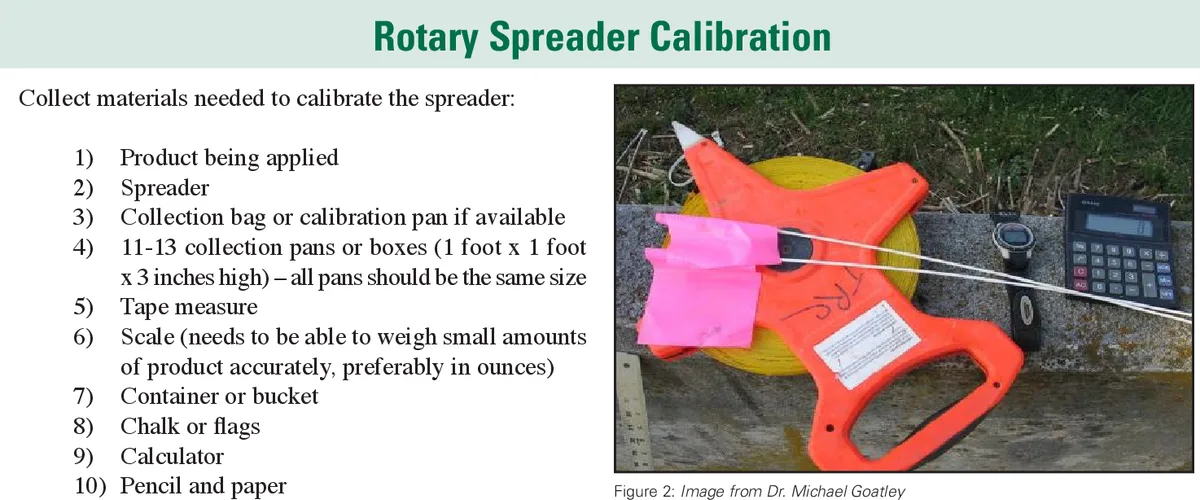
Image source: Web (Bing) / semanticscholar.org
Step 6: Apply in two passes and water it in
Put down half the product walking north to south, then the other half walking east to west. That crosshatch pattern hides overlap errors instead of turning them into stripes. Water in with about 0.1 to 0.25 inch right after, unless rain is due within a day.
Two housekeeping notes. Sweep every granule off the driveway and sidewalk back onto the grass, because those wash straight to the storm drain. And if you’re seeding rather than feeding an established lawn, get sorting out the soil first and hold off on the first cut after seeding until the new grass is genuinely ready.
Perennial Ryegrass Fertilizer Schedule by Season
Fall does the heavy lifting. If your budget only stretches to two feedings, put both of them between late August and early November.
That’s when perennial ryegrass builds roots, stores carbohydrates, and thickens without pushing soft growth into winter. Spring feeding gets more attention than it deserves. It greens the lawn fast, then hands you a mowing problem in June.
Go by soil temperature, not the calendar. Nitrogen starts working when the soil sits around 55 to 65°F at two inches deep. That’s the same window where ryegrass seed germinates in 5 to 10 days.
| Window | Timing cue | Nitrogen per 1,000 sq ft | Product type |
|---|---|---|---|
| Late spring | steady growth, mowed twice | 0.5 to 0.75 lb | balanced slow-release |
| Early fall | warm soil, cooling nights | 1 lb | quick plus slow blend |
| Late fall | slowing growth, still green | 0.75 to 1 lb | quick-release, higher K |
| Summer | irrigated and cool only | 0 to 0.5 lb | slow-release only |
If you’re in a cool, humid climate, that table is close to your whole program. Three feedings, about 2.75 pounds of nitrogen, done.
If you’re in the transition zone, delete the summer row completely. July and August nitrogen feeds gray leaf spot far better than it feeds grass. Move that share into September.
If you garden in a long, mild maritime climate, stretch the same annual budget across four or five smaller doses from March through November. Extended growing seasons reward spoon-feeding over big single hits.
If the lawn sits in shade, cut every number above by about a third and lean on potassium instead of nitrogen.
If you’re overseeding, feed lightly at seeding, then wait until the new grass has been cut three times before you touch it again.
Slow-Release vs. Quick-Release: Which to Use and When
Both work. The difference is how fast the nitrogen reaches the roots, and that single factor decides your burn risk and your timing.
Quick-release nitrogen dissolves on contact. Urea (46-0-0), ammonium sulfate (21-0-0), and calcium nitrate green the lawn within five to seven days and fade in two to four weeks. They’re cheap per pound of nitrogen and completely unforgiving if you overdose.
Slow-release nitrogen trickles. Polymer-coated urea, sulfur-coated urea, IBDU, and methylene urea release over 6 to 16 weeks depending on coating thickness and soil temperature. That slower curve lets you push a single dose to roughly 1.5 pounds per 1,000 square feet with much less scorch risk.
| Feature | Quick-release | Slow-release |
|---|---|---|
| Green-up | 5 to 7 days | 2 to 3 weeks |
| Response window | 2 to 4 weeks | 6 to 16 weeks |
| Burn risk | High | Low |
| Max single dose | 1 lb N/1,000 | 1.5 lb N/1,000 |
| Cost per 1,000 sq ft | $1 to $3 | $4 to $8 |
| Best timing | Fall, cool weather | Late spring and summer |
If your only feeding is the late-fall one, quick-release is fine. Cool soil and slow top growth protect you. If you’re feeding in June, insist on a product that’s at least half water-insoluble nitrogen (WIN).
If you want the lowest-effort program, buy one coated product and use it three times a year. If you want to fix a specific deficiency fast, a small quick-release dose gets you there in a week.
Organic options sit in the middle. Biosolids, compost, and feather meal run roughly 3 to 6% nitrogen and release over months. They’re gentle and build soil, but too slow to rescue a starving lawn in a fortnight.
Common Mistakes That Burn Lawns (and Waste Money)
Most fertilizer damage isn’t a bad product. It’s a good product applied at the wrong moment or the wrong rate.
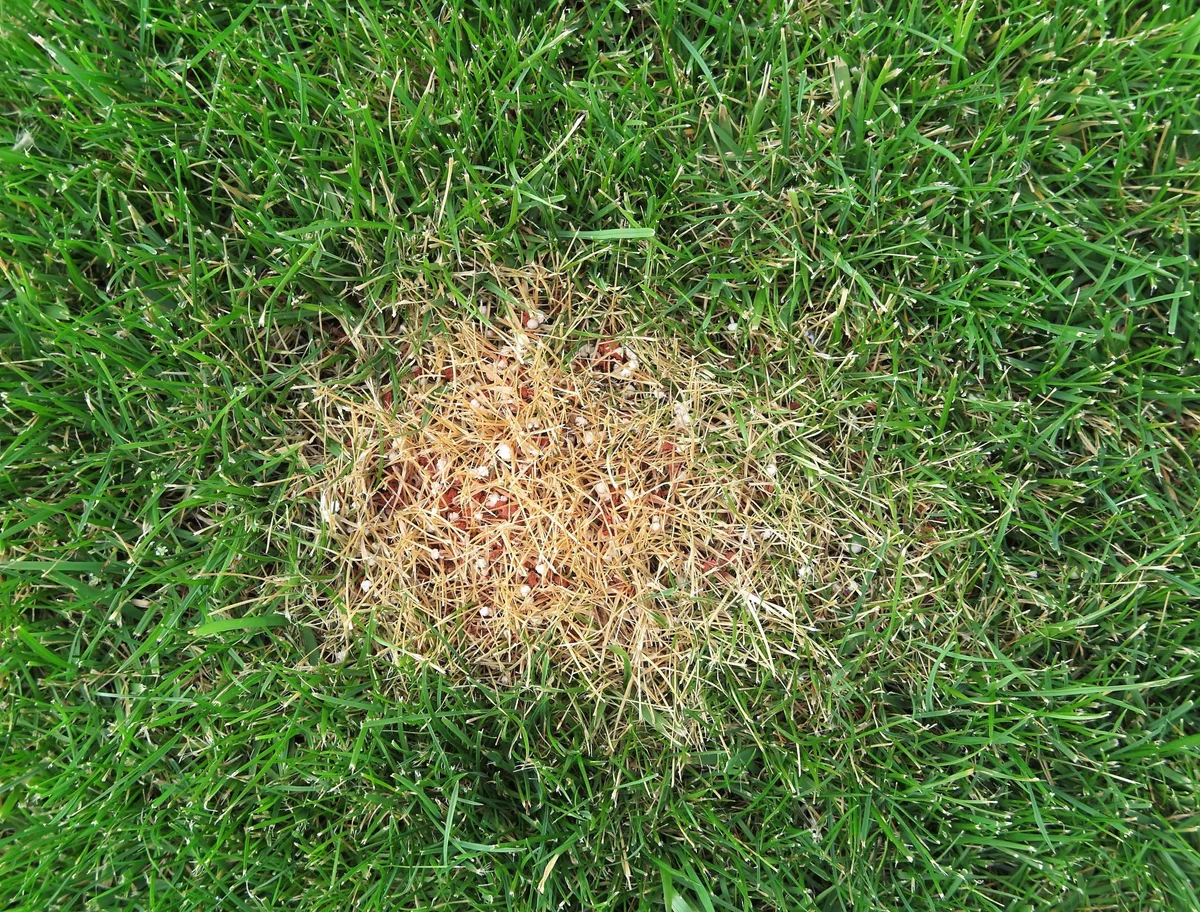
Image source: Web (Bing) / backyardboss.net
Spreading onto wet grass
Wet blades grab granules and hold them in place. You get speckled burn in a polka-dot pattern that looks like disease but isn’t. Apply to dry turf, then irrigate straight after.
Applying before a heavy rain
More than half an inch of rain within a few hours washes granules off slopes and into storm drains. Check the forecast and water lightly yourself instead.
Overlapping the spreader pass
A rotary spreader throws 8 to 12 feet. Overlap too little and you get pale stripes. Overlap too much and the seam gets a double dose.
Fix it with a crosshatch pattern, not a steadier hand.
Feeding in the heat of summer
Perennial ryegrass slows above 85°F. Nitrogen at that point feeds disease and scorches roots. Skip it or use coated product at a reduced rate.
Loading up a new seedling lawn
Anything above 1 pound of nitrogen per 1,000 square feet at seeding is wasted. Young roots can’t take it up. This matters more if you’re getting seed to sprout in July heat, when everything is already stressed.
Guessing at phosphorus
Most established lawns need none. Skip P unless a soil test says otherwise, and check your state’s rules first. Several states restrict phosphorus in lawn fertilizer outright.
Mowing too short after a growth flush
Never remove more than a third of the blade at once. Scalping after a feed stops the grass dead and opens the door to weeds.
Leaving granules on concrete
Sweep every stray granule off paths, driveways, and drains. That material goes straight to the nearest waterway.
Pro Tips for Even Coverage and Zero Stripes
Weigh the product, don’t eyeball it. Split your calculated amount into two equal halves by weight, then apply one half walking north to south and the other east to west.
Mark your passes. Drop a few tent pegs or flags at 10-foot intervals along the first pass line. It stops the drift that turns one wide stripe into three skinny ones.
Set rotary spreaders to a 50% overlap. The right edge of each pass should land on the middle of the previous one. With a drop spreader, do the perimeter first, then run straight lines inside it.
Pick your conditions. Dry grass, calm air under 5 mph, and a steady walking pace. Speed up and the rate drops.
Slow down and it climbs.
Water it in properly. Around 0.1 to 0.25 inch right after application moves granules off the blades and into the soil. It also cuts volatilization loss from surface urea.
Return your clippings. Mulch mowing can supply up to a quarter of your annual nitrogen for free, which means you can trim the bag rate slightly.
Keep a record. Date, product, pounds applied, and pounds of actual nitrogen per 1,000 square feet. Two seasons of notes will tell you more about your lawn than any forum thread ever will.
Calibrate twice a year and store leftovers in a sealed bucket off the garage floor. Damp fertilizer turns to brick and never spreads evenly again.
Frequently Asked Questions
How much fertilizer should I apply per feeding?
Keep any single quick-release dose at 1 pound of actual nitrogen per 1,000 square feet. With a fully coated slow-release product you can stretch to about 1.5 pounds. Convert to bag weight by dividing your target nitrogen by the nitrogen percentage on the label.
Is spring or fall the better time to feed perennial ryegrass?
Fall wins comfortably. September and late October feedings build roots and carbohydrate reserves before winter. Spring feeding mainly produces top growth, which means extra mowing and softer grass heading into summer heat.
If you must choose one, choose fall.
What NPK ratio suits perennial ryegrass?
Nitrogen does the work, so a ratio close to 3-1-2 or 4-1-2 fits most established lawns. Skip phosphorus unless a soil test shows a real deficit. Potassium earns its place going into winter, especially on shaded or stressed turf.
Can I fertilize perennial ryegrass in summer?
Only with slow-release nitrogen, and only if you’re irrigating consistently. Keep the rate under 0.5 pounds per 1,000 square feet, or skip the feeding altogether. In hot, humid regions, summer nitrogen reliably triggers gray leaf spot and brown patch.
How soon can I mow after fertilizing?
Mow first, then feed. Granules need a day to dissolve and settle, and cutting right after application knocks product into clumps. Wait two to three days after a feed, and keep the mower deck high.
What happens if I apply too much fertilizer?
You’ll see crispy brown streaks, dark green overlap bands, and fast wilting in the worst spots. Water deeply for several days to dilute the salts. Then stop feeding for at least six to eight weeks and let the grass recover before you touch it again.